


By Stephen Witt
Talk about putting the cart before the horse.
Los Angeles County Supervisor Lindsey P. Horvath (D – Western Los Angeles and San Fernando Valley, including Santa Monica, Beverly Hills, West Hollywood, Calabasas, Malibu, Pacoima, Panorama City, Sylmar) yesterday greenlighted a 30-day report on improvements at Whiteman Airport before a much-anticipated $2.1 million study the county contracted on whether the controversial airport should even remain open.

“I think we need to do more and think creatively and as innovatively as we can, and really push that boundary to make sure that we’re protecting our communities,” said Horvath.
Meanwhile, outreach to the majority working-class Latino community of Pacoima — many of whom want the airport closed — was given short shrift.
The confusion over timelines and exactly what is being done at Whiteman arose at the Board of Supervisors’ regular meeting, where Item 16 called for a status report from the Department of Public Works on safety measures at Whiteman following Horvath’s May 5 motion.
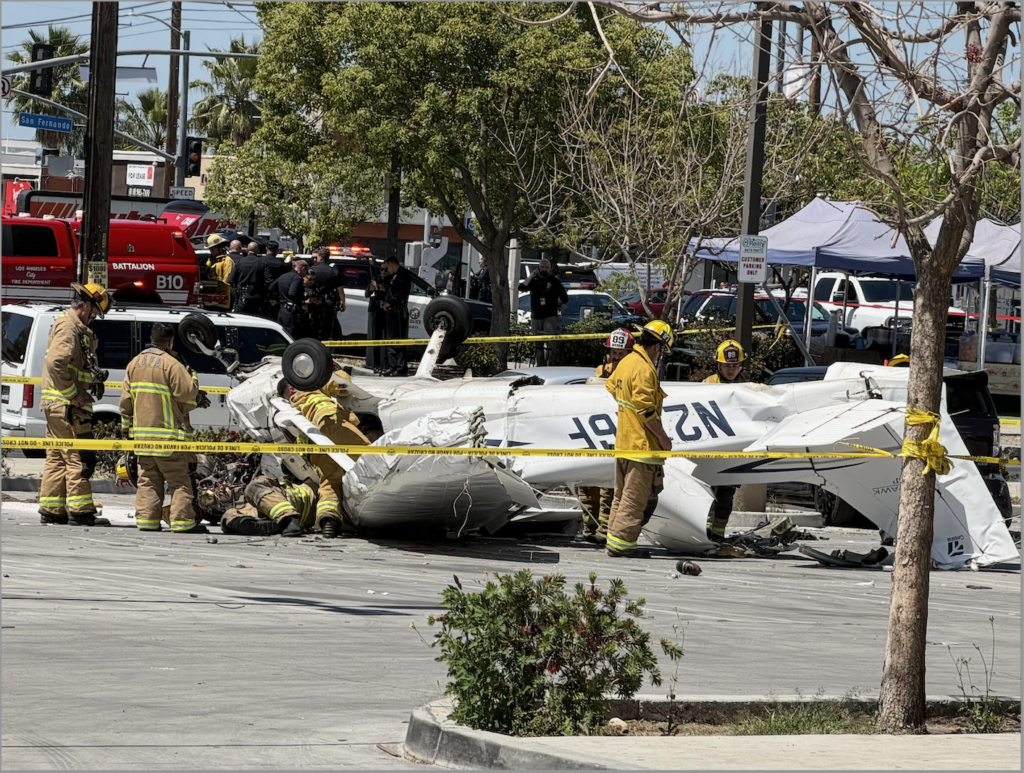
Horvath’s motion was triggered by an April 20 crash in which a Cessna 172 clipped power lines and crashed upside-down into an auto parts store parking lot near the airport, critically injuring the pilot. A second crash followed on June 16, when a 77-year-old pilot crashed through a perimeter fence and into a parking lot after his landing gear failed to deploy.
Department of Public Works Director Mark Pestrella presented the status report to the Board, outlining three initiatives underway: quarterly pilot safety seminars, a $5 million FAA (Federal Aviation Administration)-funded runway and taxiway rehabilitation project, and a community outreach campaign.
Following Pestrella’s presentation, Horvath introduced a floor amendment that passed unanimously, directing Public Works to report back within 30 days on five additional accountability measures: the operational implications of an FAA Part 150 noise study; federal grant requirements for residential sound insulation; the feasibility of enhanced FAA ramp inspections; whether pilot safety seminars can be made mandatory at Whiteman; and legislative advocacy for tougher FAA oversight of aircraft maintenance and pilot certification. Community outreach appeared in none of the five items.
Horvath acknowledged the county’s jurisdictional limits throughout the discussion.
“My team has worked with Public Works to determine where the county could step out of our lane to play a greater role in functions that are traditionally FAA responsibility, and we keep bumping up against preemption issues,” she said.
Horvath also put the airport’s full crash record on the official Board record for the first time, citing cross-referenced National Transportation Safety Board (NTSB) investigations.
“According to the NTSB, every single crash has been caused by pilot error or aircraft malfunction,” she said. The airport has recorded approximately 35 crashes over the last 25 years.
Pestrella told the Board that accepting the FAA Airport Improvement Program grant for the runway project “would only commit the airport to remaining open for three years.”
However, FAA grant assurances for construction projects typically obligate a sponsor to keep an airport open for up to 20 years — a distinction the Board did not address Tuesday.
The Trifiletti Consulting land use study — a contract that has grown from $600,000 to $2.1 million — will not be completed until the end of the year, Horvath confirmed. That study is examining every scenario for Whiteman’s future, including closure.
Horvath has previously held back a separate Part 150 noise study specifically because its findings could trigger federal grant obligations before the county knows whether closure is viable — raising the question of why a 30-day improvement report was ordered before the study that should inform those decisions is complete.
While Pestrella reported that the Department of Public Works was also launching a communication campaign this month, using social media and other tools to improve public education and collaboration, no budget, timeline, Spanish-language component, community liaison, or metrics were specified.
Horvath didn’t include any specifics on how the community would be engaged in her motion.