


LA County floats $48.8 billion budget, braces for fed funding cuts

By Los Angeles County Politics

Los Angeles County is in the deceptive calm before the storm — a $48.8 billion recommended budget for fiscal year 2026-27 that avoids layoffs and across-the-board cuts today, but warns that collapsing federal support for Medi-Cal and food assistance could force service reductions and job losses within two to three years.

The spending plan, presented to the Board of Supervisors today by Acting Chief Executive Officer Joseph M. Nicchitta, is roughly 7% lower than last year’s $52.5 billion final adopted budget — a decrease that reflects the removal of one-time prior year funding rather than any genuine reduction in services.

“LA County is currently in the eye of a hurricane,” Nicchitta said. “Previous cuts of 8.5% and a hiring freeze helped balance our spending plan, but we’re preparing for major new budget impacts to our health and social services departments in 2027. We are doing all we can to prepare for the next phase of the storm.”

The budget funds a workforce of 115,885 county employees and covers services touching nearly 10 million residents across all 88 municipalities and unincorporated communities in Los Angeles County.

Where the money comes from

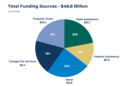
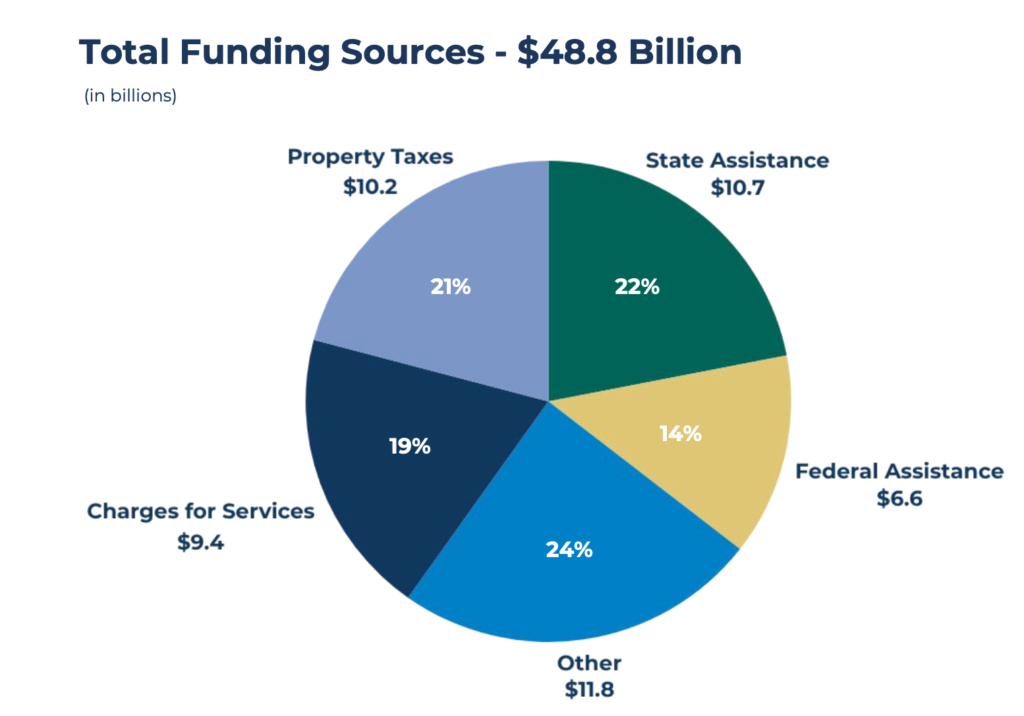
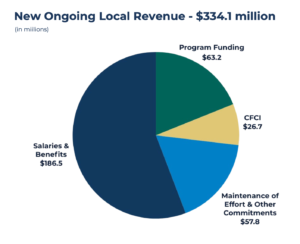
The $48.8 billion draws from five major revenue streams: State assistance at $10.7 billion (22%), property taxes at $10.2 billion (21%), a variety of other sources at $11.8 billion (24%), charges for services at $9.4 billion (19%), and federal assistance at $6.6 billion (14%). 

Property taxes are the primary source of revenue the County controls directly. The roughly 40 cities that contract with the County for services like law enforcement and public works contribute through those service agreements, reflected in the charges for services figure.

Where the money goes

Despite the public visibility of the Sheriff’s Department and Fire Department, the dominant cost centers are health and human services — public hospitals, mental health services, foster care, food assistance, and homelessness programs. 

A newly created Department of Homeless Services and Housing, operational since January 2026, controls roughly $660 million of the $1.08 billion in voter-approved Measure A homelessness funding. Correctional Health Services — medical and mental health care inside County jails — costs nearly $555 million annually on its own.
The pressure points

The single most consequential number in the budget is $662.2 million — the estimated decline in federal revenue to the County’s public hospital system under H.R. 1 and related Medi-Cal cuts. To maintain current services, the health system will draw down $743.6 million in reserves this year. Those reserves are projected to run out by FY 2028-29. The Department of Public Health has already closed seven clinics due to its own structural deficit, with six remaining.

Compounding the federal threat is the County’s $4.8 billion obligation to survivors of childhood sexual abuse under Assembly Bill 218 — described in budget documents as the largest such settlement in American history — with payments required through 2030 and debt service extending to FY 2050-51.

What comes next

Yesterday’s recommended budget is the first step in a multi-phase process. Public hearings begin May 6. The Board of Supervisors adopts a budget June 22. A supplemental budget is adopted September 29, becoming the county’s final spending plan for fiscal year 2026-27. The Board can modify the CEO’s recommendations by a simple majority of three votes during deliberations. 

Residents can find more information and submit input at ceo.lacounty.gov/budget.

 

Leave a Reply

Your email address will not be published. Required fields are marked *

This site uses Akismet to reduce spam. Learn how your comment data is processed.

By Los Angeles County Politics

Los Angeles County is in the deceptive calm before the storm — a $48.8 billion recommended budget for fiscal year 2026-27 that avoids layoffs and across-the-board cuts today, but warns that collapsing federal support for Medi-Cal and food assistance could force service reductions and job losses within two to three years.

The spending plan, presented to the Board of Supervisors today by Acting Chief Executive Officer Joseph M. Nicchitta, is roughly 7% lower than last year’s $52.5 billion final adopted budget — a decrease that reflects the removal of one-time prior year funding rather than any genuine reduction in services.

“LA County is currently in the eye of a hurricane,” Nicchitta said. “Previous cuts of 8.5% and a hiring freeze helped balance our spending plan, but we’re preparing for major new budget impacts to our health and social services departments in 2027. We are doing all we can to prepare for the next phase of the storm.”

The budget funds a workforce of 115,885 county employees and covers services touching nearly 10 million residents across all 88 municipalities and unincorporated communities in Los Angeles County.

Where the money comes from

The $48.8 billion draws from five major revenue streams: State assistance at $10.7 billion (22%), property taxes at $10.2 billion (21%), a variety of other sources at $11.8 billion (24%), charges for services at $9.4 billion (19%), and federal assistance at $6.6 billion (14%). 

Property taxes are the primary source of revenue the County controls directly. The roughly 40 cities that contract with the County for services like law enforcement and public works contribute through those service agreements, reflected in the charges for services figure.

Where the money goes

Despite the public visibility of the Sheriff’s Department and Fire Department, the dominant cost centers are health and human services — public hospitals, mental health services, foster care, food assistance, and homelessness programs. 

A newly created Department of Homeless Services and Housing, operational since January 2026, controls roughly $660 million of the $1.08 billion in voter-approved Measure A homelessness funding. Correctional Health Services — medical and mental health care inside County jails — costs nearly $555 million annually on its own.

The pressure points

The single most consequential number in the budget is $662.2 million — the estimated decline in federal revenue to the County’s public hospital system under H.R. 1 and related Medi-Cal cuts. To maintain current services, the health system will draw down $743.6 million in reserves this year. Those reserves are projected to run out by FY 2028-29. The Department of Public Health has already closed seven clinics due to its own structural deficit, with six remaining.

Compounding the federal threat is the County’s $4.8 billion obligation to survivors of childhood sexual abuse under Assembly Bill 218 — described in budget documents as the largest such settlement in American history — with payments required through 2030 and debt service extending to FY 2050-51.

What comes next

Yesterday’s recommended budget is the first step in a multi-phase process. Public hearings begin May 6. The Board of Supervisors adopts a budget June 22. A supplemental budget is adopted September 29, becoming the county’s final spending plan for fiscal year 2026-27. The Board can modify the CEO’s recommendations by a simple majority of three votes during deliberations. 

Residents can find more information and submit input at ceo.lacounty.gov/budget.