

By Stephen Witt, Los Angeles County Politics
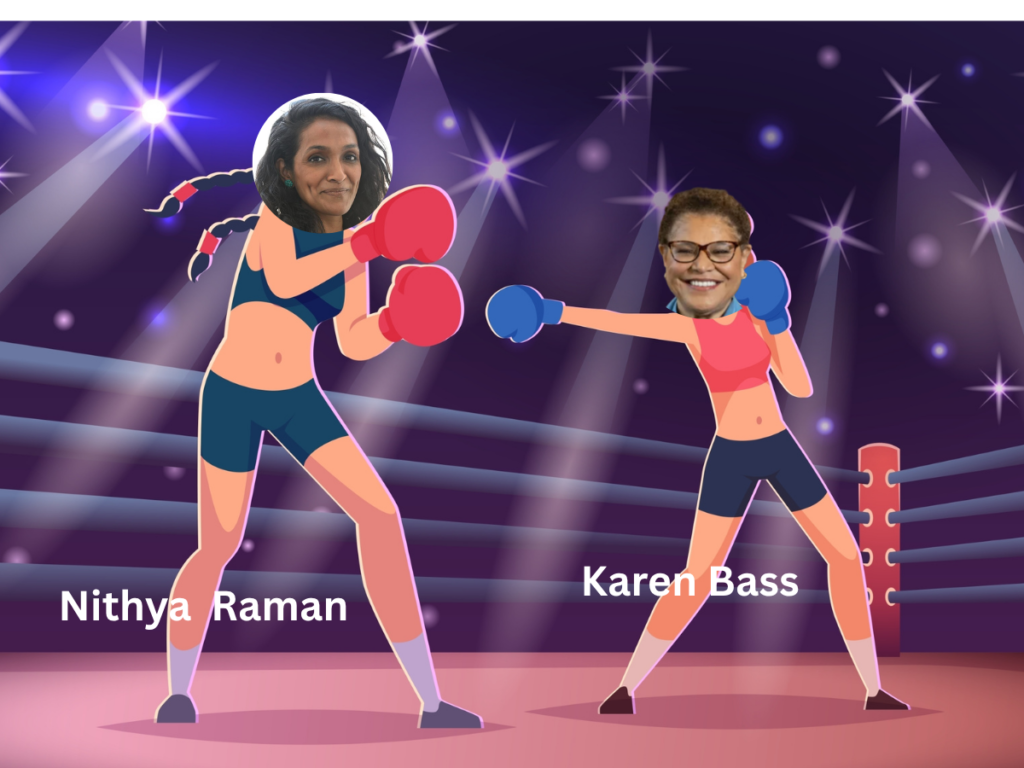
Labor Day, beyond celebrating the nation’s workers, is often seen as the unofficial kickoff to the November general elections. And in a county where registered Democrats now narrowly outnumber Republicans and independents combined, the race for Los Angeles mayor features longtime Democratic stalwart and incumbent Mayor Karen Bass against a more progressive upstart, City Councilmember Nithya Raman. Here’s LACP’s tale of the tape as we head into the final months before the Nov. 3 general election.
CAMPAIGN WAR CHEST
Looking strictly at general election money, not primary carryover, Bass raised $511,687 and spent just $43,852 in the period ending June 30, leaving her with $490,986 cash on hand plus $675,368 in matching funds.
Raman raised $172,926 and spent $40,840, leaving her with $145,992 in cash on hand plus $1,025,595 in matching funds.
Add cash on hand to matching funds for each candidate and the two campaigns land within roughly $5,000 of each other, at about $1.17 million apiece heading into the fall.
Independent expenditure groups have already spent $322,539 boosting Raman and just $1,000 against her in the general, while Bass has seen no outside spending activity on her behalf or against her in this period.
Edge: Even
BACKGROUND AND SUPPORT
Bass enters the race with the institutional weight of the Democratic establishment behind her: a broad coalition built over decades in Sacramento and Washington, labor union backing, and the kind of citywide name recognition that comes with incumbency.
Raman draws her strength from a different well entirely, as a prominent member of the Los Angeles Democratic Socialists of America, the second-largest DSA chapter in the country with roughly 6,000 dues-paying members, according to the chapter’s own membership figures. That base has already elected four Los Angeles City Councilmembers and two school board members, giving Raman a built-in volunteer and organizing infrastructure most challengers never get.
This is fundamentally a battle between the Democratic machine and the party’s insurgent left flank.
Edge: Bass
DEMOGRAPHICS
Bass’s coalition skews toward the city’s Black voters, older homeowners, and the moderate-to-liberal Democratic base that has anchored Los Angeles mayoral politics for a generation, with particular strength in South LA and pockets of the San Fernando Valley.
Raman’s base is younger, whiter and more concentrated in the dense, renter-heavy neighborhoods of her own council district and the adjacent Eastside, where DSA-LA’s organizing has been strongest. Bass’s coalition is broader geographically, but Raman’s is more intensely mobilized within a smaller footprint.
That said, there is a growing disenchantment of Bass, perhaps due to media and incumbent fatigue. Raman notably visited the San Fernando Valley Economic Alliance earlier this year and is working to appear more moderate to these folks.
Edge: Bass
ISSUES
Homelessness, housing costs, and policing dominate this race, as they have in every LA mayoral contest for a decade. Bass points to her Inside Safe program and her leadership through the Palisades and Eaton fire recovery as evidence of results, while Raman has directly attacked Bass’s budget as a “status quo” approach that asks residents to accept less while paying more.
On policing specifically, Bass’s own Aug. 31 executive directive ordering independent review of officer-involved deaths tied to mental health crises shows an incumbent playing defense on an issue Raman and the DSA-aligned council bloc have pushed for years.
Edge: Even
CAMPAIGN STYLE/STRATEGY
Bass is strong on retail politics. In person, she knows how to make constituents feel important. In political speak, this is sometimes called kissing babies. Raman’s campaign relies on good old-fashioned door-knocking and grassroots organizing, something the DSA has proven it can do. Both candidates’ campaigns appear very media-shy. Their communications teams are wary of giving media access, and sometimes it’s hard to get even basic questions answered through their spokespeople. However, this may change depending on polls and as the election date gets closer
Edge: Even
INTANGIBLES
The comparison every Raman supporter wants to make is to Zohran Mamdani’s stunning DSA-backed win in New York City last November, but the two cities aren’t a clean match. NYC-DSA has more than 15,000 members, nearly triple DSA-LA’s size, concentrated in a dense city with a strong-mayor system, and Mamdani ran during an election cycle where incumbent Mayor Eric Adams did not seek re-election, meaning he never had to unseat a sitting mayor the way Raman does.
Los Angeles, by contrast, has a comparatively weak mayor’s office next to a powerful 15-member council, and DSA-LA’s own strategists have said their path to power has always run through the council, not the sixth floor of City Hall.
The Mamdani coalition also leaned heavily on a bloc that doesn’t map onto Los Angeles the same way: exit polls from the Associated Press and NBC News found roughly 9 in 10 Muslim voters in New York backed Mamdani. This group made up about 4% of that city’s electorate but is heavily concentrated and politically organized within a compact five-borough map. Los Angeles County’s Muslim population is comparable in raw size, estimated between 400,000 and 500,000 residents. Still, it’s spread across LA County, against the voters in just the City of Los Angeles, without anything close to the same concentrated electoral punch. Another factor worth noting: the sharp Israel-Gaza divide that shaped the NYC race, including Mamdani’s own comments about Israel and genocide, is unlikely to carry the same electoral weight here, given LA’s large Israeli expatriate and Persian Jewish populations.
Edge: Bass
Early voting and mail-in voting begin Monday, Oct. 5, 2026. The general election is Tuesday, Nov. 3, 2026. To find your polling place or nearest vote center, click here.