


Whiteman Airport study offers three futures and endorses none

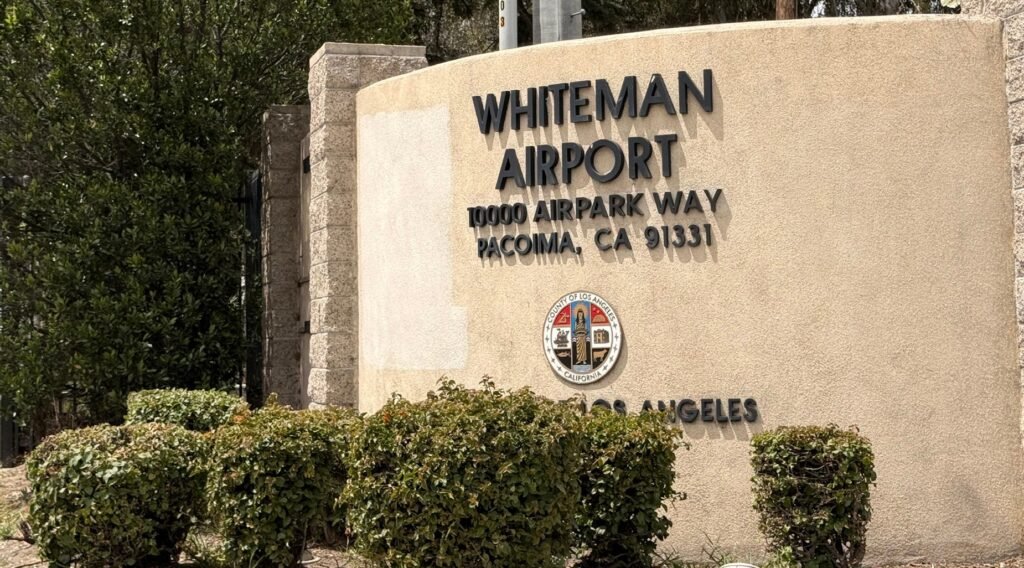
The sign at Whiteman Airport, 10000 Airpark Way in Pacoima. Los Angeles County’s $2.1 million study weighs keeping, remaking or closing the 184-acre airport. (Photo: Marietta Torriente/Trifiletti Consulting)

By Stephen Witt, Los Angeles County Politics

Put more money into Whiteman Airport, remake it into a mixed-use airport with new businesses and community uses, or shut it down.

Trifiletti Consulting laid out those three paths in the executive summary of its $2.1 million Whiteman Airport Land Use Study and Economic Impact Analysis for the county’s Department of Economic Opportunity (DEO). The study team presented it to the public last night at Los Angeles Mission College in Sylmar.

“It does not recommend an outcome. It sets out what each option would require, what it would cost, how long it would take, and which decisions rest with the County and which rest with the federal government,” the study states.

The Board of Supervisors ordered the study of the 184-acre Pacoima airport in April 2024 on a motion by Los Angeles County Supervisor Lindsey Horvath (D-Santa Monica, Beverly Hills, West Hollywood, Calabasas, Malibu, Pacoima, Panorama City), after years of community pressure that began with a November 2020 plane crash into a Pacoima neighborhood.

The motion limited the study to the airport property. A study team leader told LACP the study did not consider closing the airport and expanding the adjacent Barton Heliport, the Los Angeles County Fire Department’s helicopter base, into the site because the department never asked for it.

Horvath’s office told LACP in June that Barton is too small for the department’s needs, including two new Firehawk helicopters.

DEO Director Kelly LoBianco told LACP safety enhancements will be part of whatever the county decides, and the public will get a comment period once the final report is out.

The county owns and operates Whiteman but does not control the airspace, pilots or aircraft. The Federal Aviation Administration (FAA) controls those, and closing the airport requires an FAA release or an act of Congress. The study says the FAA has approved closures since 1999 only to replace an airport with a better facility or retire an obsolete one, and Whiteman, with 391 based aircraft, fits neither.

Scenario 1, called Preserve and Improve, keeps the airport in its current footprint. The county would rehabilitate older hangars, build new ones and add a third-party helicopter hangar area, and resume taking FAA grants, which it paused in 2020, to repair the runway and taxiways. The study projects $14.3 million in net revenue through 2050 on a net present value basis and about 382 jobs within five years, compared with a $27 million loss if nothing changes.

Scenario 2, called Transform and Optimize, also keeps the airport open but consolidates aviation into a compact core along the runway with about 97 new hangars. That frees four sites for healthcare, biotechnology, logistics, retail and recreation uses, and a private partner would take on much of the aviation capital and maintenance burden. The study projects $24.3 million in net revenue through 2050 and about 1,933 jobs in roughly 10 years.

Scenario 3, called Transform and Repurpose, closes the airport. About 102 of the 184 acres would become roughly 8 million square feet of development, including about 4,232 residential units. The study rates FAA approval far from certain but assumes it comes around 2050 or 2051, followed by seven to 10 years of demolition and cleanup. Through 2050 the scenario shows a $16.2 million net loss, excluding about $90 million in demolition and remediation and the estimated $3.46 billion redevelopment program. At full build-out in 2075 or later, it delivers the biggest economic payoff of the three, about 12,102 jobs and $3.16 billion in annual economic output.

On safety, the study found the National Transportation Safety Board (NTSB) investigated 12 accidents at or near Whiteman from 2015 to 2026. Four people died, all aboard aircraft, and no one on the ground was hurt. The NTSB attributed each accident to pilot error, operational factors or mechanical failure, never to the airfield or control tower.

Whiteman’s accident count is similar to or lower than at regional airports, but among five similar urban airports nationwide it recorded more accidents than the average and more deaths than any of them.

The study did not run new public health or air quality analyses and relied on a county review that found no evidence of elevated blood lead levels in nearby children.

Christina Pascucci of the public relations firm Atlas Impact, who represents the Whiteman Airport Coalition, told the Los Angeles Daily News the coalition supports Scenario 2.

“Why is the county spending $2.1 million of taxpayer dollars for a study for an airport that they can’t close?” Pascucci told the Daily News.

Roberto Barragan, executive director of Pacoima-based Initiating Change in Our Neighborhoods Community Development Corporation (ICON CDC) and a longtime advocate for closing the airport, said that for 75 years Whiteman Airport ignored Pacoima, its home.

“This new study, its executive summary presented tonight, with more Whiteman tenants present than Pacoima residents, has done the same, ignored Pacoima. Ignored Pacoima’s safety, noise and environmental concerns. And tells us that 25-40 years is too long to wait for change. And, oh, FAA is the bad guy. We have been waiting for 75 years for 200 acres to be Pacoima-centric rather than private aviation-centric. Enough,” said Barragan.

The study team plans to publish the final report Nov. 19, followed by a 90-day comment period, and expects the county to wrap up its review around February. Residents can read the executive summary at whplandusestudy.com.


Leave a Reply

Your email address will not be published. Required fields are marked *

This site uses Akismet to reduce spam. Learn how your comment data is processed.

  • Latest
  • Comments
  • Trending

By Stephen Witt, Los Angeles County Politics

Put more money into Whiteman Airport, remake it into a mixed-use airport with new businesses and community uses, or shut it down.

Trifiletti Consulting laid out those three paths in the executive summary of its $2.1 million Whiteman Airport Land Use Study and Economic Impact Analysis for the county’s Department of Economic Opportunity (DEO). The study team presented it to the public last night at Los Angeles Mission College in Sylmar.

“It does not recommend an outcome. It sets out what each option would require, what it would cost, how long it would take, and which decisions rest with the County and which rest with the federal government,” the study states.

The Board of Supervisors ordered the study of the 184-acre Pacoima airport in April 2024 on a motion by Los Angeles County Supervisor Lindsey Horvath (D-Santa Monica, Beverly Hills, West Hollywood, Calabasas, Malibu, Pacoima, Panorama City), after years of community pressure that began with a November 2020 plane crash into a Pacoima neighborhood.

The motion limited the study to the airport property. A study team leader told LACP the study did not consider closing the airport and expanding the adjacent Barton Heliport, the Los Angeles County Fire Department’s helicopter base, into the site because the department never asked for it.

Horvath’s office told LACP in June that Barton is too small for the department’s needs, including two new Firehawk helicopters.

DEO Director Kelly LoBianco told LACP safety enhancements will be part of whatever the county decides, and the public will get a comment period once the final report is out.

The county owns and operates Whiteman but does not control the airspace, pilots or aircraft. The Federal Aviation Administration (FAA) controls those, and closing the airport requires an FAA release or an act of Congress. The study says the FAA has approved closures since 1999 only to replace an airport with a better facility or retire an obsolete one, and Whiteman, with 391 based aircraft, fits neither.

Scenario 1, called Preserve and Improve, keeps the airport in its current footprint. The county would rehabilitate older hangars, build new ones and add a third-party helicopter hangar area, and resume taking FAA grants, which it paused in 2020, to repair the runway and taxiways. The study projects $14.3 million in net revenue through 2050 on a net present value basis and about 382 jobs within five years, compared with a $27 million loss if nothing changes.

Scenario 2, called Transform and Optimize, also keeps the airport open but consolidates aviation into a compact core along the runway with about 97 new hangars. That frees four sites for healthcare, biotechnology, logistics, retail and recreation uses, and a private partner would take on much of the aviation capital and maintenance burden. The study projects $24.3 million in net revenue through 2050 and about 1,933 jobs in roughly 10 years.

Scenario 3, called Transform and Repurpose, closes the airport. About 102 of the 184 acres would become roughly 8 million square feet of development, including about 4,232 residential units. The study rates FAA approval far from certain but assumes it comes around 2050 or 2051, followed by seven to 10 years of demolition and cleanup. Through 2050 the scenario shows a $16.2 million net loss, excluding about $90 million in demolition and remediation and the estimated $3.46 billion redevelopment program. At full build-out in 2075 or later, it delivers the biggest economic payoff of the three, about 12,102 jobs and $3.16 billion in annual economic output.

On safety, the study found the National Transportation Safety Board (NTSB) investigated 12 accidents at or near Whiteman from 2015 to 2026. Four people died, all aboard aircraft, and no one on the ground was hurt. The NTSB attributed each accident to pilot error, operational factors or mechanical failure, never to the airfield or control tower.

Whiteman’s accident count is similar to or lower than at regional airports, but among five similar urban airports nationwide it recorded more accidents than the average and more deaths than any of them.

The study did not run new public health or air quality analyses and relied on a county review that found no evidence of elevated blood lead levels in nearby children.

Christina Pascucci of the public relations firm Atlas Impact, who represents the Whiteman Airport Coalition, told the Los Angeles Daily News the coalition supports Scenario 2.

“Why is the county spending $2.1 million of taxpayer dollars for a study for an airport that they can’t close?” Pascucci told the Daily News.

Roberto Barragan, executive director of Pacoima-based Initiating Change in Our Neighborhoods Community Development Corporation (ICON CDC) and a longtime advocate for closing the airport, said that for 75 years Whiteman Airport ignored Pacoima, its home.

“This new study, its executive summary presented tonight, with more Whiteman tenants present than Pacoima residents, has done the same, ignored Pacoima. Ignored Pacoima’s safety, noise and environmental concerns. And tells us that 25-40 years is too long to wait for change. And, oh, FAA is the bad guy. We have been waiting for 75 years for 200 acres to be Pacoima-centric rather than private aviation-centric. Enough,” said Barragan.

The study team plans to publish the final report Nov. 19, followed by a 90-day comment period, and expects the county to wrap up its review around February. Residents can read the executive summary at whplandusestudy.com.