


By Stephen Witt, Los Angeles County Politics
Editor’s Note: The LACP Interview is a new series of conversations with the leaders shaping Los Angeles County. This interview has been edited for length and clarity.
When Ruben Gonzalez took over as president and chief advocacy officer of the Valley Industry & Commerce Association on Sept. 21, he inherited one of the most influential business voices in Southern California from Stuart Waldman, who led VICA for about 19 years. Gonzalez said his first priority is to protect what Waldman built, calling VICA “one of the most effective advocacy groups I’ve seen in my 30 years in this business.”
Founded in 1949, the Van Nuys-based VICA advocates for employers across the San Fernando Valley, from one-person shops to Microsoft, Google, NBCUniversal and Paramount. Gonzalez brings 30 years in LA politics and business advocacy, including seven years at the Los Angeles Area Chamber of Commerce, several tours inside City Hall, including as deputy city controller under Laura Chick, and 11 years running his own public affairs firm. A Garden Grove native and Loyola Marymount University graduate, he took the VICA job after what he calls a “constructive midlife crisis” as he approached 50. “I need a vocation, not a job,” he said.
LACP sat down with Gonzalez at VICA’s offices on Wednesday, six weeks into the job.
LACP: For readers who may not know VICA, tell me a little about the organization: who your members are and what VICA does.
Gonzalez: VICA is the close to 80-year regional advocacy group for the San Fernando Valley, and not just for businesses, for the Valley. We care about the benefit of businesses, we care about job creation, and we care about quality of life for the neighborhoods and communities and residents here. I’m one of them; I just moved to Studio City. We consider residents and businesses our constituents. My bottom line is creating jobs.
VICA is not the narrative that folks who aren’t fans of business like to put out, the fat cats sitting around a table. We are made up of nonprofits, educational institutions, one-person firms, mom-and-pop shops that have been in your neighborhood for decades and the new pop-up that just came up on your block, all the way up to Microsoft, Google, NBCUniversal, Paramount and Oracle. I’ve worked with many associations. This is the most diverse membership, and everyone has a seat at the table.
LACP: Mayor-elect Nithya Raman wasn’t the business community’s favored candidate. How will VICA work with her and the new City Council?
Gonzalez: As much as we can, as much as they’re willing to work with us. Think of the movie “Gladiator.” The gladiators go in the arena and beat each other up, and when the fight’s over, they go back and have dinner together. We had a hard-fought campaign on both sides. They ran a fantastic campaign, and I commend them for that. Now we’re past the election, so let’s get past the rhetoric and do what we need to do where the rubber meets the road. We’re willing partners with the mayor-elect and the new council members, as long as they’re willing partners with us.
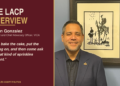
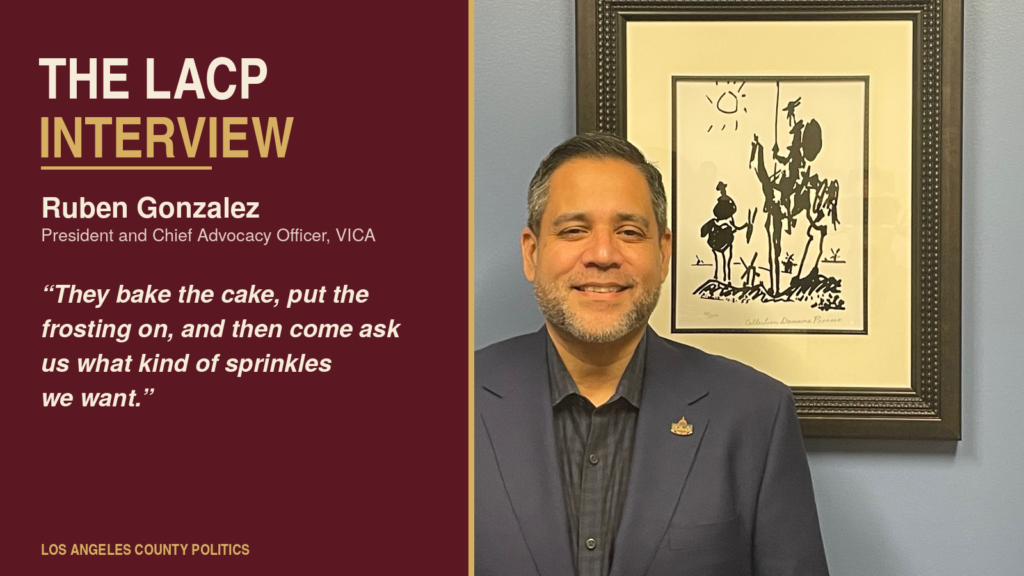
Here’s the message I’ve been sharing with folks on her transition team since the election. When progressive leaders work with business, the key is to invite us into the room early. What happens too often is they bake the cake, put the frosting on, and then come ask us what kind of sprinkles we want. That’s a recipe for battles. If you bring us in when you’re pulling together the ingredients, we know we’re not going to get our way on every issue. Businesses don’t expect to win 100%, because running a business, whether it’s a one-person shop, a mom-and-pop restaurant or a Fortune 100 company, is about dealing with reality, adapting and compromise. If we’re part of that process, 99 times out of 100, we’re going to support the final product, because we were engaged and included.
LACP: We’re LA County Politics, and the conversation here is very city-centric. Supervisor Lindsey Horvath just announced she’s running for the county’s first elected County Executive. How do you see this new county government?
Gonzalez: Personally, I’m in favor of it. Supervisors were representing way too many people, which pulls them further away from the people they govern. Adding seats brings the legislative body closer to the voters, but you need that central figure to keep an eye on the forest while supervisors focus on their plot of trees.
This first election is critical. I say this with complete sincerity: this is a George Washington moment. When you’re the first to sit in an executive role, so much of it is created by custom and tradition rather than black-and-white rules. Whoever takes this job is going to have to create that culture, and literally write the role on the fly. It’s an incredible opportunity, but it’s also a danger if the wrong person gets in there. We need someone with gravitas to make it an impactful position.
LACP: Do you have a relationship with Horvath’s office? She’s making a strong play to be the first elected county executive.
Gonzalez: She wasn’t on the ballot on Tuesday, but she’s probably the most influential elected official right now in the LA region. She made the right picks in her endorsements, and she was one of the main faces of this restructuring of the county. I’ve known her for years. She’s a great person and an impressive elected official. As with most electeds, we’re not going to agree on everything. But the general approach from the business community is, just come to the table and work with us, and don’t have the attitude that it’s my way or the highway.
LACP: Voters approved Measure FD, the half-cent sales tax for the Fire Department. Is that a burden on Valley businesses or a fair price for fire protection?
Gonzalez: We can hold two ideas in our head at once. We need greater fire resources to deal with wildfires and, more to the point, prevent them through smart management up front. At the same time, any half-cent increase in the sales tax for any reason is a burden on businesses and consumers. But it passed, so now we have to hold everyone accountable and make sure the money goes to things that actually make us safer.
What’s the accountability on those dollars? Is the money being used to meet the stated goal of the measure? I want to see more firefighters, and cutting-edge technology. There’s drone and AI technology that can map the entire city and flag potential flashpoints where there’s too much vegetation. And I want to see some of that money go into those spots and cut back that undergrowth.
LACP: In Pacoima, there’s a push to close Whiteman Airport for economic development. Does VICA have a position, and what kind of development would you like to see in the Northeast Valley?
Gonzalez: Whiteman’s still in process, but my personal belief is that we’ll be looking at that asset as an important part of the overall conversation about economic development in the Valley. I went to the committee meeting the other day, and what I wanted to say was, everybody just breathe. We have a significant asset, in land and otherwise, in an area that needs economic development, housing and more job centers. The draft study is being run by a fantastic consulting group that has credibility with all of us, and I’m looking forward to the full report.
I don’t think Whiteman is currently a successful going concern. The county can’t continuously prop up the airfield when it’s not creating any real benefit or economic activity for the community. The pilots who want to keep things as they are should worry that it could go the other way: if the county decides to invest in it as an aviation facility, prices to use the airfield are going to go up. And you also can’t have a community that says aviation doesn’t matter, wipe it out and build whatever. Both sides have valuable insights. The Northeast Valley has greatly improved since Monica Rodriguez came to the council. She’s done very well moving the ball, and I look forward to working with her. If I had a magic wand, I’d get all the stakeholders in a room, close the door, be honest and decide what kind of cake we want to bake.
LACP: Beyond Whiteman, what’s VICA’s agenda for 2027?
Gonzalez: We’re going to focus on economic development in 2027. Not only what opportunities there are in specific projects, but also challenging the city of LA to create an actual infrastructure for economic development. It’s been 14 years since the redevelopment agencies were shut down. In what amounted to a budget move, Gov. Jerry Brown closed shop on them, and the city of LA never landed on an effective replacement. During Antonio Villaraigosa’s last two years, he launched an initiative to come up with a new structure so Los Angeles could bring business and jobs and economic activity. It was a great proposal, but it got caught in politics. Administrations flip, and the new guys don’t want to carry on what the old guys were working on. We’re going to put a spotlight on that, and on best practices from around the country.
The political atmosphere now has everyone fighting over how to divide the economic pie, making sure they and theirs get the biggest piece and those they don’t agree with get as little as possible. Our focus is to grow the pie so that everybody benefits.
LACP: What is VICA doing to keep entertainment and other key industries from leaving the Valley?
Gonzalez: We’re going to push anything that supports our production community: the film tax credit, and making permitting and the bureaucracy even more efficient. Lately, it’s less about losing production to Georgia and more about the United States losing production to London and Eastern Europe. A very knowledgeable person told me, and I’m still tracking down the written source, that of the 50,000-plus people in LA who lost jobs to runaway production, about two-thirds are Valley residents. TV and film production is a no-brainer: it’s an immediate injection of economic benefit into a community. We’re going to lean in.
LACP: What are the biggest challenges facing Valley employers right now?
Gonzalez: We always say the No. 1 thing business needs is certainty. Uncertainty is the biggest challenge: “I didn’t budget for that new county fee.” “I didn’t budget for that new state tax.” When LA raised the minimum wage, businesses faced a 60% increase in labor costs over four years. Day to day, you don’t know what your energy costs are going to be. The tariff regime is just bad policy, whether you’re conservative or progressive, and the war in Iran has hit energy costs, which underlie everything in our economy.
But at a more macro level, certainty can be the challenge. My biggest fear with the rise of DSA in the city of LA is that groups like DSA use the same structure and tactics as MAGA, just with a different agenda. At the baseline of their approach is a belief that they know best. When you have folks with a conclusion in search of a rationale, who cherry-pick the facts that support the ending they’ve already decided on, that’s where certainty is a problem. They don’t invite anybody in to bake the cake. We won’t know until we see how our newly elected leaders actually govern. I’ve been surprised over and over. So again, treat it like the gladiatorial arena: the fight is over, so how do we govern?
LACP: Barri Worth Girvan won the West Valley’s open council seat. What do you expect from her, and how will VICA work with her?
Gonzalez: VICA will work with her seamlessly. Barri is a longtime Valley public servant. In this race we had two quality candidates, both known entities, both respected. While of course you want to see your endorsed candidates win, Barri is a conscientious, thoughtful, dynamic person, and we’ll have no problem working with her hand in hand.
LACP: What do the newly approved City Charter changes, especially the planning overhaul, mean for Valley businesses?
Gonzalez: I’ll be honest and say three words I say a lot: I don’t know yet. With charter changes, you’re basically talking about constitutional changes, so we have to watch how they’re implemented, how this mayor goes about it and how the new city attorney weighs in with legal opinions. People have ignored this because everybody focuses on the mayor’s race or their council seat, but I think the most significant potential impact of this election is having a DSA candidate as city attorney.
When I was deputy city controller under Laura Chick, I learned that office can largely run on rails. But half of the city attorney’s office is general counsel for the city. City staff, department heads, council members and the mayor go to the city attorney’s office every day to ask what the legal pathway is for what they want to do. In saying what’s possible and what’s not, you are making policy. I’ve seen great policies die because the city attorney over that section had a personal opinion, and nobody above was going to push the other way.
LACP: On a more personal note, who are your favorite writers?
Gonzalez: For my brain candy, I love mysteries, especially the ones set in LA, because I love reading about places I go to: Faye Kellerman and Jonathan Kellerman, John Grisham. I usually switch those out with a biography of some political person.
But the writer I probably take in the most material from is Aaron Sorkin. I think he’s a mix of Shakespeare and Mark Twain for our time: “The West Wing,” “The Newsroom,” even “Sports Night.” Wherever he puts the show, his writing is some of the deepest and clearest illustration of where we are, and the case for where we should go. On “The West Wing,” very few people are demonized. It could be the most liberal character or the most conservative character, but they’re shown with respect, and everyone gets a chance to weigh in. I think he’s a political philosopher of the 21st century.
LACP: And your heroes?
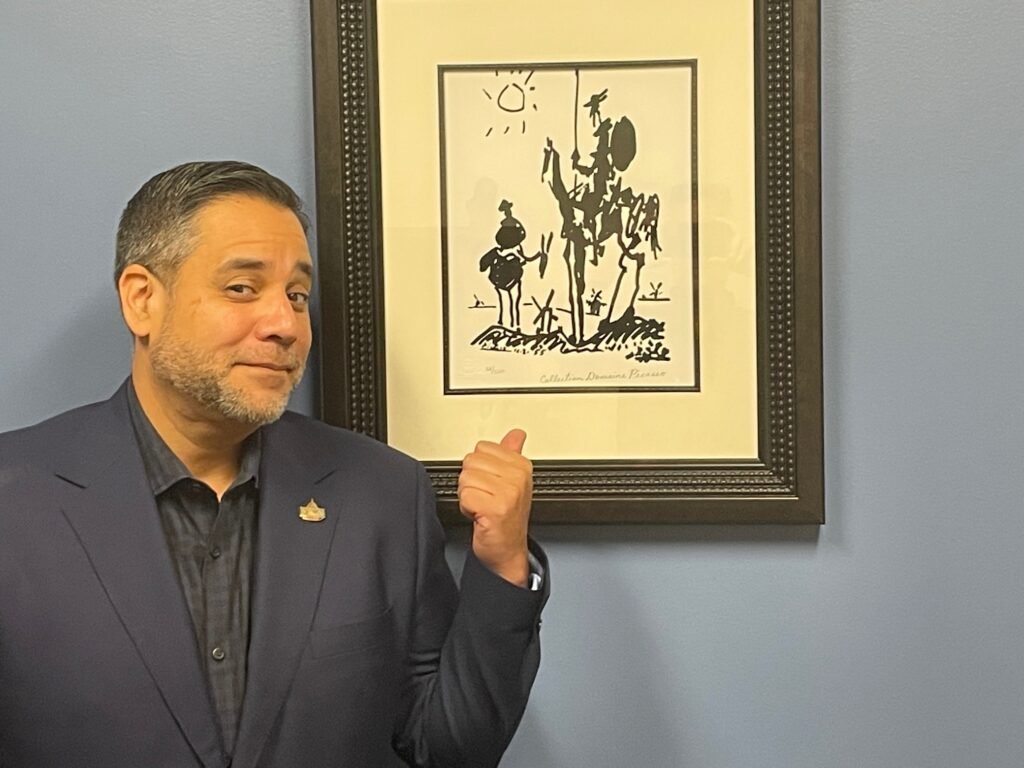
My political hero is Winston Churchill. No one’s perfect, but holding the world together for freedom for about 18 months with nothing more than will and incredible oratory is impressive. And then Don Quixote, because I think we should all tilt at windmills. Whenever I’m talking to anyone about a project or an issue, I ask, if I gave you a magic wand, what would be the perfect outcome? Know your ideals first, then back them down to what can practically be done. People say don’t let the perfect be the enemy of the good. I like to say don’t let the perfect be the enemy of the possible.