


By Stephen Witt, Los Angeles County Politics (LACP)
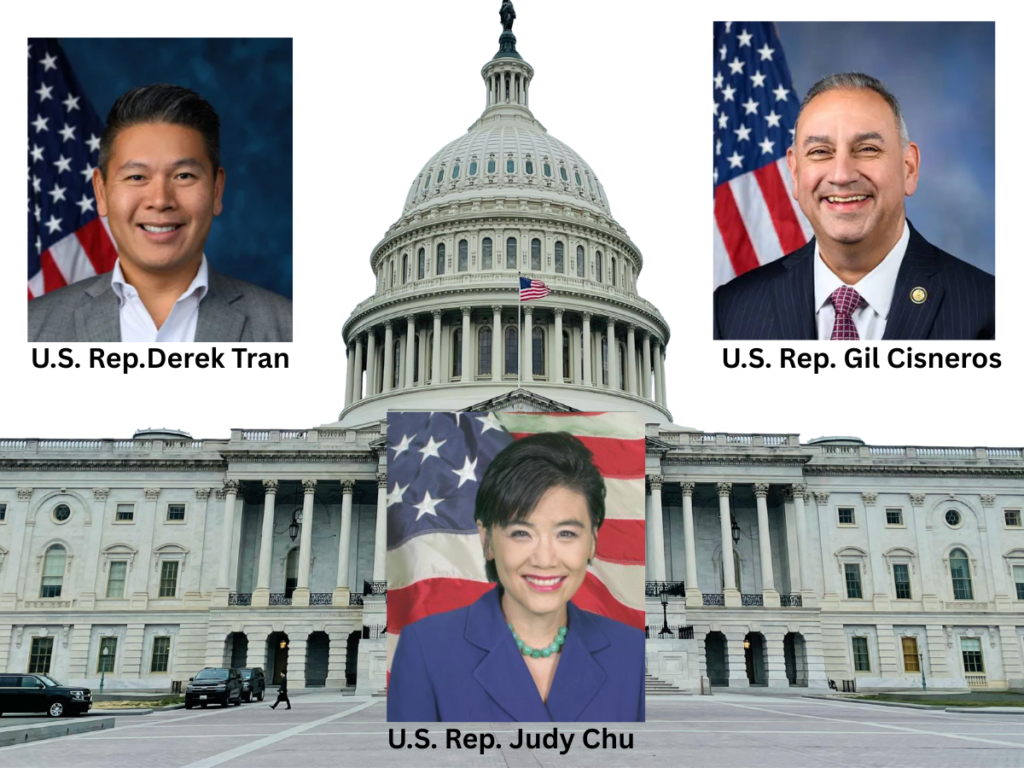
Three members of the all-Democratic Los Angeles congressional delegation issued statements this week following the partisan 216-212 passage of the National Defense Authorization Act for Fiscal Year 2027, a $1.15 trillion defense package that cleared the House on near-party-line support.
U.S. Reps. Judy Chu, Gil Cisneros and Derek Tran emphasized two flashpoints in their opposition: continued funding for the Trump administration’s military operations in Iran, and the inclusion of the SAVE America Act, a voter-identification measure Democrats say would erect new barriers to voting, including for military families stationed abroad.

“This year’s NDAA gives President Trump a $1.15 trillion blank check to continue his illegal, destabilizing, and deeply unpopular war in Iran, while once again asking working families to pay the price,” said Chu (D-Pasadena, Monterey Park, San Gabriel, Alhambra, and the west San Gabriel Valley). “At a time when Americans are struggling to afford groceries, gas, housing, child care, and health care, House Republicans have chosen to pour another $250 billion into a Pentagon that has failed six consecutive audits instead of investing in the people they were elected to serve.”
Chu’s office noted that $250 billion — the added sum she says lawmakers diverted toward war funding — is roughly equivalent to what would be needed to fund SNAP benefits for 110 million people, or Medicaid coverage for 29 million.

Cisneros (D-El Monte, West Covina, Baldwin Park, Azusa, Covina, Glendora, La Puente, San Dimas, Monrovia, San Gabriel Valley), a Navy veteran and former Under Secretary of Defense for Personnel and Readiness, cast his no vote from a position of direct institutional experience with the Pentagon, arguing the bill fails to rein in Defense Secretary Pete Hegseth.
“For over 60 years, the NDAA has been a bipartisan collaboration,” said Cisneros. “For the second year in a row, Republicans chose to play political games and put their divisive culture wars above the needs of our military. It authorizes another blank check for the latest forever war in Iran, fails to address our urgent national security needs, and is riddled with harmful policies that hurt our troops.”
Cisneros’ office pointed to several provisions it said undercut the bill’s stated purpose, including funding for a new battleship project and what his statement characterized as expanded authority to deploy servicemembers for immigration enforcement along the southern border.
Tran (D-Cerritos, Artesia, Hawaiian Gardens, Lakewood/Orange County), an eight-year Army veteran, took a different path to the same no vote — he supported the bill when it advanced out of the House Armed Services Committee, then turned against the final floor version after Republicans rejected two of his amendments and added the SAVE America Act.
“I was disappointed that Congressional Republicans rejected my proposed amendments to prevent the further delay of critical arms sales to Taiwan and prevent future hazmat crises following the Garden Grove chemical incident in May,” said Tran. “Our servicemembers and their families deserve better than political games, and, as a Veteran, I cannot in good conscience vote for the bill in this form.”
Tran’s rejected amendments sought to require additional safety transparency from defense contractors handling hazardous materials — prompted by a hazmat incident at a Garden Grove aerospace facility — and to guarantee U.S. arms commitments to Taiwan after the administration froze a $14 billion arms package earlier this year.
All three members’ no votes were not enough to sink the bill, which now heads to the Senate.