

By Los Angeles County Politics (LACP)
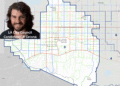
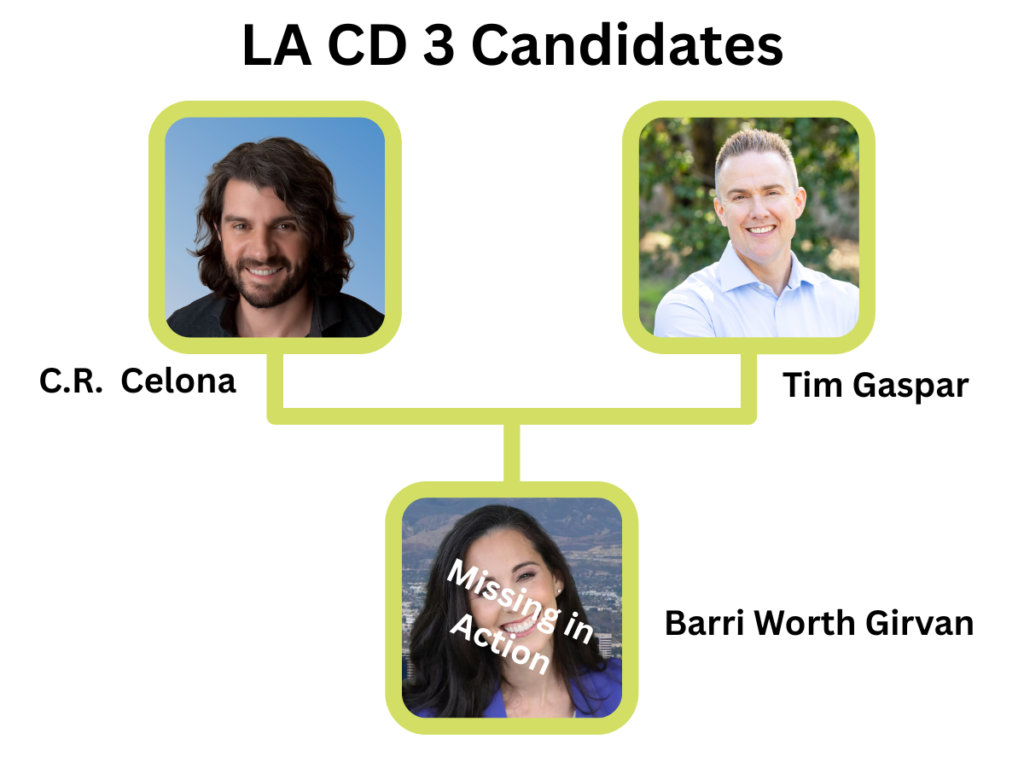
As the June 2 primary approaches in the race to replace term-limited Councilmember Bob Blumenfield in Los Angeles City Council District 3 (Woodland Hills, Tarzana, Reseda, Winnetka, and Canoga Park), Los Angeles County Politics put two questions to the three declared candidates — and got answers from two of them.
LACP emailed questions to C.R. Celona, Tim Gaspar, and Barri Worth Girvan last Thursday, following up with calls and emails over four days to ensure responses. Celona and Gaspar replied. Worth Girvan did not respond to numerous emails and phone calls.
The questions and answers are published verbatim below.
Question 1: The proposed development of approximately 398 homes on the Woodland Hills Country Club property has drawn significant community opposition over fire safety and evacuation concerns. Do you support or oppose the project as currently proposed, and why? What role should the next CD3 councilmember play in shaping its outcome?
Question 2: Los Angeles has lost significant entertainment industry production to Georgia and New York in recent years. What specific steps would you take as CD3 councilmember to bring film and television jobs back to the West Valley?
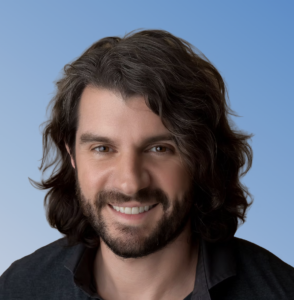
C.R. Celona
Q1: Los Angeles is in a housing shortage. If we’re serious about affordability, we must build more housing. That includes projects like the Woodland Hills Country Club proposal, which offers affordable housing for seniors and options for first-time homebuyers. But housing only works if it’s done responsibly. Right now, I do not support the project as currently proposed because the Los Angeles Fire Department has raised real concerns about fire safety and evacuation. In a high-risk area like this, those issues are critical for the community. This shouldn’t be framed as “build or don’t build.” That’s the kind of thinking that keeps us stuck in this housing crisis. We need to build but we also need to get it right.
The role of the next Councilmember is to make that happen. That means bringing the developer, LAFD, and the community to the table early and working through these issues proactively, not letting them drag on for years, and not ignoring them either. We should be pushing for a revised plan that addresses access, evacuation routes, and emergency response capacity while still delivering the housing our city desperately needs. Too often, City Hall blocks developments in our city, leading to the shortage of housing we see all across the city. We need leadership that focuses on solving the problem by building more housing, making it safer, and moving with urgency.
Q2: To fix this, we need to make it easier to produce in Los Angeles. First, we have to overhaul the permitting process. That means clear timelines, standardized rules across departments, and a single point of coordination so productions aren’t navigating a maze just to shoot a scene. If a project meets the requirements, it shouldn’t take months to get approved.
Second, we need to fully staff and empower the city’s film office so it can actually coordinate across departments like police, transportation, fire, and public works. Productions should be getting fast, predictable answers. Third, we need consistency. Right now, productions can get completely different answers depending on who they talk to, and that uncertainty kills projects. We need a system where the rules are clear upfront so people can plan and move forward with confidence. We also need to lower barriers for smaller productions. That means piloting things like waiving certain fees for low-impact shoots, aligning overly restrictive requirements, like posting timelines, with state standards, and regularly reviewing outdated restrictions and “special conditions” that no longer make sense but still limit filming.
And we need to be honest around the fact that there are cases where productions are being hit with excessive fees, inconsistent rules, or pushback at multiple levels, from within the community. If we want these jobs back, we need a more balanced, film-friendly approach that respects neighborhoods but doesn’t make filming impossible. At the same time, we need to partner with the state to stay competitive on tax incentives. Other states are aggressively going after these jobs, and we can’t afford to sit back. The city should be actively pushing for stronger, smarter incentives that keep production, and the jobs that come with it, here in the Valley. This is fixable. We already have the talent and infrastructure. We just need a system that actually works.
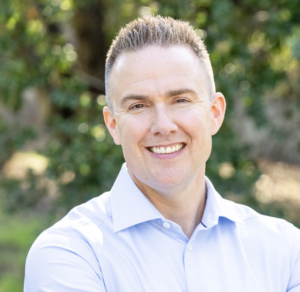
Tim Gaspar
Q1: I support building more housing in Los Angeles, and I believe deeply in responsible, well-planned growth. But I oppose the Woodland Hills Country Club proposal as currently proposed because it fails basic tests of responsible development for a hillside, high-fire area with constrained infrastructure.
At this scale and in this location, the project raises serious public safety and quality-of-life concerns. It would add hundreds of daily car trips onto narrow hillside streets that were never designed for that volume. It would require extensive grading in a Very High Fire Severity Zone and in a sensitive area bordering the Santa Monica Mountains. In a district that already faces wildfire risk, heat, and evacuation constraints, these are not technicalities. They are core life-safety issues that must be addressed before any project of this magnitude moves forward.
I am also concerned about process. Residents who will live with the long-term consequences were not meaningfully engaged early. A project this large should not be presented as a near fait accompli. Community input is not a box to check. It is essential to shaping housing that fits local infrastructure, protects the environment, and preserves quality of life.
The next CD3 councilmember should play an active, constructive role: insisting on clear, independent analysis of fire risk and evacuation capacity; requiring concrete infrastructure and emergency-response improvements as conditions of approval; and pushing for a real redesign that reduces density, grading, and traffic impacts to match the realities of this site. I want housing built, but I want it built in a way that is safe, sustainable, and earns community trust through genuine engagement and transparency.
Q2: The West Valley has the talent, crews, locations, and small businesses that support production. What we need is a City Hall that makes it easier to shoot here and competitive to stay here.
As CD3 councilmember, I would focus on practical steps that reduce friction and cost for local production while protecting neighborhoods. First, I would push for faster, more predictable permitting and clearer timelines, including a single point of contact in the council office to help productions navigate FilmLA, LADOT, LAPD, and other departments. Uncertainty and delays drive costs, and costs drive productions away.
Second, I would advocate for targeted improvements to City services that productions rely on: better coordination for street closures and traffic control, consistent enforcement to keep permitted locations workable, and clean, well-maintained public spaces that reduce the need for costly private workarounds.
Third, I would partner with industry, labor, and educational institutions to strengthen local pipelines into good union jobs, including internships, workforce training, and outreach that connects young people in the Valley to careers in film and television.
Finally, I would use the council office as a bridge between neighborhoods and production, setting clear expectations so residents are respected and shoots can proceed smoothly. If we make LA easier to work in and reliable to work with, we can compete again and keep entertainment jobs in the Valley.
Barri Worth Girvan did not respond to numerous emails and phone calls.
Early voting begins with mailed ballots next month. If no candidate receives 50% plus one vote on June 2, the top two finishers advance to the November general election.