


By Stephen Witt, Los Angeles County Politics (LACP)
As Los Angeles County and City struggle with rising homelessness, the only Republican on the five-member Board of Supervisors is weighing in on the White House’s new approach to treating it.
Los Angeles County Supervisor Kathryn Barger (R-Palmdale, Lancaster, Santa Clarita, San Marino, Pasadena, La Cañada Flintridge, and portions of the San Gabriel Valley) told LACP that while many unhoused residents struggle with substance abuse and mental health issues, the White House’s push for “Treatment First” can coexist with the county’s approach to “Housing First.”
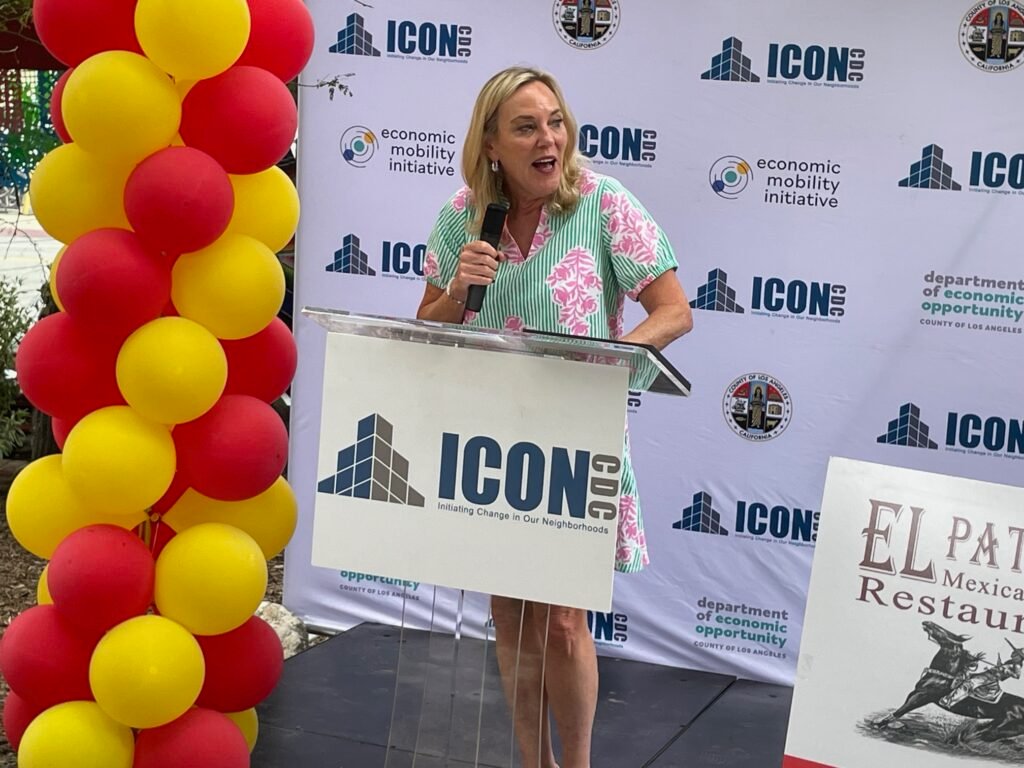
“It’s not an either-or. I am a housing first advocate, right? But not as the only way to address this issue. We have crisis on the street. It’s not a one-size-fits-all. There are people that housing first works for. But if you don’t address the mental health and the substance abuse issues, it’s all for now,” said Barger at the reopening celebration of El Patron Restaurant in Altadena, as businesses in the area recover from the devastating Eaton fire.
The debate centers on a 37-page “Treatment First” Best Practices Toolkit the Trump administration released this summer, jointly issued by the Office of National Drug Control Policy, the U.S. Department of Health and Human Services and the U.S. Department of Housing and Urban Development (HUD).
The toolkit argues housing without treatment requirements attached only masks underlying addiction, mental illness or trauma.
The toolkit also specifically highlights Barger’s Fifth District Homeless Outreach Services Team (HOST) program, devoting an entire chapter to the model as one worth replicating nationally. Barger’s district has posted some of the county’s strongest results. This year’s Point-in-Time Count found unsheltered homelessness in the Antelope Valley fell 37%, a drop the county attributed in a July 24 statement to a combination of programs including Pathway Home, Project Homekey and intensive street outreach, including HOST.
Barger drew a sharp line between that policy debate and a separate federal funding fight between HUD and the Los Angeles Homeless Services Authority (LAHSA), which recently went to court after the Trump administration attempted to suspend the agency’s funding.
“The HUD and the issue regarding losses is an entirely different issue. That has to do with accountability. That has to do with monitoring. It has to do with accounting for the dollars that are being funded. HOST is embraced by our homeless services department, but the board has to authorize funding to go to law enforcement in order for them to release and expand on those funds,” said Barger.
Barger credited HOST, which embeds law enforcement alongside outreach workers, as the driving force behind her district’s results. The Board of Supervisors initially declined to fund the law enforcement component using general homelessness dollars, she said, prompting her to use Fifth District discretionary funding rather than Measure A dollars to stand up dedicated HOST teams.
“The HOST has been, I would argue, probably the ingredient that’s created successes in my district for not only outreach for the homeless population but actually the cleanup efforts that we’ve done, especially with encampments,” said Barger. “At one point, they out of their own pocket paid for an individual to fly home to the Midwest because they reunited the family.”
Barger said the teams have recorded zero arrests to date, but more of her board colleagues are now expressing interest in dedicated HOST teams of their own even as the Sheriff’s Department lacks the staffing to expand the program districtwide.
“Everyone’s seen the successes of HOST, but the sheriff doesn’t have the personnel to expand it because of the shortage. I still have my teams, and now many of my colleagues want to have dedicated HOST teams, but there is not the personnel,” said Barger.