

County Department of Health questioned about slow-walking food cart permits

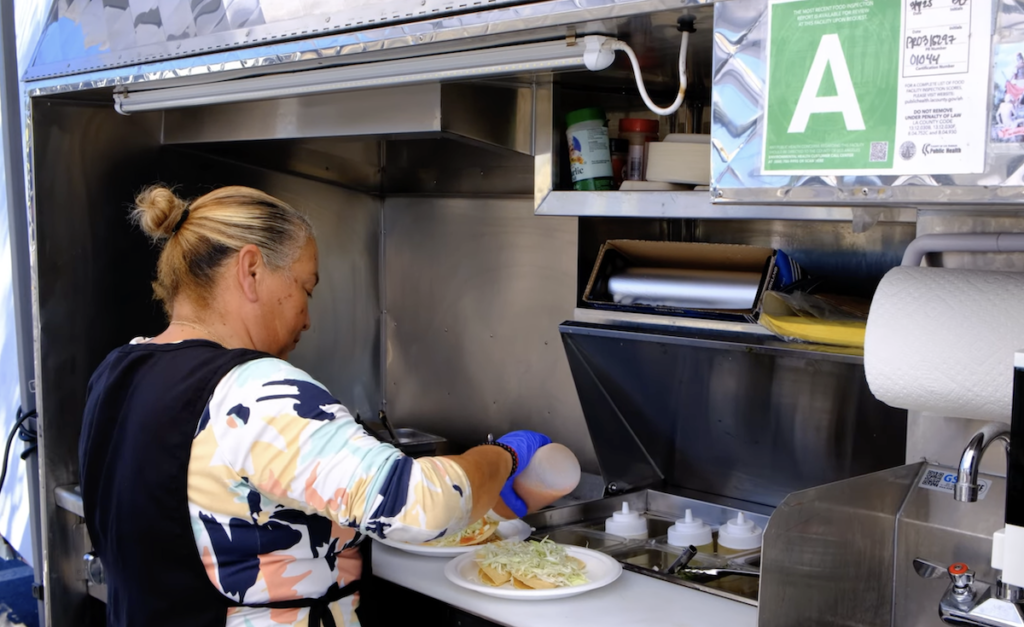
A vendor prepares food from a health code-compliant cart displaying an 'A' grade, distributed through ICON CDC's Sidewalk Vending Program. The nonprofit says it has provided more than 50 compliant carts to date, but its executive director alleges dozens more vendors are stuck waiting on LA County permits. (Photo: courtesy ICON CDC)

By Stephen Witt

A local nonprofit with a county contract to help street food vendors get licensed is alleging the Los Angeles County Department of Public Health (DPH) is slow-walking the permit process.

But DPH officials deny the allegation—even as dozens of local working-class food cart entrepreneurs have waited months for their permits.

The dispute centers on Compact Mobile Food Operation (CMFO) permits, which vendors need to legally operate carts in LA County.

Roberto Barragan, executive director of ICON Community Development Corporation, which coordinates CMFO applications for vendors on behalf of the city and county of Los Angeles, said ICON has 45 complete, paid applications pending with DPH for cart vendors since June, some submitted as early as April and still unresolved months later.

Barragan contends that during multiple meetings with DPH staff member Joshua Trapesonian, he was told the reason for the slowdown in issuing permits was because staffing resources were being diverted to address 2026 FIFA World Cup-related inspections.

But the DPH communications team denied both that they are slow-walking the permit process and that the World Cup has anything to do with it.

“The Department of Public Health’s Mobile Food Program (MFP) has not slowed the processing of Public Health Permit applications for new Compact Mobile Food Operations (CMFOs) since June 2026. The 2026 FIFA World Cup events had no impact on the permitting process,” DPH said in an email to LACP.

DPH officials said processing time from application submission to permit issuance depends on many factors, such as application review, scheduling inspections of the CMFO, and scheduling inspections for alternative CMFO storage or commissary locations.

“If all application information is complete, the CMFO has been certified by Public Health and the applicant does not require additional inspections of alternate CMFO storage or alternate commissary locations, the average time to process new applications and issue the invoice for the Public Health Permit is approximately twenty days,” they added.

DPH officials said that after the invoice is paid, the CMFO is approved to operate with the physical permit being mailed to the operator about three weeks after payment.

DPH wrote there are 28 CMFO applications pending and that though the department has made every effort to process these new CMFO applications expeditiously.

“There have been delays outside the control of Public Health, including payment of invoices, missing information on applications, and availability of applicants for scheduling of additional required inspections of alternate commissary or home storage locations,” they wrote.

But Barragan said the DPH claim that the average processing time is 20 days does not align with the reality of the applications ICON has managed.

“We have applications that were submitted months ago — some as early as April 2026 — that remain pending without resolution, far exceeding the twenty-day timeline stated in your response. These delays have created significant hardship for our vendors, who have been waiting for months to obtain the permits necessary to legally operate,” said Barragan in an emailed response.

“We’ve paid all invoices received by DPH and provided all required documentation for vendors via email,” he wrote. “ICON CDC now has 45 complete and paid applications pending with DPH for cart vendors starting from June 2026.”

Barragan noted that ICON CDC has partnered with the City of Los Angeles to implement a very effective Sidewalk Vending Program that has served over 1,000 vendors citywide and distributed over 50 permitted carts in every council district.

“We have vendors that want to be permitted and carts that are being provided by the City and County of Los Angeles. Our only obstacle to distributing another 100 before the end of the year is DPH,” he wrote.

Leave a Reply

Your email address will not be published. Required fields are marked *

This site uses Akismet to reduce spam. Learn how your comment data is processed.

  • Latest
  • Comments
  • Trending

By Stephen Witt

A local nonprofit with a county contract to help street food vendors get licensed is alleging the Los Angeles County Department of Public Health (DPH) is slow-walking the permit process.

But DPH officials deny the allegation—even as dozens of local working-class food cart entrepreneurs have waited months for their permits.

The dispute centers on Compact Mobile Food Operation (CMFO) permits, which vendors need to legally operate carts in LA County.

Roberto Barragan, executive director of ICON Community Development Corporation, which coordinates CMFO applications for vendors on behalf of the city and county of Los Angeles, said ICON has 45 complete, paid applications pending with DPH for cart vendors since June, some submitted as early as April and still unresolved months later.

Barragan contends that during multiple meetings with DPH staff member Joshua Trapesonian, he was told the reason for the slowdown in issuing permits was because staffing resources were being diverted to address 2026 FIFA World Cup-related inspections.

But the DPH communications team denied both that they are slow-walking the permit process and that the World Cup has anything to do with it.

“The Department of Public Health’s Mobile Food Program (MFP) has not slowed the processing of Public Health Permit applications for new Compact Mobile Food Operations (CMFOs) since June 2026. The 2026 FIFA World Cup events had no impact on the permitting process,” DPH said in an email to LACP.

DPH officials said processing time from application submission to permit issuance depends on many factors, such as application review, scheduling inspections of the CMFO, and scheduling inspections for alternative CMFO storage or commissary locations.

“If all application information is complete, the CMFO has been certified by Public Health and the applicant does not require additional inspections of alternate CMFO storage or alternate commissary locations, the average time to process new applications and issue the invoice for the Public Health Permit is approximately twenty days,” they added.

DPH officials said that after the invoice is paid, the CMFO is approved to operate with the physical permit being mailed to the operator about three weeks after payment.

DPH wrote there are 28 CMFO applications pending and that though the department has made every effort to process these new CMFO applications expeditiously.

“There have been delays outside the control of Public Health, including payment of invoices, missing information on applications, and availability of applicants for scheduling of additional required inspections of alternate commissary or home storage locations,” they wrote.

But Barragan said the DPH claim that the average processing time is 20 days does not align with the reality of the applications ICON has managed.

“We have applications that were submitted months ago — some as early as April 2026 — that remain pending without resolution, far exceeding the twenty-day timeline stated in your response. These delays have created significant hardship for our vendors, who have been waiting for months to obtain the permits necessary to legally operate,” said Barragan in an emailed response.

“We’ve paid all invoices received by DPH and provided all required documentation for vendors via email,” he wrote. “ICON CDC now has 45 complete and paid applications pending with DPH for cart vendors starting from June 2026.”

Barragan noted that ICON CDC has partnered with the City of Los Angeles to implement a very effective Sidewalk Vending Program that has served over 1,000 vendors citywide and distributed over 50 permitted carts in every council district.

“We have vendors that want to be permitted and carts that are being provided by the City and County of Los Angeles. Our only obstacle to distributing another 100 before the end of the year is DPH,” he wrote.