


LA County fire recovery report finds no one had clear top-down authority

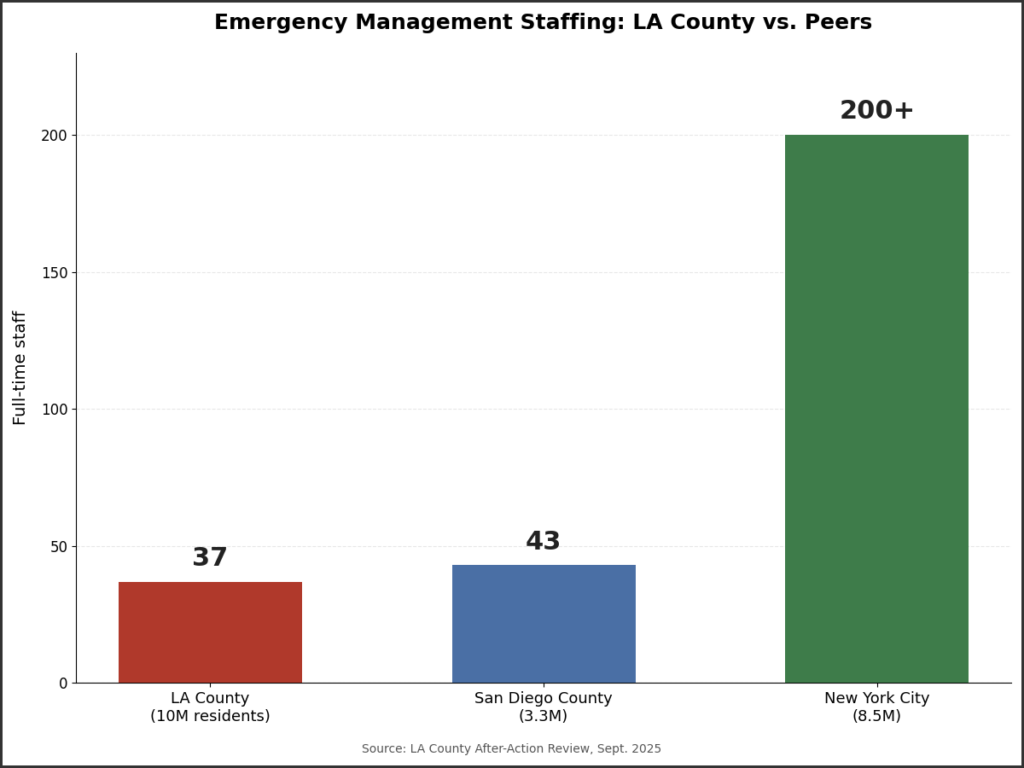
The county's Office of Emergency Management had just 37 full-time staff at the time of the January 2025 fires, fewer than San Diego County despite serving a population three times as large. Friday's after-action report on the county's fire recovery found that same lack of capacity may have contributed to confusion over who held final authority during key recovery decisions. (Source: LA County After-Action Review, Sept. 2025)

By Stephen Witt, Los Angeles County Politics (LACP)

Who’s in charge? When it comes to the emergency response to last year’s devastating Eaton and Palisades fires, the answer is the buck didn’t stop anywhere.

That’s one of the main takeaways from a county-commissioned report released Friday, on the 25th anniversary of the Sept. 11 terrorist attacks, examining how Los Angeles County handled recovery and repopulation after the fires.

The report found that even as debris crews worked fast and radios stayed up, no one could clearly say who held final authority over some of the biggest recovery decisions.

The 185-page after-action review, conducted by the McChrystal Group, examined the county’s recovery and repopulation performance across six areas: communications; volunteer and donations management; recovery; repopulation; shelter, housing and people at higher risk; and public health and access and functional needs. It covers the period from Jan. 7 to March 31, 2025, and produced 26 findings and 25 recommendations.

Among those findings, one stands out: “repopulation decision authority was not clearly understood” across county agencies, including what role the county’s Office of Emergency Management was supposed to play, and what authority Public Health Department (DPH) representatives actually had when they sat in on repopulation and reentry discussions.

“The review did not identify evidence that County agencies intentionally withheld services from any population,” the report states. “Where gaps were identified, they reflected structural or resource-related challenges rather than intentional actions and are addressable through targeted organizational improvements.”

The report separately found that DPH’s own wildfire-specific emergency response responsibilities had never been translated into a formal role matrix or decision-support protocol before the fires hit — meaning department staff were present for major calls on reentry, debris staging and environmental testing without a clearly defined say in the outcome.

This isn’t the first time county reviewers have flagged this exact gap.

The new report includes a formal comparison against the county’s 2019 after-action review of the Woolsey Fire, which produced 85 recommendations. Of those, the review team found only 30 had been implemented before the January 2025 fires, six were still in progress, and 15 have no confirmed update at all six years later. One unresolved Woolsey recommendation, No. 62, called on the county to establish clear repopulation decision-making authority, including who holds final say. The new report found the same gap resurfaced nearly word for word.

A separate after-action review released last year, examining the county’s fire alerts and evacuations, found that OEM — the agency responsible for coordinating the county’s disaster response — had just 37 full-time staff and no dedicated operating budget at the time of the fires, for a county of 10 million people.

By comparison, last year’s report found San Diego County’s equivalent office has 43 staff, and New York City’s emergency management department has more than 200, for a city of 8.5 million. The report called the county’s emergency preparedness staffing “fundamentally inadequate.”

The Board of Supervisors voted 5-0 on Sept. 30, 2025 to direct the County CEO to study restructuring OEM into an independent, fully resourced department with its own budget and clearer authority.

“Change moves at the speed we choose — and when it comes to emergency preparedness, we are choosing urgency,” Supervisor Lindsey Horvath (D-West Hollywood, Santa Monica, Hollywood, San Fernando Valley, Sylmar, San Fernando) said at the time.

Nearly a year later, OEM still operates as a division inside the CEO’s office, according to the county’s own website.

The report and its recommendations are scheduled for discussion by the Board of Supervisors at its next meeting, 9:30 a.m. tomorrow, Tuesday, Sept. 15, at the Kenneth Hahn Hall of Administration, 500 W. Temple St., Room 381B, in Los Angeles. Supervisors may also address the status of last year’s directive to restructure OEM. The meeting can be streamed at bos.lacounty.gov.

Leave a Reply

Your email address will not be published. Required fields are marked *

This site uses Akismet to reduce spam. Learn how your comment data is processed.

  • Latest
  • Comments
  • Trending

By Stephen Witt, Los Angeles County Politics (LACP)

Who’s in charge? When it comes to the emergency response to last year’s devastating Eaton and Palisades fires, the answer is the buck didn’t stop anywhere.

That’s one of the main takeaways from a county-commissioned report released Friday, on the 25th anniversary of the Sept. 11 terrorist attacks, examining how Los Angeles County handled recovery and repopulation after the fires.

The report found that even as debris crews worked fast and radios stayed up, no one could clearly say who held final authority over some of the biggest recovery decisions.

The 185-page after-action review, conducted by the McChrystal Group, examined the county’s recovery and repopulation performance across six areas: communications; volunteer and donations management; recovery; repopulation; shelter, housing and people at higher risk; and public health and access and functional needs. It covers the period from Jan. 7 to March 31, 2025, and produced 26 findings and 25 recommendations.

Among those findings, one stands out: “repopulation decision authority was not clearly understood” across county agencies, including what role the county’s Office of Emergency Management was supposed to play, and what authority Public Health Department (DPH) representatives actually had when they sat in on repopulation and reentry discussions.

“The review did not identify evidence that County agencies intentionally withheld services from any population,” the report states. “Where gaps were identified, they reflected structural or resource-related challenges rather than intentional actions and are addressable through targeted organizational improvements.”

The report separately found that DPH’s own wildfire-specific emergency response responsibilities had never been translated into a formal role matrix or decision-support protocol before the fires hit — meaning department staff were present for major calls on reentry, debris staging and environmental testing without a clearly defined say in the outcome.

This isn’t the first time county reviewers have flagged this exact gap.

The new report includes a formal comparison against the county’s 2019 after-action review of the Woolsey Fire, which produced 85 recommendations. Of those, the review team found only 30 had been implemented before the January 2025 fires, six were still in progress, and 15 have no confirmed update at all six years later. One unresolved Woolsey recommendation, No. 62, called on the county to establish clear repopulation decision-making authority, including who holds final say. The new report found the same gap resurfaced nearly word for word.

A separate after-action review released last year, examining the county’s fire alerts and evacuations, found that OEM — the agency responsible for coordinating the county’s disaster response — had just 37 full-time staff and no dedicated operating budget at the time of the fires, for a county of 10 million people.

By comparison, last year’s report found San Diego County’s equivalent office has 43 staff, and New York City’s emergency management department has more than 200, for a city of 8.5 million. The report called the county’s emergency preparedness staffing “fundamentally inadequate.”

The Board of Supervisors voted 5-0 on Sept. 30, 2025 to direct the County CEO to study restructuring OEM into an independent, fully resourced department with its own budget and clearer authority.

“Change moves at the speed we choose — and when it comes to emergency preparedness, we are choosing urgency,” Supervisor Lindsey Horvath (D-West Hollywood, Santa Monica, Hollywood, San Fernando Valley, Sylmar, San Fernando) said at the time.

Nearly a year later, OEM still operates as a division inside the CEO’s office, according to the county’s own website.

The report and its recommendations are scheduled for discussion by the Board of Supervisors at its next meeting, 9:30 a.m. tomorrow, Tuesday, Sept. 15, at the Kenneth Hahn Hall of Administration, 500 W. Temple St., Room 381B, in Los Angeles. Supervisors may also address the status of last year’s directive to restructure OEM. The meeting can be streamed at bos.lacounty.gov.