



By Stephen Witt
Editor’s Note: This is the second in a series of stories about Whiteman Airport.
For decades, residents of Pacoima have lived with aircraft noise at all hours and the ever-present fear of plane crashes in their neighborhood. Now, a voice from an unexpected quarter—the legal aid community—has added weight to their calls for the redevelopment of Whiteman Airport.

Yvonne Mariajimenez, President and CEO of Neighborhood Legal Services of Los Angeles County, served on the Community Advisory Committee that voted in February 2023 to recommend closing the 184-acre general aviation airport. In a recent interview, she took the leadership at Whiteman to task for what she called decades of neglect, lack of transparency, and missed opportunities to serve the surrounding low-income community.
“This community has really been taken advantage of,” Mariajimenez said. “There’s a lot that could have been done. A lot of goodwill could have been created had they mitigated the situation and the conditions that existed there. But they didn’t, and they weren’t transparent.”
The committee’s recommendation came after months of deliberation. Veronica Padilla-Campos, executive director of the grassroots nonprofit organization Pacoima Beautiful, introduced the motion for the airport to cease operations.
Padilla-Campos did not return several emails or calls seeking comment on Whiteman Airport..
Mariajimenez was appointed to the advisory committee by then-LA County Supervisor Sheila Kuehl. What she found on the committee persuaded her that closure was warranted.
“For too long, LA County and the aviation businesses that are there have neglected and ignored the grievances of the surrounding communities, and in particular Pacoima,” Mariajimenez said. “A lot could have been done to mitigate some of the issues that the community has raised for decades.”
Chief among those grievances was that Whiteman was the only municipal airport in the county operating 24 hours a day, seven days a week. “After 10 o’clock, there’s no tower controller,” Mariajimenez revealed. So people flew on their own.”
The community had long requested a curfew to limit nighttime flights. While a voluntary curfew now exists, Mariajimenez noted it is “not legally enforceable.”
THE NOISE NOBODY ADDRESSED
Perhaps most troubling to Mariajimenez was what she discovered about noise pollution. When she asked during committee meetings whether a noise study had been conducted, she was initially met with silence—until officials admitted one had indeed been done.
“I said, ‘Why don’t we know about that?'” Mariajimenez recalled. “So they reported on it, they brought the study. Turns out that the study confirms that the decibel, or the noise levels in the surrounding community far exceed what they should.”
The study identified homes within a specific radius of the airport that were eligible for noise reduction benefits—double-paned windows and other mitigation measures. “Nothing was done, nothing was done about that,” she said.
Mariajimenez contrasted this with how Los Angeles County handled noise issues around Los Angeles International Airport. “A lot of money was spent in neighborhoods surrounding LAX, and some of those neighborhoods are not low-income neighborhoods, right? And they did a lot of noise prevention and double paning of windows in those communities,” she said. “Well, it could have been done in Pacoima too, but they didn’t.”
A COMMUNITY’S STRUGGLE
The stakes are particularly high given Pacoima’s demographics and history of economic hardship. In the 1920s, Pacoima became known as the only place people of color could purchase land in the San Fernando Valley, attracting diverse families. By the 1950s, it evolved from farmland to a bedroom community for workers at Lockheed and other nearby industries. But the closing of factories in the early 1990s caused widespread job losses, and by 1994, Pacoima had become the poorest area in the San Fernando Valley.
Today, the neighborhood remains 91% Hispanic, with a median household income of approximately $80,574. Educational attainment is low, with 44% of adults lacking a high school diploma.

THE MISSED OPPORTUNITY
What perhaps frustrates Mariajimenez most is the wasted potential. She sees value in small municipal airports as pathways to aviation careers—her own son trained at Van Nuys Airport before joining the Air Force, where he now serves as a lieutenant.
Mariajimenez spent an entire Saturday at Whiteman Airport to better understand both sides of the issue. She was impressed by a group of aviators who provided free plane rides to youth to promote interest in aviation. “These small municipal airports can be career ladders to jobs in aviation,” she acknowledged.
But the aviation businesses at the airport never developed formal job training programs for the surrounding community. “They could have turned that into a job training program,” Mariajimenez said. “It wasn’t until the community complained about shutting it down that they said, ‘Oh, we could—this is a job training effort. This could be an opportunity to connect youth to careers in aviation.’ Well, they haven’t done that for decades.”
WHAT COMES NEXT
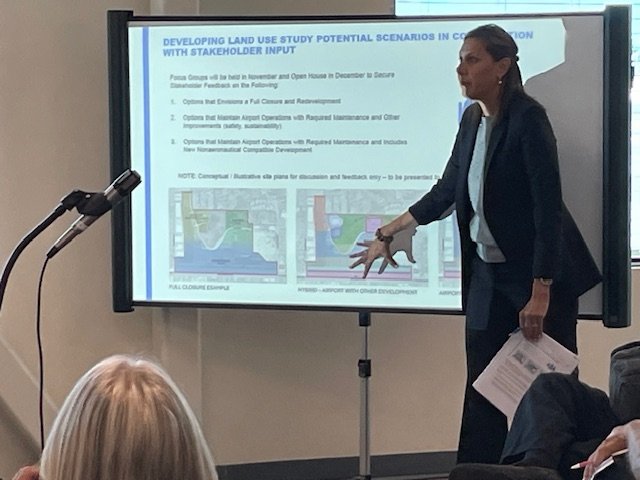
Now, as the county moves forward with studying the airport’s future, the 184 acres occupied by Whiteman Airport represent one of the most developable pieces of property in the San Fernando Valley. Los Angeles County has commissioned Trifiletti Consulting to conduct a study on redeveloping the airport site, with results expected by the end of the year.
Community members have articulated clear desires for what should replace it. “The community wants housing, both affordable and market rate,” said Mariajimenez. “They want job training programs, retail, green space, a place where families can gather and the kids can play, movie theaters, and entertainment.”
The timing is particularly significant. Los Angeles Metro is constructing a 6.7-mile light rail line along Van Nuys Boulevard with 11 stations, including three in Pacoima, with completion expected in 2031.
Mariajimenez emphasized the importance of coordinated planning. “I’m hoping that both the city and county joint power will get together and take a bird’s eye view of what’s happening at Whiteman, and what’s happening with the light rail, and that it’s done in a coordinated manner that is for equity in the community,” she said.












Comments 2
It is a valiant cause to address Whiteman Airport in the public press. Unfortunately, that the statements made for so long by some who are assumed to be trustable are disputed by facts. The published county records are very clear.
Yvonne Mariajimenez’s response to the noise study results are recorded by the LACDPW, CAC records for all to read, She was perceived as disappointed that the HMMS noise study report did NOT reveal unacceptable noise levels outside the immediate buildings near the runway. Result: About 150 spaces might be eligible for remediation, and 90% of the cost to do so would be available from federal funds. That option was not approved of by the faction opposed to the airport that would prefer re-development, to wage lead issues proven wrong by the LA County Health Dept., Air quality issues proven wrong by the SCAQMD, and the alleged lack of Community Support, proven wrong by a survey of surrounding neighborhood councils, like this one, Sylmar that promoted a Job Fair and Career Day. reference: https://www.sylmarneighborhoodcouncil.org/page/viewpage/5616 as well as residents who overwhelmingly signed a petition to keep the airport open, as opposed to the petition that was circulated by Pacoima Beautiful that offered pay to petition circulators.
Per an LACDPW draft report: “A total of $19 million of income is generated annually for the total workforce, while an estimated $54.5 million of annual airport-related spending benefits the airfield and the surrounding community each year. Further details can be found in the 2020 Economic Impact Analysis1.
Additionally, there are several ongoing opportunities for youth at Whiteman Airport including:
The Air Explorer Program which provides low-cost flight training for young people.
San Fernando Valley 99s Aviation Explorers 747 program which offers flight skills training for teens.
The Civil Air Patrol Squadron 35 which provides education and training for interested civilians.
The Experimental Aircraft Association (EAA) Young Eagles program which offers free flights and awareness programs for community youth.”
* Plus, the FAASAFETY team offers many weekly/monthly scheduled free safety seminars to any person interested in flight training held at the CAP headquarters, and VISTA Aviation provides flight instruction for those who wish to fly for pleasure or for work.
It is ironic. Close the airport folks claim that airport doesn’t support the community, but should the airport close, neighborhood gentrification would evolve, and many of the current residents would no doubt be fiscally forced away, and even more ironic, businesses like “Neighborhood Legal Services” would have far fewer green card applicants to serve.
The LADPW also states: The Airport is funded through an enterprise fund. It is a separate account from LA County’s “general fund,” for specific services that are funded directly by fees and charges to the users of these services.
Though the community schools have not allowed in-person airport participation promotion, despite many EAA efforts, per a county’s draft document a considerable amount of Community Open Houses, Town Halls, and social media outreach including Facebook & Instagram, plus flyers with QR codes, phone numbers, and email addresses were formulated.
The comment regarding the tower closing early like many towers do is both biased and laughable. Wikipedia states: “There are approximately 20,000 non-towered airports in the United States, which means that nearly 95% of all public-use land airports do not have air traffic control towers.”
It is on the CAC record that the chief of the adjacent county helicopter base reported when asked that closing the airport would be unfavorable. The lives and property saved by the helicopters cleared for departure by the Whiteman tower during the recent fires cannot be underestimated.
Because of an LA County 1999 Osborne St. real-estate purchase that is included in the Airport Master Plan, Whiteman Airport per the Airport Improvement Program (AIP) guidelines, Whiteman Airport benefits from perpetuity.
Fact finding and reference material including many reproduced L A County documents can be found at the website of the Southern California Aviation United Working Group: https://scauwg.org/whiteman-airport.
It is a valiant cause to address Whiteman Airport in the public press. Unfortunately, that the statements made for so long by some who are assumed to be trustable are disputed by facts. The published county records are very clear.
Yvonne Mariajimenez’s response to the noise study results are recorded by the LACDPW, CAC records for all to read, She was perceived as disappointed that the HMMS noise study report did NOT reveal unacceptable noise levels outside the immediate buildings near the runway. Result: About 150 spaces might be eligible for remediation, and 90% of the cost to do so would be available from federal funds. That option was not approved of by the faction opposed to the airport that would prefer re-development, to wage lead issues proven wrong by the LA County Health Dept., Air quality issues proven wrong by the SCAQMD, and the alleged lack of Community Support, proven wrong by a survey of surrounding neighborhood councils, like this one, Sylmar that promoted a Job Fair and Career Day. reference: https://www.sylmarneighborhoodcouncil.org/page/viewpage/5616 as well as residents who overwhelmingly signed a petition to keep the airport open, as opposed to the petition that was circulated by Pacoima Beautiful that offered pay to petition circulators.
Per an LACDPW draft report: “A total of $19 million of income is generated annually for the total workforce, while an estimated $54.5 million of annual airport-related spending benefits the airfield and the surrounding community each year. Further details can be found in the 2020 Economic Impact Analysis1.
Additionally, there are several ongoing opportunities for youth at Whiteman Airport including:
The Air Explorer Program which provides low-cost flight training for young people.
San Fernando Valley 99s Aviation Explorers 747 program which offers flight skills training for teens.
The Civil Air Patrol Squadron 35 which provides education and training for interested civilians.
The Experimental Aircraft Association (EAA) Young Eagles program which offers free flights and awareness programs for community youth.”
* Plus, the FAASAFETY team offers many weekly/monthly scheduled free safety seminars to any person interested in flight training held at the CAP headquarters, and VISTA Aviation provides flight instruction for those who wish to fly for pleasure or for work.
It is ironic. Close the airport folks claim that airport doesn’t support the community, but should the airport close, neighborhood gentrification would evolve, and many of the current residents would no doubt be fiscally forced away, and even more ironic, businesses like “Neighborhood Legal Services” would have far fewer green card applicants to serve.
The LADPW also states: The Airport is funded through an enterprise fund. It is a separate account from LA County’s “general fund,” for specific services that are funded directly by fees and charges to the users of these services.
Though the community schools have not allowed in-person airport participation promotion, despite many EAA efforts, per a county’s draft document a considerable amount of Community Open Houses, Town Halls, and social media outreach including Facebook & Instagram, plus flyers with QR codes, phone numbers, and email addresses were formulated.
The comment regarding the tower closing early like many towers do is both biased and laughable. Wikipedia states: “There are approximately 20,000 non-towered airports in the United States, which means that nearly 95% of all public-use land airports do not have air traffic control towers.”
It is on the CAC record that the chief of the adjacent county helicopter base reported when asked that closing the airport would be unfavorable. The lives and property saved by the helicopters cleared for departure by the Whiteman tower during the recent fires cannot be underestimated.
Because of an LA County 1999 Osborne St. real-estate purchase that is included in the Airport Master Plan, Whiteman Airport per the Airport Improvement Program (AIP) guidelines, Whiteman Airport benefits from perpetuity.
Fact finding and reference material including many reproduced L A County documents can be found at the website of the Southern California Aviation United Working Group: https://scauwg.org/whiteman-airport.