



By Los Angeles County Politics(LACP)
The county’s own consultant on the Whiteman Airport land-use study said Monday that while winning Federal Aviation Administration (FAA) approval to close the Pacoima airport is a difficult and time-consuming process, it is not an impossible one — and she has the track record to back it up.
Lisa Trifiletti of Trifiletti Consulting, who is leading the county’s comprehensive study of Whiteman’s future, told a gathering of closure advocates at Van Nuys Airport that she has personally negotiated FAA reversals on airport land issues at LAX, Inglewood, El Segundo, and Culver City — in some cases returning to the agency three separate times before securing approval.
“I also know that you can push FAA,” Trifiletti said. Her study, she added, is explicitly “assuming that we are able to meet the FAA test” on full closure, while acknowledging it “may take some time to achieve.”
That assessment stands in direct contrast to the picture painted by a recent San Fernando Valley Sun story, which reported on a January 2026 FAA letter and characterized its findings as suggesting closure was effectively off the table. The Sun quoted selectively from the letter without providing a link to the full document or the broader context of its contents.
LACP is seeking a complete copy of the letter and will report on its full findings in a follow-up story.
Based on what the Sun reported, the letter does make clear that LA County cannot unilaterally close the airport. Because the county has accepted multiple Airport Improvement Grants for Whiteman, the land is subject to federal obligations that do not expire. The FAA confirmed the property remains “federally obligated until released by the FAA,” and that any closure must “demonstrate a net benefit to civil aviation” — with “non-aviation interests” unable to serve as justification.
But Trifiletti’s comments suggest that threshold, while high, is negotiable — and the airport’s own operational picture may ultimately help make the case. According to the study presentation, Whiteman is currently running at roughly 68% vacancy, and is burdened by long-term leases the county cannot terminate, some running as late as 2059.
According to attendees who spoke with LACP after the meeting, a significant number of aircraft at Whiteman are no longer airworthy but remain on site because dismantling costs roughly $10,000 per plane. “It’s like an airplane junkyard,” one attendee said.
The FAA’s own test for closure requires demonstrating that activity levels can be absorbed elsewhere — a bar that may look different when measured against an airport operating well below capacity with a significant number of non-flying planes on the ground.
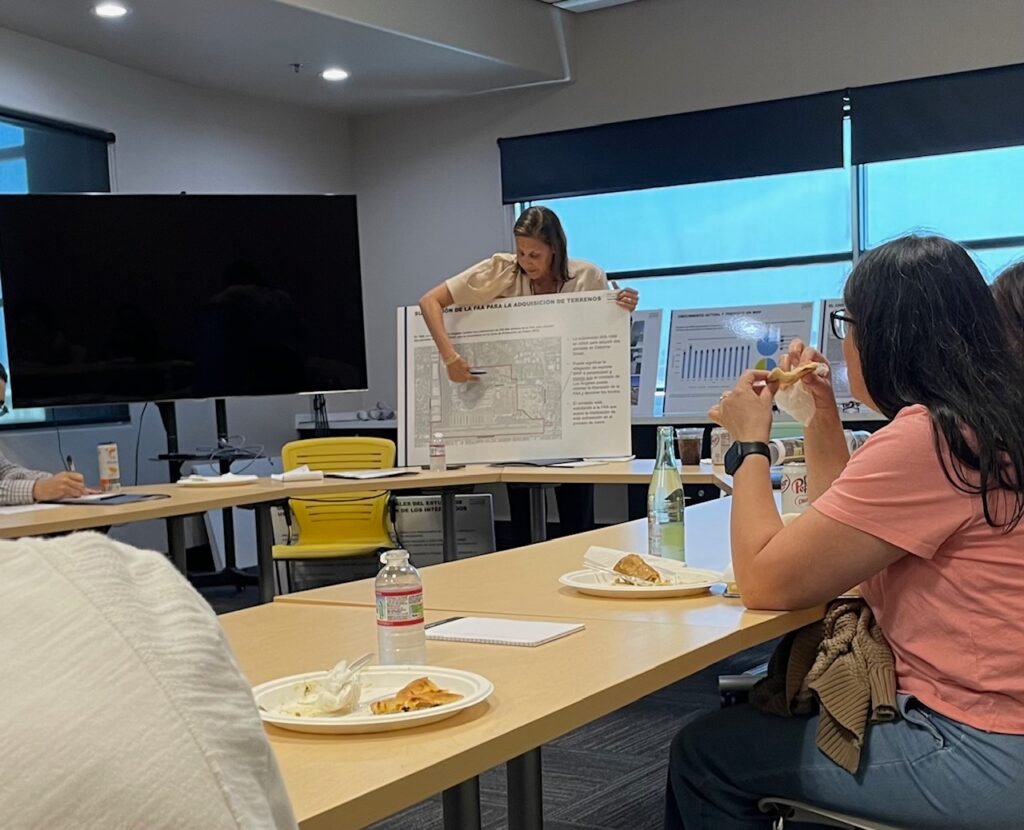
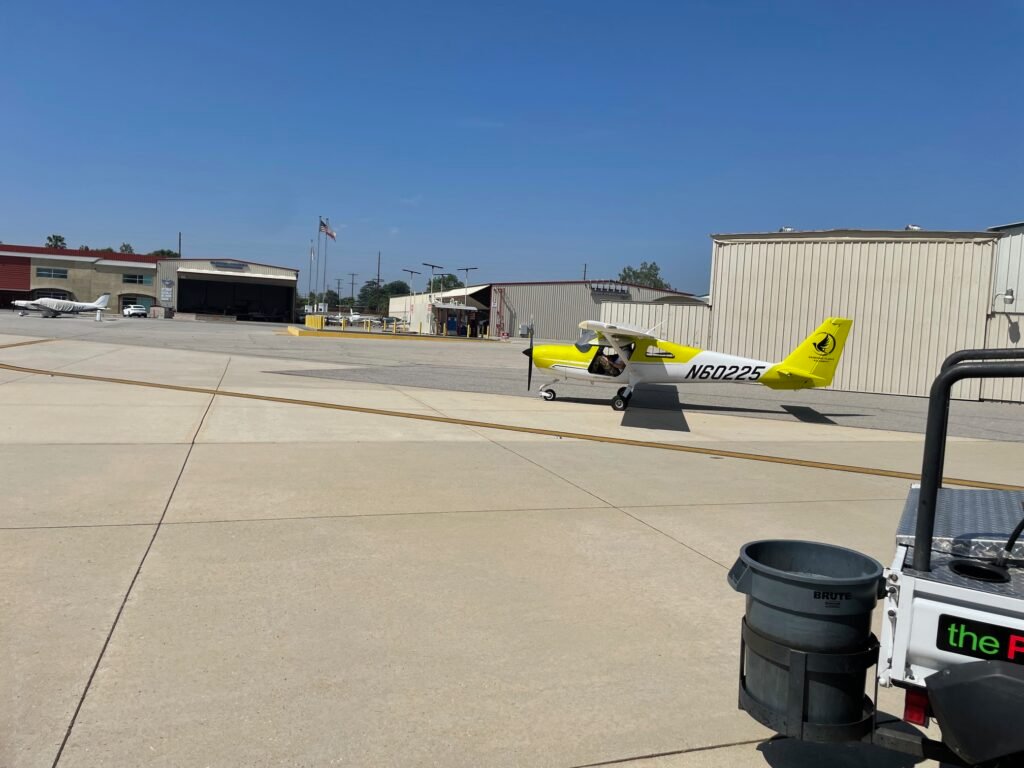
Monday’s gathering brought members of the NEST Coalition — a group of Pacoima- and San Fernando Valley-area nonprofits advocating for closure — to Prop Park BNY, a privately developed fixed-base operator facility at Van Nuys that houses small propeller aircraft, the same category that makes up the overwhelming majority of Whiteman’s current traffic.
Steve Argubright, co-owner of the Prop Park and managing partner of Pacific Aircraft Development — which has also developed and managed facilities at Whiteman — led the group through the facility, explaining hangar rental operations, aircraft storage logistics, and how private general aviation functions alongside a public runway. The visit was organized by Trifiletti to show closure advocates what a scaled-down, mixed-use airport operation might look like.
The tour was the latest step in a study process underway since April 2024, when LA County initiated the comprehensive land-use review following community health and safety concerns. Trifiletti’s team has conducted more than 50 stakeholder meetings to date, with scenario findings expected by May and a full report to the county by the end of June.
Even with Trifiletti’s cautious optimism about the FAA process, closure advocates are recalibrating expectations.
One NEST Coalition member who attended Monday’s tour told LACP that while the group still wants to see full closure pursued, the near-term target has shifted. “Partial closure is the preference,” the source said. “There will be a lot of pushback from FAA in terms of getting a full closure, but we still want to see a full effort put into what that would look like — and to see that presented to the community so they have a full picture of all scenarios.”
The NEST Coalition tour was coordinated by Pacoima Beautiful’s Veronica Padilla, whose organization has been among the leading advocates for closure, with political support from LA County Supervisor Lindsey Horvath, Councilmembers Monica Rodriguez and Imelda Padilla, and State Sen. Caroline Menjivar.
Trifiletti’s final report is expected by the end of June.
Editor’s Note: LACP sent three media inquiries to Angela Herrera-Perez, Senior Public Information Specialist at the LA County Department of Economic Opportunity, beginning March 19, seeking details about this meeting. After receiving no response, LACP notified her on the morning of March 23 that it would be attending. Herrera-Perez replied 11 minutes later asking “what meeting you are referring to.” Upon arrival, LACP was told the event was not open to media. LACP disputed that characterization and was admitted.
Editor’s Note: Trifiletti Consulting has clarified that her firm’s FAA negotiations referenced above involved compatible development at operating airports, not airport closures, and that all three study scenarios remain equally under consideration.










Comments 2
There’s a difference between reporting on a public issue and shaping a narrative. The recent coverage of Whiteman Airport is starting to blur that line.
Over the past several months, at least nine stories have been published about the airport’s potential closure. Across those pieces, one thing stands out: the voices being amplified are almost entirely those advocating for redevelopment or closure. Elected officials, advocacy groups, and proposals for housing, film campuses, and even a 5,000-seat soccer stadium are given center stage.
What’s missing are the people who actually use and depend on the airport today. Airport businesses. Pilots. Workers. Families. Nearby residents who rely on it for access, jobs, and public safety. Their absence isn’t a small oversight. It fundamentally skews the picture.
The Whiteman Airport Coalition was formed in response to narratives like this because the community deserves clear, accurate information about the airport and a full understanding of what’s actually at stake.
The most recent article raises an even more serious concern. It attributes statements to the County’s consultant, suggesting that FAA barriers to closure can be “cleared” through persistence. That framing is now being used to reinforce the idea that closure is simply a matter of political will.
But according to direct communication with the consultant, that is not what she said.
That matters.
Whiteman Airport is not just a piece of land to be reimagined. It is a federally obligated airport, bound by grant assurances and land-use requirements tied to federal funding. Those obligations are not optional, and they are not resolved through messaging or momentum. Any discussion of closure has to start with that legal reality, something reinforced again today in coverage from AOPA.
At the same time, redevelopment claims are being presented with little scrutiny. Projections of thousands of jobs and tens of millions in revenue are repeated, while the airport’s existing role, including hundreds of jobs, ongoing economic activity, and regional functions like emergency response, is treated as secondary or ignored altogether.
Even the way the community is described deserves a closer look. Pacoima is often framed through demographics and need, but without including the full range of voices within that community, especially those connected to the airport as it exists today.
This isn’t about being for or against change. It’s about accuracy, balance, and accountability.
When coverage consistently leans in one direction, repeats speculative claims, and mischaracterizes key expert input, it doesn’t just inform the public. It shapes outcomes.
Decisions about Whiteman Airport will have long-term consequences for jobs, public safety, and the surrounding community. Those decisions deserve reporting that reflects the full reality, not just one version of it.
The statements attributed to the consultant were recorded. The quotes are verbatim. LACP stands by its reporting.
— Stephen Witt, Editor-in-Chief