



By Stephen Witt
Editor’s Note: This is the first of a series of stories regarding Whiteman Airport.
Los Angeles County officials presented early findings of a comprehensive land-use study for Whiteman Airport in Pacoima yesterday, outlining potential scenarios ranging from full closure and redevelopment to continued airport operations with improvements—but not before facing pointed questions about how the process should be framed and whether the county was learning lessons from Santa Monica’s controversial airport closure.
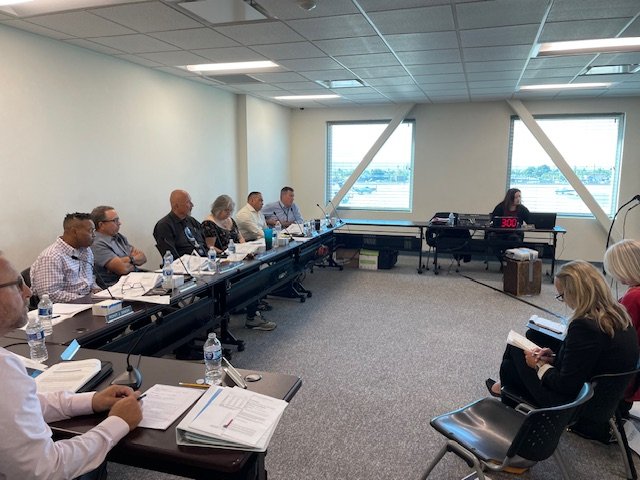
Lisa Trifiletti of Trifiletti Consulting delivered the preliminary presentation to the LA County Aviation Commission at Whiteman Airport. The presentation detailed the progress of a study initiated in April 2024 following community concerns about health and safety impacts from airport operations.
The presentation sparked immediate pushback from LA County Aviation Commissioner Christopher Thomas, who challenged what he perceived as an imbalance in how alternatives were being framed.
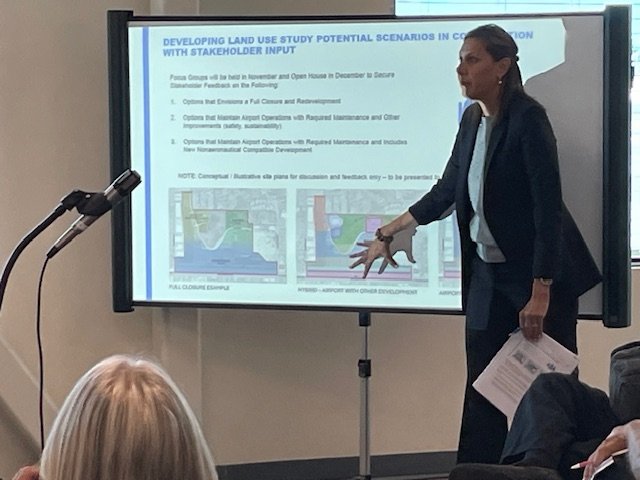
“I think it’s disingenuous if we don’t say it in those clear words, because most of what I heard is, this is about closure,” Thomas said during the meeting. “How are we going to close it? 90% of what you talked about is around closure. But I don’t think that’s what you’re really saying.”
Thomas said he was involved in Santa Monica’s airport closure process, and warned that the county risked repeating mistakes made in that controversial decision. He said this process left many residents wishing they understood the full economic impact and alternative options before voting to close the facility.
“Many people in Santa Monica actually don’t want the airport to be closed,” Thomas explained. “They would have preferred to have understood up front that it would cost $100 million to close it. There was hundreds of millions of dollars of economic impact per year, which was lost, which they didn’t know about. And we could have had a hybrid solution.”
Trifiletti acknowledged the concern and clarified that the study is intended as a framework for decision-making rather than a predetermined path toward closure.
“I did not ever intend to be disingenuous,” Trifiletti responded. “This is such a complexity… it is about framework analysis for people to make ultimate decisions.”
She explained that her initial stakeholder meetings—more than 50 to date—were designed to build relationships and provide consistent information to all parties. Moving forward, the team plans to conduct structured focus groups in November where participants will receive the same baseline information about existing conditions, forecasting, market demand analysis, lease terms, and the closure process, she said.
“We’re bringing people together so they’re not hearing it on a one-off basis. They’re actually hearing it together as a group,” Trifiletti said.
Thomas pressed the economic stakes of any decision, citing a 2020 study showing Whiteman contributes over $100 million annually in economic impact to the community. This figure was not substantiated at press time nor was it broken down in profit/loss.
“Over the next 10 years, how will you replace a billion dollars of value to our community?” he asked. “That’s number one.”
He also raised recent UCLA research on air quality following recent fires, noting that one 12-hour fire event produced pollutants “10 times the impact of this airport since its inception” in terms of lead, arsenic, selenium, and other contaminants.
“When you start to frame those two things to people, they say, ‘Oh, we want to close up—what was going to be replaced by low-income housing?’ How much in taxes does that generate?” Thomas said.
Thomas also emphasized the need to consider future aviation technologies that could transform the airport’s role, particularly electric vertical takeoff and landing (eVTOL) aircraft.
“The Chinese have what they call the low altitude economy,” he explained. “Many of the big cities with the first 3,000 feet of each of those major cities have already mapped out transportation routes for their drones, and then people do delivery.”
He noted that eVTOLs are already permitted in New York for routes between Manhattan and JFK starting next year, and similar operations are underway in Seattle with 50-80 mile routes.
“FAA says they’re imperceptible at 500 feet,” Thomas said. “To not include air mobility for you and me, in 20 or 30—or our kids—years’ time would be a disservice to the community here,” Thomas argued.
Trifiletti acknowledged the potential for a hybrid approach to keep the airport operational while freeing underutilized land for compatible development.
She suggested helicopter operations, eVTOL facilities, and aviation-related commercial development could coexist with the airport while generating additional economic value.
“You can keep an airport and make it a center for excellence,” Trifiletti said, describing this as “one thing we really want to explore and do a deep dive” during the upcoming community engagement process.
Other commissioners emphasized the importance of community input and the irreversible nature of any closure decision.
Commissioner Charles Nelson noted he lives a mile and a half from the airport and emphasized the need for facts over political rhetoric.
“We have a great opportunity for creativity and to make this something that it hadn’t been before… You’re not going to get [this resource] back. You’re not going to put another airport somewhere else,” said Nelson.
“There’s so much more that we can do than just look at this and do one tunnel vision saying that, close it and that’s it,” he added.
Commissioner Rohit Singh stressed the importance of presenting quantified data in standardized formats to avoid any perception that information is being manipulated to favor a particular outcome.
“When you put that number in front of the community, it’s a very different way of looking at a project versus just ‘we can do this, this or this,'” the commissioner said.
Trifiletti agreed that all scenarios would be fully quantified after the initial community engagement phase.
“This moment that we’re in is before we actually say, ‘this is what we quantify,'” she explained. “There’s this one interim step, framing everything in the same way, getting people to understand the scenario, answering questions, and then going into the quantification aspect.”
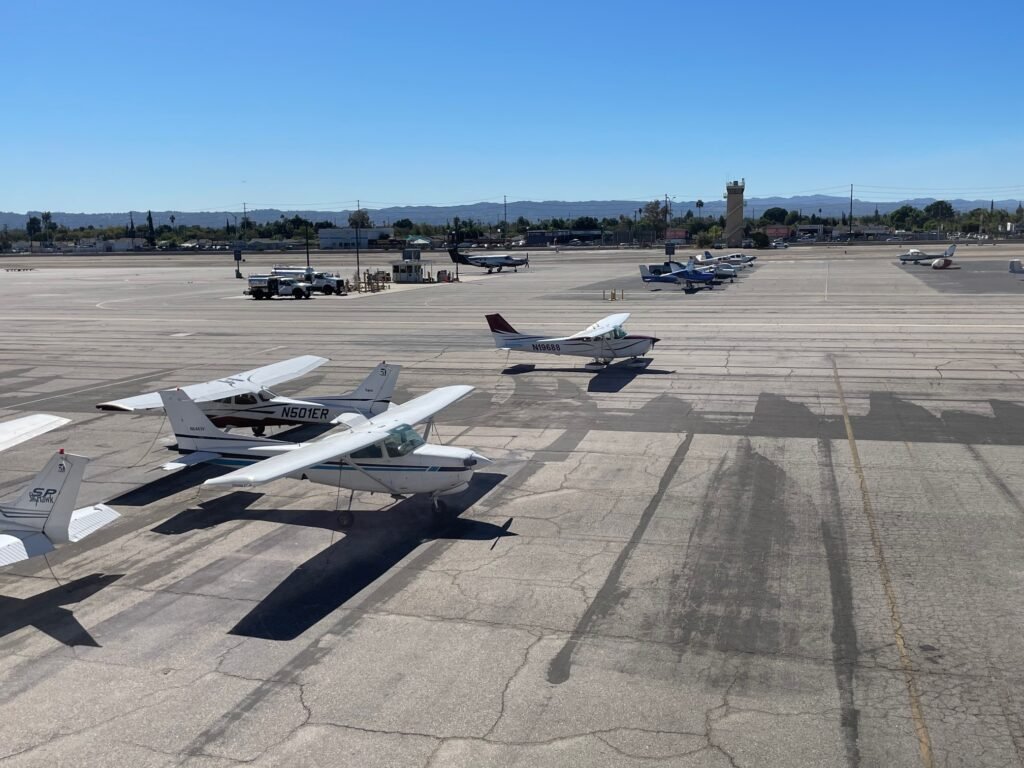
The 184-acre airport located in Pacoima has operated since 1946 and came under county ownership in 1970. It primarily serves private single-engine piston aircraft (85.9%), helicopters (11.8%), and multi-engine aircraft (2.2%). Emergency aircraft and media helicopters occupy and utilize a small portion of the site.
The commission’s discussion made clear that whatever path is chosen, it must be based on transparent, quantified analysis that gives the community full information about the long-term implications of each option—a lesson commissioners said was not adequately learned from Santa Monica’s experience.
“I want to make sure that all of these stakeholders have a say in an equal manner,” said Thomas. “And come up with the highest possible value regardless of what that happens to be.”
The next LA County Aviation Commission meeting is slated for 10 a.m., Dec. 3, at San Gabriel Valley Airport, 4233 Santa Anita Avenue in El Monte.










Comments 1
Whiteman Airport is an outstanding airport for general aviation and takes a substantial burden of general aviation workload from nearby Van Nuys Airport. Van Nuys Airport is extremely busy with commercial and general aviation. Whiteman Airport relieves Van Nuys Airport of general aviation traffic but Van Nuys Airport is still listed as the busiest airport in the United States due to the number of takeoffs and landings. This can only get worse if Whiteman Airport is dissolved. We have a national shortage of commercial, military and airline pilots slots that need to be filled by young people aspiring to become pilots ad infinitum. Whiteman airport substantially supports primary, general aviation pilot training which is a springboard for future airline, commercial and military pilots. Please consider Whiteman airport as being extremely essential to the community and the nation today and in the future.