



Hochman brings murder charges in brutal dementia patient’s death
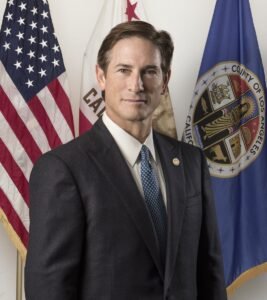
Los Angeles County District Attorney Nathan Hochman has charged a transient with murder in the killing of an 84-year-old man living with dementia who wandered from a convalescent home before being beaten and set on fire on a downtown Los Angeles street.
Lavonta Martel Wilder, 40, is charged with one count of murder with a special allegation of a prior serious felony in the April 19 death of Bang Cho.
According to prosecutors, Cho was seated on Sixth Street between Hope Street and Grand Avenue at approximately 11:55 p.m. when he stood up, briefly approached a passerby, then walked behind Wilder and grabbed one of the bags Wilder was carrying. Wilder is accused of viciously punching and kicking Cho in the head and body, lifting him over his shoulder and slamming him to the ground — before setting him on fire.
Cho was transported to a hospital, where he died the following day. Wilder was located nearby and taken into custody.
“This case involves an elderly man who was disoriented and living with dementia, conditions that made him particularly vulnerable,” Hochman said. “The level of violence alleged here is brutal, callous and extreme, and our prosecutors will pursue this case with the urgency it demands to ensure accountability and justice for the victim and his loved ones.”
Bail was set at $2,050,000. Wilder’s arraignment was continued to May 21 in Department 30 of the Foltz Criminal Justice Center.If convicted as charged, Wilder faces up to life in state prison.
The case is being prosecuted by Deputy District Attorney Elizabeth Karb of the Arson and Explosives Section.
Harabedian bill lets SGVCOG ditch the lowest-bidder rule

Assemblymember John Harabedian (D-Pasadena, Altadena, La Cañada Flintridge, Sierra Madre, Monrovia) announced Wednesday that AB 1786, his bill extending best-value construction contracting authority to the San Gabriel Valley Council of Governments (SGVCOG) and general law cities, has passed the Assembly Committee on Local Government and advances to Assembly Appropriations in May.
Under current law, the SGVCOG and general law cities are limited to lowest-bid contracting for large infrastructure projects — a restriction that prevents them from factoring in contractor experience, expertise, and speed when awarding contracts, risking delays and cost overruns.
AB 1786 would give these agencies the option — not the requirement — to use best-value contracting, weighing those factors alongside price, with the goal of delivering roads, housing, and infrastructure projects more efficiently and at lower long-term cost to taxpayers.
“Local governments and regional partners like SGVCOG are focused on getting projects built that people can actually see and use, whether that is safer roads, improved infrastructure, or housing,” Harabedian said. “This bill helps make that work more practical by giving them another option to deliver projects in a way that keeps costs down and moves timelines forward.”
SGVCOG President Ed Reece called the bill a needed reform for an increasingly complex public infrastructure landscape.
“Relying solely on the lowest bid increases the risk of delays and higher long-term costs,” Reece said. “This bill provides a smart and balanced approach by giving local governments the flexibility to prioritize experience, capability, and long-term value — ultimately leading to better outcomes for our communities and taxpayers,” said Reece.
Lieu bill takes aim at feds muscling in on protests

U.S. Rep. Ted Lieu (D-Torrance, Culver City, Santa Monica, Pacific Palisades, communities of the Westside and South Bay) introduced legislation Thursday with Rep. Maxine Dexter (D-OR) that would restrict the deployment of federal law enforcement agents to peaceful protests and limit the ability of federal agencies to expand their reach into local jurisdictions without state or local approval.
The Prevent the Misuse of Federal Law Enforcement Act responds directly to the Trump administration’s deployment of federal agents to protests in Los Angeles, Minneapolis, Chicago, and Portland — deployments that Lieu and other critics argued were made without coordination with local officials and escalated rather than de-escalated tensions.
“Nobody should be intimidated by law enforcement while exercising their right to peacefully protest,” Lieu said. “Local communities should have a say in how policing is carried out in their jurisdictions. We must ensure all Americans can safely exercise their right to protest without fear of those sworn to protect them.”
Specifically, the bill would prohibit the Department of Homeland Security from using officers or agents to police protests at federal properties unless requested by a state’s chief executive, bar the U.S. Marshals Service from deputizing local or state law enforcement without approval from the relevant jurisdiction, and prohibit Drug Enforcement Administration officers from enforcing non-drug-related laws.
The bill now awaits referral to committee.
Allen pushes two wildfire bills through with bipartisan backing

State Sen. Ben Allen (D-Pacific Palisades, Malibu, Santa Monica, and communities of the Westside and South Bay) celebrated the unanimous bipartisan passage of two wildfire resilience bills out of committee this week — one targeting individual home hardening and one establishing regional public-private partnerships to coordinate community-scale fire mitigation efforts.
“Too many lives are being lost, homes destroyed, and public resources wasted to more frequent and destructive fires,” Allen said. “The fire risk we face is driving an affordability crisis through rising insurance premiums and utility bills. It’s clear we need a more holistic approach to building community resilience.”
The first bill, SB 894, would create a low-interest loan program for homeowners and small businesses to finance home hardening and defensible space improvements — structural upgrades that research shows can reduce a structure’s fire risk by nearly 50 percent when combined, but which many residents cannot afford without financial assistance. The program is modeled after the GoGreen clean energy loan program.
The second bill, SB 1297, would establish Regional Wildfire Public Private Partnerships bringing together insurers, utilities, public agencies, and nonprofits to pool funding, data, and resources for community-scale mitigation efforts — addressing what Allen described as a costly and inefficient status quo in which siloed efforts miss the opportunity to target mitigation where it will do the most good.
Both bills now advance to the Senate Appropriations Committee.