


Updated with a statement from Supervisor Lindsey Horvath.
By Stephen Witt, Los Angeles County Politics
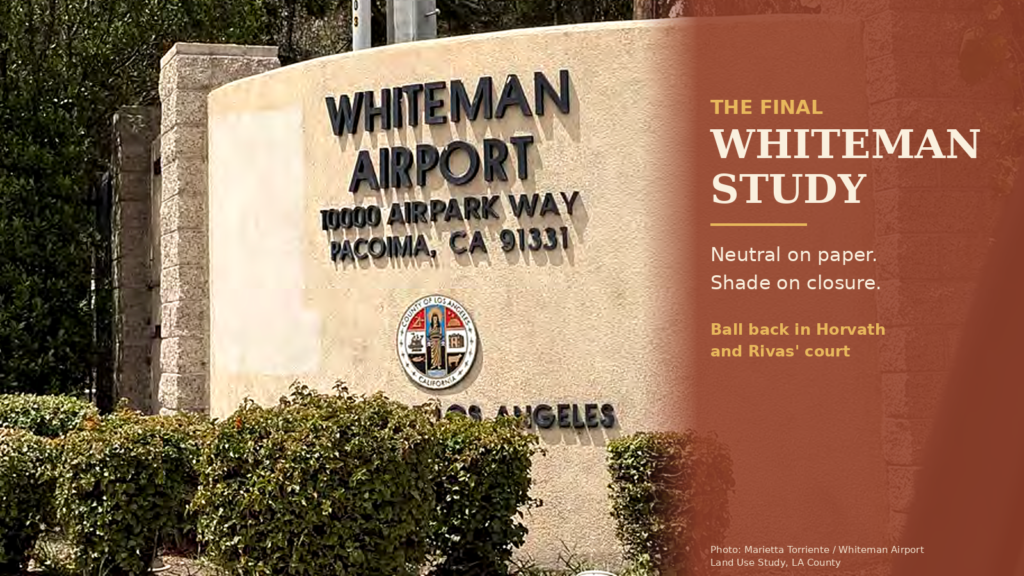
The final Whiteman Airport study released late yesterday claims to weigh three futures for the Pacoima airfield impartially, but it makes the money case for keeping the airport open, favors shrinking it and ringing it with new development, and throws shade on closing it.
Meanwhile, with the $2.1 million study complete, the ball is back in the court of Los Angeles County Supervisor Lindsey Horvath (D-Santa Monica, Beverly Hills, West Hollywood, Calabasas, Malibu, Pacoima, Panorama City), along with U.S. Rep. Luz Rivas (D-San Fernando, Pacoima, Arleta, Panorama City, Sylmar, Van Nuys). Rivas’s district includes the airport, and her role could prove pivotal because the report points to an act of Congress as the only proven way to close it around the Federal Aviation Administration (FAA).
Horvath, who authored the April 2024 motion that launched the study, urged residents in a statement yesterday to weigh in during the 90-day public comment period.
“The safety and well-being of Pacoima residents always come first. For years, families living near Whiteman Airport have raised concerns about safety, noise, and the impacts to their neighborhoods. Residents deserve to feel safe in their homes, schools, and community, and their voices are essential in shaping decisions that affect their daily lives,” said Horvath.
“This study is an important step forward in understanding the opportunities and challenges surrounding the future of Whiteman Airport. No decisions have been made, and the people who live, work, and raise their families in Pacoima are central to this process. Their experiences, concerns, and priorities will help inform what comes next,” she added.
For Pacoima residents who have pushed for closure since a plane crashed into their neighborhood in 2020, the numbers are grim. The closure scenario assumes federal approval no earlier than 2050, because of long-term leases the county cannot break and a multiyear federal review.
“In practice, the closure process takes many years, and the FAA rarely grants closure requests,” the report states.
Full redevelopment would not come until 2075 or later. The county would lose $16.2 million through 2050, or $116.2 million counting the site’s value after that, excluding $90 million in demolition and cleanup and a $3.46 billion buildout. The report also argues closure would largely shift flight risk to Burbank and Van Nuys airports rather than eliminate it.
The study also undercuts the county’s talking points on airport finances. Whiteman is the only one of the county’s five general aviation airports to run an operating surplus, and the executive summary credits it with propping up the rest.
“WHP’s performance effectively supports the rest of the County airport system,” the executive summary states.
Deeper in, the consultants walk that back, because the county runs all five airports through a single Aviation Enterprise Fund that does not assign shared costs and grants to individual airports.
“This Study treats WHP as the system’s primary positive contributor on an operating basis: it does not conclude that Whiteman Airport subsidizes the other four airports, and it does not conclude the reverse,” the report states.
The report tells the county to compile an airport-by-airport financial reconciliation so the Board of Supervisors can accurately assess Whiteman’s finances. When LACP requested Whiteman-specific financial data in May, the county’s Department of Economic Opportunity said the fund’s budgets are not broken out by airport.
Not all of the study’s lean is the consultants’ doing. Because the county bought airport land in 1999 with FAA grant money, the FAA confirmed in a Jan. 21, 2026, letter that the county must operate Whiteman indefinitely unless the agency releases it. The FAA has approved closures only for airports being replaced or with almost no traffic, and Whiteman, with 391 based aircraft, fits neither, the report says.
The exception is Rialto Municipal Airport in San Bernardino County, which Congress forced closed in 2005 legislation after the FAA refused to release it. It still took until 2014. The report lists Rivas’s office among those consulted.
Scenario 2, “Transform and Optimize,” comes out strongest financially. It would consolidate aviation along the runway and open four development sites for healthcare and workforce training, biotech, logistics, and retail and recreation, projecting a $24.3 million gain through 2050 and about 1,933 jobs within 10 years. Scenario 1, with modest upgrades, projects $14.3 million. Doing nothing would lose $27 million.
Both open-airport scenarios depend on about $95.1 million in FAA grants. The county paused new FAA grants in 2020 to avoid deepening its federal obligations, but the study reveals it quietly applied for an FAA pavement grant in May 2026.
Since 2015, the National Transportation Safety Board (NTSB) has investigated 12 accidents at or near Whiteman, killing four aircraft occupants, more deaths than at any of five comparable urban airports the study examined. The NTSB blamed every accident on pilot error, aircraft operation or mechanical failure, not the airfield.
About 1,635 residents live within the airport’s high-noise zone, and the FAA noise study that could fund soundproofing for eligible homes has not started.
Residents can review the study and submit comments during the 90-day comment period at opportunity.lacounty.gov/whp.
LACP contacted the offices of Horvath and Rivas and the Los Angeles County Department of Public Works early Friday for comment. This story will be updated, or a follow-up story will run, when we receive their responses.













Comments 1
Just a note. The estimated closure date, should the airport’s FAA perpetuity be voided by Congress, is indeed far into the future per the report. THAT is VERY GOOD NEWS for the present Pacoima Community! Gentrification, meaning increased property values, should the airport close, will be delayed. That means the inevitable rent increases and eviction notices will be stalled. That means the resident community as we know it today will not be forced out of their homes and have to move. That’s right, those people, in the minority, but with organized anti-airport loud voices, if they don’t own their homes, plus so many others in the community today, will most possibly be forced to move away from Pacoima should they not wish to pay increased rents. Ironic, isn’t it. – A message from the Southern California Aviation United Working Group (SCAUWG.ORG)