


By Los Angeles County Politics (LACP)
Los Angeles County is preparing for the biggest overhaul of its government in generations, and the Board of Supervisors takes up the blueprint today.
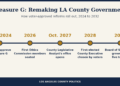
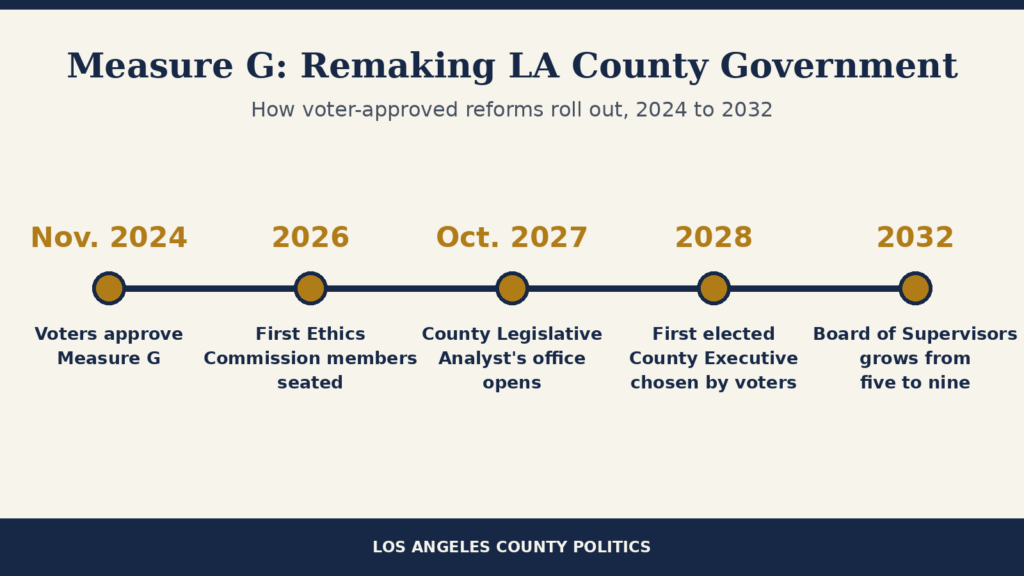
Voters approved Measure G in November 2024. It creates an elected County Executive, chosen by voters countywide starting in 2028, expands the Board of Supervisors from five members to nine in 2032, and creates the county’s first independent Ethics Commission, which began taking shape this month.
Today, the Board will consider two more pieces of the plan: how the new County Executive’s office will work, and new rules giving the public more time to see what the Board will vote on.
Both sets of recommendations come from the county’s Governance Reform Task Force, a 13-member panel set up under Measure G to guide the transition. The first item was originally scheduled for Oct. 6, but Los Angeles County Supervisor Holly J. Mitchell (D-Inglewood, Hawthorne, Gardena, Compton, Carson) asked to continue it for two weeks.
What is an elected County Executive?
Right now, a Chief Executive Officer runs the county’s day-to-day operations and is hired by, and answers to, the five supervisors. Under Measure G, voters will elect a County Executive instead, much like a mayor runs a city.
The County Executive would represent roughly 9.7 million residents, about 25 percent of the state’s population, more than the population of all but 10 states, and more than twice as many as the Los Angeles mayor. Aside from San Francisco, where the mayor also serves as the executive of a combined city and county, Los Angeles will be the only county in California with a directly elected executive.
The task force’s framework spells out what that person will do: lead the county’s departments, oversee and evaluate department heads, manage some budget decisions, represent the county with state and federal governments, and handle constituent services.
The Board would direct county staff to rewrite county rules to give the new executive those powers and to study how other functions, like constituent services and the county’s lobbying operation, would transfer to the new office.
One change is mostly symbolic but could matter to voters. For decades, the Board of Supervisors chair has also carried the title “Mayor of Los Angeles County.” With an elected County Executive coming, the task force recommends dropping that title to avoid confusion.
The county would also run a public education campaign before the first County Executive election, explaining how the job differs from the Board’s.
Two new offices to watch the money
The plan creates two new offices. A Director of Budget and Management would take over core budget and fiscal work now done by the Chief Executive Office. A County Legislative Analyst would serve as an independent, nonpartisan office giving the Board its own analysis of policy and spending, similar to the Legislative Analyst’s Office that advises state lawmakers in Sacramento.
The county would launch a national search for the first analyst, with the office up and running by Oct. 1, 2027.
More time to see what’s on the agenda
The second item may matter most to residents who follow county business. Measure G requires the Board to post its agenda at least 120 hours, or five days, before each meeting, longer than the 72 hours state law requires.
Under the task force’s plan, the main agenda would be published by 4 p.m. on the second Friday before each Tuesday meeting, 11 days out. A supplemental agenda would follow by 4 p.m. the Wednesday before the meeting, six days ahead. Items added after those deadlines would be limited to genuine emergencies allowed under the state’s open meetings law, and the county would adopt new standards to make agendas clearer and easier to read.
Today’s own agenda shows the difference. The main agenda was posted Oct. 14, six days before the meeting, and the supplemental agenda on Oct. 16, just four days before.
The Board meets at 9:30 a.m. at the Kenneth Hahn Hall of Administration, 500 W. Temple St. Agendas and public comment information are available at bos.lacounty.gov.