

Sun Valley recycler steels itself against new shredder law

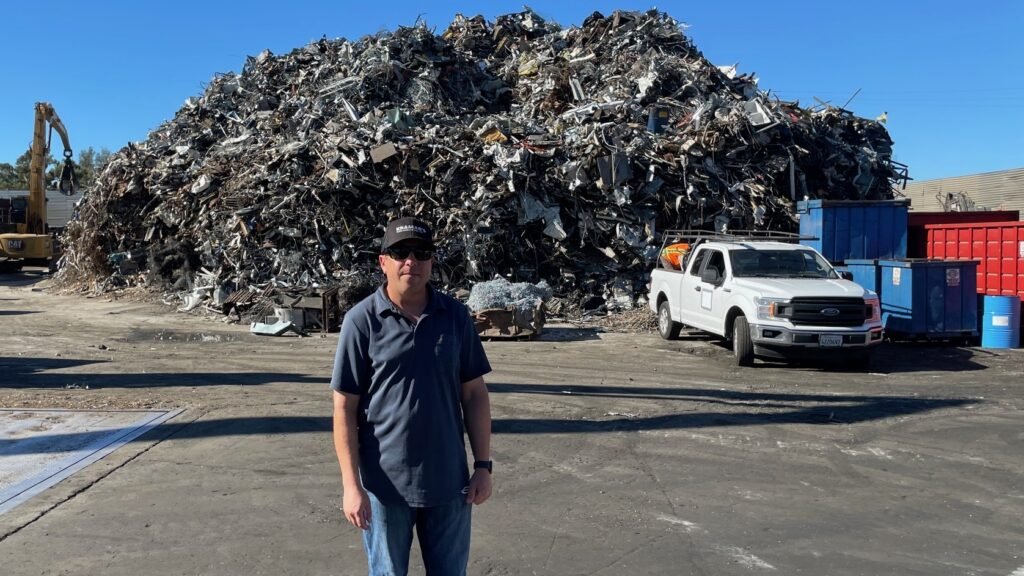
Mitch Kramar at his family's scrap yard, Kramar's Iron and Metal, in Sun Valley, where scrap metal is sorted, processed and shipped to steel mills. Photo by Stephen Witt/LACP

By Stephen Witt, Los Angeles County Politics

For more than 70 years, the Kramar family has bought old sinks, bicycles, window frames, and factory scraps at its Sun Valley yard, cut the metal down, and shipped it to steel mills worldwide. Now Mitch Kramar says a new state law could put the family out of business.

Gov. Gavin Newsom signed Senate Bill 811 in late September. The law, written by State Sen. Anna Caballero (D-Merced County), creates a new state permit system with yearly fees for every California business that runs a metal shredder.

The fight centers on what happens to the leftovers after metal gets shredded. The biggest recyclers feed whole cars into giant shredders and pull out the steel. What remains is a hazardous mix of ground-up plastic, foam, rubber and glass that the industry calls “fluff.”

For decades, the big shredders have mixed chemicals into the fluff so they can dump it in ordinary landfills. Kramar’s company never uses that process, but the new law regulates it as if it did.

“Shredders like mine have to comply with the same rules and permits as these auto shredders even though we don’t shred cars or chemically treat anything,” said Kramar.

When Kramar’s shredding leaves behind hazardous material, the company ships it to licensed hazardous-waste sites and pays full price, as state law already requires. Under SB 811, it must still get the same permits as the car shredders. The California Department of Toxic Substances Control (DTSC), the state agency that polices hazardous waste and will run the new program, has not yet said how much the permits will cost.

“It’s just people passing rules and regulations that don’t know anything about our industry,” said Kramar.

Kramar said the public misunderstands what yards like his do.

“People fail to realize how important the metal recycling industry is in helping the environment, keeping metals out of landfills and off streets, and helping to cut down on greenhouse gases from mining virgin materials,” said Kramar.

“If we weren’t here, this stuff would go to a landfill,” said Kramar.

According to trade publication Argus Media, the state’s largest shredders backed the bill. They are SA Recycling, Sims Metal, Radius Recycling and American Iron & Metal. Kramar points out that most of them are foreign-owned. Sims is Australian and a part-owner of SA Recycling. American Iron & Metal is Canadian. Japan’s Toyota Tsusho bought Radius last year for about $1.3 billion, according to the Mercury News.

The small yards were not the only ones fighting the bill. Environmental groups also opposed it, but for the opposite reason. They argue it lets big car shredders slip under California’s hazardous waste laws and largely police themselves.

“We are disappointed in this blatant giveaway to industry,” said Thien Chau, a senior attorney at Earthjustice, in an Oct. 1 statement.

The argument goes back decades. A 1988 state policy has kept shredder waste from being formally labeled hazardous, according to the Mercury News, and state regulators have tried to close that loophole since at least 2000. The shredding industry has fought them in court.

Newsom vetoed a nearly identical bill, SB 404, last year. In his veto message, he said it did not clearly spell out which hazardous waste rules applied to the facilities. This year the Legislature sent him SB 811, and he signed it. The measure, which Kramar says did not meaningfully change from the first, takes effect Jan. 1.

Kramar’s grandfather started the yard at 8821 San Fernando Road in the early 1950s, buying used farm equipment. Today Kramar runs the company with his father, his uncle and his cousin. The business employs more than 40 people, runs about 15 trucks and operates two yards, one of them home to its shredder.

Its customers range from factories and trash haulers to the pickup-truck collectors who make a living gathering scrap off the street. Steel sells for roughly $140 to $220 a ton. Most of it leaves through the Port of Long Beach for mills in Vietnam, Taiwan, Malaysia, Turkey and India.

The yard’s roots in the neighborhood run deep, including with LA City Councilmember Imelda Padilla (D-Van Nuys, Arleta, Lake Balboa, Panorama City, Sun Valley).

“Imelda Padilla knows us. She’s been here multiple times. She actually lives down the street, and she told us that when she was a kid, her dad would bring us scrap metal,” said Kramar.

Leave a Reply

Your email address will not be published. Required fields are marked *

This site uses Akismet to reduce spam. Learn how your comment data is processed.

  • Latest
  • Comments
  • Trending

By Stephen Witt, Los Angeles County Politics

For more than 70 years, the Kramar family has bought old sinks, bicycles, window frames, and factory scraps at its Sun Valley yard, cut the metal down, and shipped it to steel mills worldwide. Now Mitch Kramar says a new state law could put the family out of business.

Gov. Gavin Newsom signed Senate Bill 811 in late September. The law, written by State Sen. Anna Caballero (D-Merced County), creates a new state permit system with yearly fees for every California business that runs a metal shredder.

The fight centers on what happens to the leftovers after metal gets shredded. The biggest recyclers feed whole cars into giant shredders and pull out the steel. What remains is a hazardous mix of ground-up plastic, foam, rubber and glass that the industry calls “fluff.”

For decades, the big shredders have mixed chemicals into the fluff so they can dump it in ordinary landfills. Kramar’s company never uses that process, but the new law regulates it as if it did.

“Shredders like mine have to comply with the same rules and permits as these auto shredders even though we don’t shred cars or chemically treat anything,” said Kramar.

When Kramar’s shredding leaves behind hazardous material, the company ships it to licensed hazardous-waste sites and pays full price, as state law already requires. Under SB 811, it must still get the same permits as the car shredders. The California Department of Toxic Substances Control (DTSC), the state agency that polices hazardous waste and will run the new program, has not yet said how much the permits will cost.

“It’s just people passing rules and regulations that don’t know anything about our industry,” said Kramar.

Kramar said the public misunderstands what yards like his do.

“People fail to realize how important the metal recycling industry is in helping the environment, keeping metals out of landfills and off streets, and helping to cut down on greenhouse gases from mining virgin materials,” said Kramar.

“If we weren’t here, this stuff would go to a landfill,” said Kramar.

According to trade publication Argus Media, the state’s largest shredders backed the bill. They are SA Recycling, Sims Metal, Radius Recycling and American Iron & Metal. Kramar points out that most of them are foreign-owned. Sims is Australian and a part-owner of SA Recycling. American Iron & Metal is Canadian. Japan’s Toyota Tsusho bought Radius last year for about $1.3 billion, according to the Mercury News.

The small yards were not the only ones fighting the bill. Environmental groups also opposed it, but for the opposite reason. They argue it lets big car shredders slip under California’s hazardous waste laws and largely police themselves.

“We are disappointed in this blatant giveaway to industry,” said Thien Chau, a senior attorney at Earthjustice, in an Oct. 1 statement.

The argument goes back decades. A 1988 state policy has kept shredder waste from being formally labeled hazardous, according to the Mercury News, and state regulators have tried to close that loophole since at least 2000. The shredding industry has fought them in court.

Newsom vetoed a nearly identical bill, SB 404, last year. In his veto message, he said it did not clearly spell out which hazardous waste rules applied to the facilities. This year the Legislature sent him SB 811, and he signed it. The measure, which Kramar says did not meaningfully change from the first, takes effect Jan. 1.

Kramar’s grandfather started the yard at 8821 San Fernando Road in the early 1950s, buying used farm equipment. Today Kramar runs the company with his father, his uncle and his cousin. The business employs more than 40 people, runs about 15 trucks and operates two yards, one of them home to its shredder.

Its customers range from factories and trash haulers to the pickup-truck collectors who make a living gathering scrap off the street. Steel sells for roughly $140 to $220 a ton. Most of it leaves through the Port of Long Beach for mills in Vietnam, Taiwan, Malaysia, Turkey and India.

The yard’s roots in the neighborhood run deep, including with LA City Councilmember Imelda Padilla (D-Van Nuys, Arleta, Lake Balboa, Panorama City, Sun Valley).

“Imelda Padilla knows us. She’s been here multiple times. She actually lives down the street, and she told us that when she was a kid, her dad would bring us scrap metal,” said Kramar.