


Harabedian’s fire relief bills signed — González honors lowriders — Enterprise turns 50 — Sánchez advances Alzheimer’s bill — Lieu presses on AI nukes

Harabedian’s wildfire relief bills signed into law

Assemblymember John Harabedian

Assemblymember John Harabedian (D-Pasadena, La Cañada Flintridge, Monrovia, Sierra Madre, Claremont) announced this week that Gov. Gavin Newsom has signed three of his bills into law, providing new protections for survivors of the Eaton and Palisades fires nearly 20 months after the disasters struck.

The first, AB 1642, establishes California’s first statewide scientific standard for testing and addressing contamination from lead, asbestos and other toxins left behind in homes that survived the fires, and sets guidelines for when a residential property or school can safely be reoccupied.

“Going forward, the question of whether a family can safely return home should be answered by science, not by an insurance company’s guesswork,” said Harabedian. “Families should not have to fight for the testing they need or be left trying to figure out on their own whether their homes are safe.”

The second law, AB 1842, creates the nation’s first statewide mortgage forbearance program for homeowners whose residences are rendered uninhabitable by a major disaster, allowing homeowners to pause mortgage payments temporarily without late fees, penalties or foreclosure risk, while protecting their credit reporting.

“Twenty months since the Eaton Fire tore through my community, too many of my neighbors are still asking basic questions: is it safe to return home, and can I afford to rebuild?” said Harabedian. “I’m honored to have authored first-in-the-nation legislation to help answer those questions by giving wildfire survivors scientific certainty in remediating smoke damage and providing essential mortgage relief.”

González’s lowrider license plate bill signed into law

Assemblymember Mark Gonzalez

Assemblymember Mark González (D-Boyle Heights, Downtown Los Angeles, Koreatown, Pico-Union, Chinatown, Vernon, Montebello, Commerce) announced this week that Gov. Gavin Newsom has signed his bill creating a specialty license plate honoring lowrider culture.

Lowriding centers on cars customized to ride low on hydraulic suspensions, often hand-painted and detailed to the smallest interior touches, built to be admired rather than driven fast. The craftsmanship behind them — welding, airbrushing, engraving, upholstery — has been passed down through generations in driveways and backyards since the 1940s, making the cars themselves a form of family and community history as much as vehicles.

“Lowriding is more than a car, it is cultura, it is art, it’s family, and it is a powerful expression of Chicano and Latino pride,” said González. “For generations, our communities have used lowriders to tell our stories, celebrate our heritage, and create something beautiful out of the streets we call home. Yet too often, lowriders were treated as a problem to be policed instead of a culture to be celebrated.”

AB 2541 establishes the Lowrider License Plate Program, directing the Department of Motor Vehicles to work with the California Arts Council to design and issue a specialty “Lowrider” plate once the DMV receives at least 7,500 paid applications, with a deadline of Jan. 1, 2032.

Revenue generated will flow into a newly created Lowrider Arts and Culture Fund, which the California Arts Council will use to fund cultural preservation and youth programming tied to lowrider heritage.

Whitesides, Chu resolution marks 50 years since Space Shuttle Enterprise rollout

U.S. Rep. George Whitesides
U.S. Rep. Judy Chu

U.S. Reps. George Whitesides (D-Santa Clarita, Palmdale, Lancaster, portions of San Fernando Valley) and Judy Chu (D-Pasadena, Monterey Park, San Gabriel, Alhambra, west San Gabriel Valley) this week introduced bipartisan legislation commemorating the 50th anniversary of the Space Shuttle Enterprise’s rollout from the Rockwell International plant in Palmdale on Sept. 17, 1976.

The resolution honors the Antelope Valley engineers, technicians and workers who designed, built and tested Enterprise, the first orbiter constructed for NASA’s space shuttle program. Enterprise conducted five free-flight tests above Edwards Air Force Base that proved the shuttle’s handling and landing characteristics were safe, paving the way for a program that flew 135 missions over three decades.

The orbiter itself never flew in space and is now on permanent display at the Intrepid Museum in New York City.

“The Antelope Valley has long been on the cutting edge of our country’s aerospace industry, and Enterprise’s rollout in Palmdale fifty years ago was a key moment in that history,” said Whitesides. “The know-how and spirit of the men and women who made Enterprise possible continues to inspire us today and is still central to the Antelope Valley’s culture and manufacturing prowess.”

“As Co-Chair of the Congressional Planetary Science Caucus and the representative of NASA’s Jet Propulsion Laboratory (JPL) in Southern California, I know that investing in space exploration is critical to the United States, from our national security, to our economy, to our leadership in scientific discovery and technological innovation,” said Chu. “Our nation’s legacy of success in space is all thanks to decades of strong funding for NASA, as well as the hard work of countless scientists and space experts.”

Sánchez’s Alzheimer’s detection bill advances out of committee

U.S. Rep. Linda Sanchez

U.S. Rep. Linda Sánchez (D-Whittier, Norwalk, Pico Rivera, Santa Fe Springs, La Mirada, Montebello, Hacienda Heights, Rowland Heights, Diamond Bar, Walnut) saw her bipartisan Alzheimer’s early-detection bill pass unanimously out of the House Ways and Means Committee this week.

The measure directs the Centers for Medicare & Medicaid Services to identify cognitive impairment detection tools to help clinicians detect, refer and diagnose Alzheimer’s disease and related dementias at their earliest stages, when intervention can be most effective. The bill has also been folded into the broader, bipartisan Alzheimer’s Screening and Prevention Act.

“This is deeply personal for me. I lost both of my parents to Alzheimer’s, and I know firsthand how much earlier detection could have meant for our family,” said Sánchez. “Advancing this bill out of committee brings us one step closer to giving other families that chance. I’m grateful to my Ways and Means colleagues for passing our bipartisan bill and will keep fighting to get it signed into law.”

An estimated 13.8 million Americans age 65 and older are projected to develop Alzheimer’s by 2060, according to the bill’s backers, who note the disease is already the fifth-leading cause of death in America. Black Americans are twice as likely and Latinos are 1.5 times as likely to develop the disease compared to the general population.

Lieu urges Trump to press Xi on AI and nuclear launch controls

U.S. Rep. Ted W. Lieu

U.S. Rep. Ted Lieu (D-Westside Los Angeles and South Bay, including Beverly Hills, Santa Monica, Culver City, Manhattan Beach, Redondo Beach, Torrance, Rancho Palos Verdes) and Sen. Ed Markey (D-Mass.) sent a letter to President Trump this week urging him to press Chinese President Xi Jinping to commit to keeping humans, not artificial intelligence, in control of nuclear weapons launch decisions.

The letter comes ahead of a planned meeting between Trump and Xi next week. Lieu and Markey authored a provision in the 2025 National Defense Authorization Act establishing it as U.S. policy that AI must not compromise the integrity of nuclear safeguards, and that a human must remain “in the loop” for every nuclear launch decision.

“As you prepare to meet with General Secretary Xi Jinping next week, we respectfully ask you to raise the issue of artificial intelligence (AI) and its use in nuclear weapons launch systems,” Lieu and Markey wrote. “The United States already requires that the use of AI should not compromise the integrity of nuclear safeguards or compromise the principle of maintaining a ‘human-in-the-loop’ in the employment of nuclear weapons. We urge you to get General Secretary Xi to commit the People’s Republic of China (PRC) to the same principle that the United States already follows.”

“AI should never launch a nuclear weapon by itself,” they added. “Since the United States follows this basic principle, so should the PRC. Your direct engagement on this matter is critical to ensuring AI doesn’t accidentally or intentionally cause a preventable nuclear disaster.”

Leave a Reply

Your email address will not be published. Required fields are marked *

This site uses Akismet to reduce spam. Learn how your comment data is processed.

  • Latest
  • Comments
  • Trending

Harabedian’s wildfire relief bills signed into law

Assemblymember John Harabedian

Assemblymember John Harabedian (D-Pasadena, La Cañada Flintridge, Monrovia, Sierra Madre, Claremont) announced this week that Gov. Gavin Newsom has signed three of his bills into law, providing new protections for survivors of the Eaton and Palisades fires nearly 20 months after the disasters struck.

The first, AB 1642, establishes California’s first statewide scientific standard for testing and addressing contamination from lead, asbestos and other toxins left behind in homes that survived the fires, and sets guidelines for when a residential property or school can safely be reoccupied.

“Going forward, the question of whether a family can safely return home should be answered by science, not by an insurance company’s guesswork,” said Harabedian. “Families should not have to fight for the testing they need or be left trying to figure out on their own whether their homes are safe.”

The second law, AB 1842, creates the nation’s first statewide mortgage forbearance program for homeowners whose residences are rendered uninhabitable by a major disaster, allowing homeowners to pause mortgage payments temporarily without late fees, penalties or foreclosure risk, while protecting their credit reporting.

“Twenty months since the Eaton Fire tore through my community, too many of my neighbors are still asking basic questions: is it safe to return home, and can I afford to rebuild?” said Harabedian. “I’m honored to have authored first-in-the-nation legislation to help answer those questions by giving wildfire survivors scientific certainty in remediating smoke damage and providing essential mortgage relief.”

González’s lowrider license plate bill signed into law

Assemblymember Mark Gonzalez

Assemblymember Mark González (D-Boyle Heights, Downtown Los Angeles, Koreatown, Pico-Union, Chinatown, Vernon, Montebello, Commerce) announced this week that Gov. Gavin Newsom has signed his bill creating a specialty license plate honoring lowrider culture.

Lowriding centers on cars customized to ride low on hydraulic suspensions, often hand-painted and detailed to the smallest interior touches, built to be admired rather than driven fast. The craftsmanship behind them — welding, airbrushing, engraving, upholstery — has been passed down through generations in driveways and backyards since the 1940s, making the cars themselves a form of family and community history as much as vehicles.

“Lowriding is more than a car, it is cultura, it is art, it’s family, and it is a powerful expression of Chicano and Latino pride,” said González. “For generations, our communities have used lowriders to tell our stories, celebrate our heritage, and create something beautiful out of the streets we call home. Yet too often, lowriders were treated as a problem to be policed instead of a culture to be celebrated.”

AB 2541 establishes the Lowrider License Plate Program, directing the Department of Motor Vehicles to work with the California Arts Council to design and issue a specialty “Lowrider” plate once the DMV receives at least 7,500 paid applications, with a deadline of Jan. 1, 2032.

Revenue generated will flow into a newly created Lowrider Arts and Culture Fund, which the California Arts Council will use to fund cultural preservation and youth programming tied to lowrider heritage.

Whitesides, Chu resolution marks 50 years since Space Shuttle Enterprise rollout

U.S. Rep. George Whitesides
U.S. Rep. Judy Chu

U.S. Reps. George Whitesides (D-Santa Clarita, Palmdale, Lancaster, portions of San Fernando Valley) and Judy Chu (D-Pasadena, Monterey Park, San Gabriel, Alhambra, west San Gabriel Valley) this week introduced bipartisan legislation commemorating the 50th anniversary of the Space Shuttle Enterprise’s rollout from the Rockwell International plant in Palmdale on Sept. 17, 1976.

The resolution honors the Antelope Valley engineers, technicians and workers who designed, built and tested Enterprise, the first orbiter constructed for NASA’s space shuttle program. Enterprise conducted five free-flight tests above Edwards Air Force Base that proved the shuttle’s handling and landing characteristics were safe, paving the way for a program that flew 135 missions over three decades.

The orbiter itself never flew in space and is now on permanent display at the Intrepid Museum in New York City.

“The Antelope Valley has long been on the cutting edge of our country’s aerospace industry, and Enterprise’s rollout in Palmdale fifty years ago was a key moment in that history,” said Whitesides. “The know-how and spirit of the men and women who made Enterprise possible continues to inspire us today and is still central to the Antelope Valley’s culture and manufacturing prowess.”

“As Co-Chair of the Congressional Planetary Science Caucus and the representative of NASA’s Jet Propulsion Laboratory (JPL) in Southern California, I know that investing in space exploration is critical to the United States, from our national security, to our economy, to our leadership in scientific discovery and technological innovation,” said Chu. “Our nation’s legacy of success in space is all thanks to decades of strong funding for NASA, as well as the hard work of countless scientists and space experts.”

Sánchez’s Alzheimer’s detection bill advances out of committee
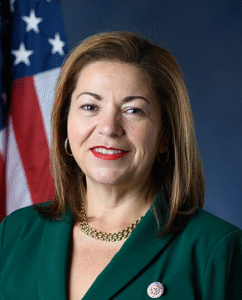
U.S. Rep. Linda Sanchez

U.S. Rep. Linda Sánchez (D-Whittier, Norwalk, Pico Rivera, Santa Fe Springs, La Mirada, Montebello, Hacienda Heights, Rowland Heights, Diamond Bar, Walnut) saw her bipartisan Alzheimer’s early-detection bill pass unanimously out of the House Ways and Means Committee this week.

The measure directs the Centers for Medicare & Medicaid Services to identify cognitive impairment detection tools to help clinicians detect, refer and diagnose Alzheimer’s disease and related dementias at their earliest stages, when intervention can be most effective. The bill has also been folded into the broader, bipartisan Alzheimer’s Screening and Prevention Act.

“This is deeply personal for me. I lost both of my parents to Alzheimer’s, and I know firsthand how much earlier detection could have meant for our family,” said Sánchez. “Advancing this bill out of committee brings us one step closer to giving other families that chance. I’m grateful to my Ways and Means colleagues for passing our bipartisan bill and will keep fighting to get it signed into law.”

An estimated 13.8 million Americans age 65 and older are projected to develop Alzheimer’s by 2060, according to the bill’s backers, who note the disease is already the fifth-leading cause of death in America. Black Americans are twice as likely and Latinos are 1.5 times as likely to develop the disease compared to the general population.

Lieu urges Trump to press Xi on AI and nuclear launch controls

U.S. Rep. Ted W. Lieu

U.S. Rep. Ted Lieu (D-Westside Los Angeles and South Bay, including Beverly Hills, Santa Monica, Culver City, Manhattan Beach, Redondo Beach, Torrance, Rancho Palos Verdes) and Sen. Ed Markey (D-Mass.) sent a letter to President Trump this week urging him to press Chinese President Xi Jinping to commit to keeping humans, not artificial intelligence, in control of nuclear weapons launch decisions.

The letter comes ahead of a planned meeting between Trump and Xi next week. Lieu and Markey authored a provision in the 2025 National Defense Authorization Act establishing it as U.S. policy that AI must not compromise the integrity of nuclear safeguards, and that a human must remain “in the loop” for every nuclear launch decision.

“As you prepare to meet with General Secretary Xi Jinping next week, we respectfully ask you to raise the issue of artificial intelligence (AI) and its use in nuclear weapons launch systems,” Lieu and Markey wrote. “The United States already requires that the use of AI should not compromise the integrity of nuclear safeguards or compromise the principle of maintaining a ‘human-in-the-loop’ in the employment of nuclear weapons. We urge you to get General Secretary Xi to commit the People’s Republic of China (PRC) to the same principle that the United States already follows.”

“AI should never launch a nuclear weapon by itself,” they added. “Since the United States follows this basic principle, so should the PRC. Your direct engagement on this matter is critical to ensuring AI doesn’t accidentally or intentionally cause a preventable nuclear disaster.”