


By Stephen Witt, Los Angeles County Politics (LACP)
Talk about politics over people.
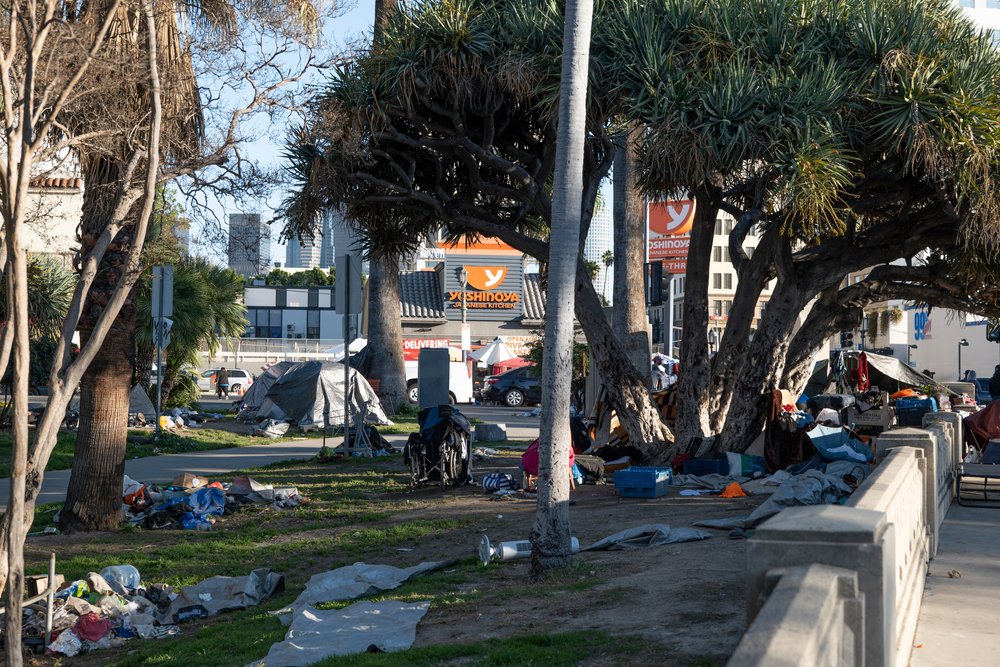
Despite the latest county data showing drug and alcohol overdose still accounts for 40% of all homeless deaths, the Los Angeles Homeless Services Authority has opted to blow off questions about a new White House initiative to tackle homelessness with a tough-love “Treatment First” policy.
The debate centers on a 37-page “Treatment First” Best Practices Toolkit the Trump administration released Aug. 12, jointly issued by the Office of National Drug Control Policy, the U.S. Department of Health and Human Services and the U.S. Department of Housing and Urban Development (HUD).
The toolkit argues that housing without treatment requirements attached only masks underlying addiction, mental illness, or trauma. It highlights the county’s successful Homeless Outreach Services Team (HOST) program, in which LA County Supervisor Kathryn Barger used discretionary funds to reduce homelessness in the Antelope Valley, as a model worth replicating nationally.


LACP emailed LAHSA’s media relations contact, Chris Yee, on Aug. 26, asking whether agency leadership, including Interim CEO Gita O’Neill, had reviewed the toolkit and how LAHSA would respond to its central argument.
The email also asked whether LAHSA sees any connection between its recent federal court win against HUD and the same administration’s broader push away from Housing First, whether the agency is considering any changes to its model, and whether LAHSA Commission Chair Stephanie Graves’s public transparency pledge extends to answering direct policy questions from the press.
LACP set a deadline of end of day Friday, Aug. 28, and asked Yee to confirm receipt of the email. That deadline passed with no response. After a follow-up email, Yee replied. “I’m sorry I didn’t respond the first time. I’m trying to see what I can get for you,” said Yee.
As of this post, LAHSA has provided no answers to any of the five questions. A follow-up sent yesterday to Yee returned an automatic reply stating Yee was out of the office and directing media inquiries to LAHSA Chief of Staff Paul Rubenstein.
The silence stands in contrast to Graves’s own words following the agency’s Aug. 13 court victory over HUD, when U.S. District Judge David O. Carter found HUD’s attempted suspension of LAHSA funding “arbitrary, capricious, an abuse of discretion, or otherwise not in accordance with law.”
“As I begin my term as Chair, I want to be direct with Angelenos: the court has called for transparency and accountability, and we intend to deliver both. Every dollar will be tracked, accounted for, and put to work housing our neighbors. Los Angeles will make the most of this moment, and of every dollar entrusted to us,” said Graves, chair of the LAHSA Commission.
Los Angeles County Supervisor Kathryn Barger told LACP last week that the HUD funding fight and the Treatment First debate are separate matters.
“The HUD and the issue regarding losses is an entirely different issue. That has to do with accountability. That has to do with monitoring. It has to do with accounting for the dollars that are being funded,” said Barger.
LAHSA’s non-response mirrors the county’s newer Department of Homeless Services and Housing (HSH), which took nine days to respond to a similar LACP inquiry about the same toolkit, and only did so after LACP had already published a story on the agency’s silence.