

Voices from Leimert Park: South LA Residents Reflect on MLK’s Legacy

Photo: Los Angeles County Politics (LACP)

By Los Angeles County Politics (LACP)

At Leimert Park in South Los Angeles on Monday, as thousands gathered for the City of Los Angeles annual Martin Luther King Jr. Day parade, a tapestry of personal memories and present-day concerns wove together the civil rights leader’s enduring legacy with contemporary struggles.

Martin Luther King Jr., born in Atlanta in 1929, became the most visible leader of the American civil rights movement from the mid-1950s until his assassination on April 4, 1968, in Memphis, Tennessee. A Baptist minister and activist, King advocated for racial equality through nonviolent resistance, delivering his iconic “I Have a Dream” speech during the 1963 March on Washington. His assassination sparked riots across American cities and deepened a national wound that many say has never fully healed.

The campaign to establish a federal holiday in King’s honor began shortly after his death, led by labor unions and civil rights activists. Musician Stevie Wonder released the song “Happy Birthday” in 1980 to promote the cause, and a petition drive collected six million signatures. President Ronald Reagan signed the bill into law in 1983, and Martin Luther King Jr. Day was first observed as a federal holiday on January 20, 1986. However, it took until 2000 for all 50 states to recognize the holiday.
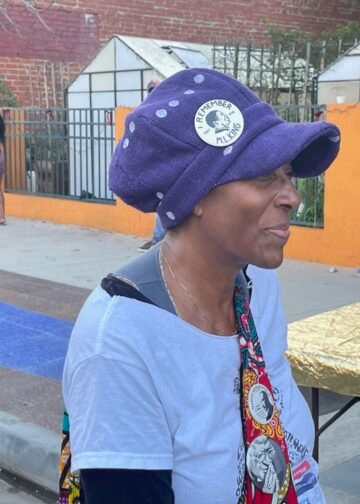
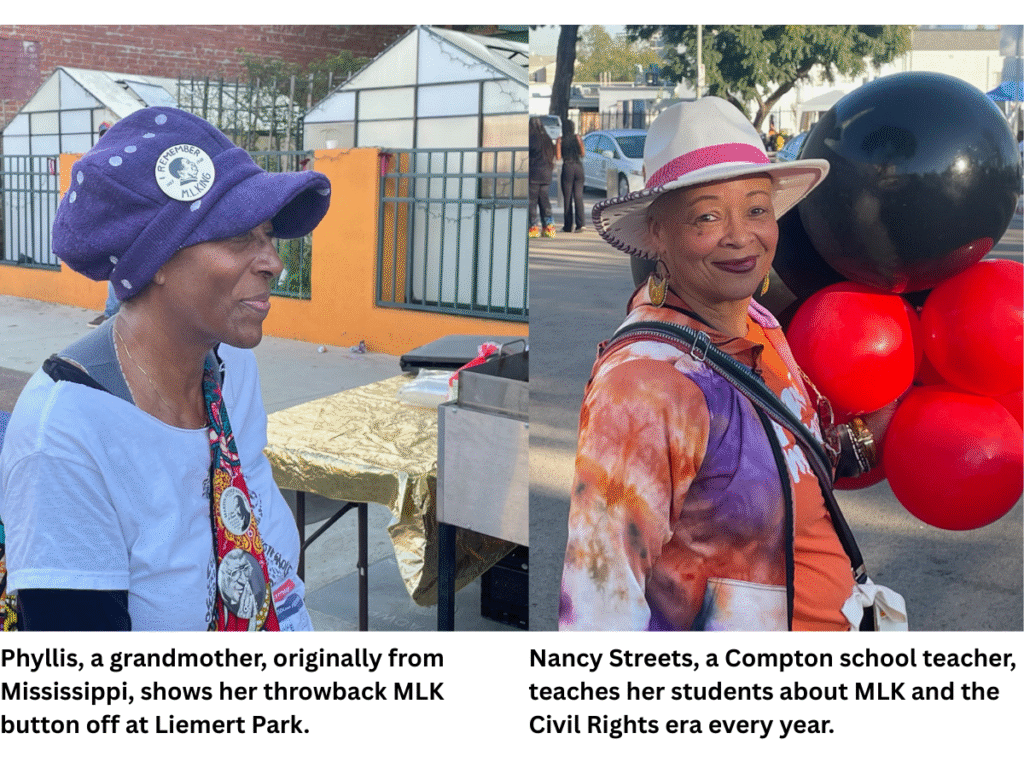
Phyllis, a grandmother, sported a purple hat with a MLK throwback button that she has had for years. Photo credit: LACP.

For Phyllis, a grandmother who brought her eight-and-a-half-year-old grandson Kasai to the celebration, King’s legacy is deeply personal. Originally from Mississippi, she was just five years old when King was murdered.

“I remember it was a sad day,” Phyllis recalled, her voice carrying the weight of decades. “I remember my parents, people being sad, and they said when he died that the skies turned dark.”

Her family had just moved from Mississippi to Los Angeles, escaping the Jim Crow South where segregation defined every aspect of daily life—from water fountains to bathrooms to where African Americans could live.

“My parents are still living, and they went through more than what we, you know, the freedoms that we see today,” Phyllis said, recalling how after she moved to Los Angeles, she lived on Hoover Street on LA’s east side, where African Americans at that time were not allowed to live on the otherside of Vermont Avenue.

When asked what King would say if he were alive today, Phyllis didn’t hesitate. “I think that he would be directing us and fighting for this homelessness,” she said, gesturing around the park. “The immigration situation, the climate of what’s going on in the world. There’s a lot of things that were fulfilled, but there are a lot of things that still remain the same, but it’s just in a different shape, fashion or form.”

Her grandson Kasai, an elementary student at Price Christian School, offered his own definition of the holiday: “To celebrate Martin Luther King Jr and what he’s done for us and that his dream made us be free and a chance to celebrate all the things he has done, and to make us remember how many people died in that horrible age of time.”

Chris, a Compton native attending the parade, spoke passionately about King’s importance, transcending racial boundaries. “It means struggle, struggle to get what was right, and the man that stood up for his people to make sure he got that,” Chris explained. “He was a good man, and he did the best he could, a religious man. He didn’t want any harm, nobody.”

When asked if King’s legacy matters only to African Americans, Chris was emphatic: “Everybody, everybody, because everybody’s in some kind of struggle. He just kept persevering. That’s a good example for everybody, especially today.”
Nancy Streets, a schoolteacher from Compton, celebrates MLK Day at Liemert Park. Photo Credit: LACP

Nancy Streets, a 71-year-old schoolteacher from Compton, said she brings King’s message into her classroom each year by requiring her students to write reports on the holiday. For her, the day means one simple directive: “Show up and serve.”

Streets expressed concern about efforts to diminish the holiday’s significance. “They’re trying to get rid of it,” she said pointedly. When asked what King would say if he were alive today, she responded with stark clarity: “The struggle continues.”

Eric, a petition gatherer originally from Philadelphia who relocated to Los Angeles, offered a historical perspective. “It’s a holiday to remember what he stood for. So it’s about peace, prosperity, and understanding about the freedoms that a lot of African Americans had to endure during the Civil Rights era,” he explained.

Eric emphasized that King’s movement benefited people beyond the African American community. “We had other races, like white folks, maybe some Hispanics here in the United States. MLK Day to me is to show how America was back during that time, when we didn’t have a lot of freedoms, or a lot of freedoms were restricted.”

However, Eric acknowledged the complexity of applying King’s vision to contemporary issues. “I don’t know what Martin Luther King would have stood for today,” he said thoughtfully. “He stood for injustices, a lot of injustices that especially affected African Americans or blacks, and fortunately, other immigrants and other people benefited from what he did.”

When asked about the future of African Americans as a community, Eric offered a nuanced view and opined tthat his was a loaded question because the Black-American diaspora has become too diverse to characterize as a single entity. 

 “People here in America—blacks—get together about certain things, we’re not as totally united like during the civil rights era. It’s more diverse now, there’s a lot of diversity because people are married to other races, and people are transient from different states to different cities and different cultures,” he said.

Leave a Reply

Your email address will not be published. Required fields are marked *

By Los Angeles County Politics (LACP)

At Leimert Park in South Los Angeles on Monday, as thousands gathered for the City of Los Angeles annual Martin Luther King Jr. Day parade, a tapestry of personal memories and present-day concerns wove together the civil rights leader’s enduring legacy with contemporary struggles.

Martin Luther King Jr., born in Atlanta in 1929, became the most visible leader of the American civil rights movement from the mid-1950s until his assassination on April 4, 1968, in Memphis, Tennessee. A Baptist minister and activist, King advocated for racial equality through nonviolent resistance, delivering his iconic “I Have a Dream” speech during the 1963 March on Washington. His assassination sparked riots across American cities and deepened a national wound that many say has never fully healed.

The campaign to establish a federal holiday in King’s honor began shortly after his death, led by labor unions and civil rights activists. Musician Stevie Wonder released the song “Happy Birthday” in 1980 to promote the cause, and a petition drive collected six million signatures. President Ronald Reagan signed the bill into law in 1983, and Martin Luther King Jr. Day was first observed as a federal holiday on January 20, 1986. However, it took until 2000 for all 50 states to recognize the holiday.

Phyllis, a grandmother, sported a purple hat with a MLK throwback button that she has had for years. Photo credit: LACP.

For Phyllis, a grandmother who brought her eight-and-a-half-year-old grandson Kasai to the celebration, King’s legacy is deeply personal. Originally from Mississippi, she was just five years old when King was murdered.

“I remember it was a sad day,” Phyllis recalled, her voice carrying the weight of decades. “I remember my parents, people being sad, and they said when he died that the skies turned dark.”

Her family had just moved from Mississippi to Los Angeles, escaping the Jim Crow South where segregation defined every aspect of daily life—from water fountains to bathrooms to where African Americans could live.

“My parents are still living, and they went through more than what we, you know, the freedoms that we see today,” Phyllis said, recalling how after she moved to Los Angeles, she lived on Hoover Street on LA’s east side, where African Americans at that time were not allowed to live on the otherside of Vermont Avenue.

When asked what King would say if he were alive today, Phyllis didn’t hesitate. “I think that he would be directing us and fighting for this homelessness,” she said, gesturing around the park. “The immigration situation, the climate of what’s going on in the world. There’s a lot of things that were fulfilled, but there are a lot of things that still remain the same, but it’s just in a different shape, fashion or form.”

Her grandson Kasai, an elementary student at Price Christian School, offered his own definition of the holiday: “To celebrate Martin Luther King Jr and what he’s done for us and that his dream made us be free and a chance to celebrate all the things he has done, and to make us remember how many people died in that horrible age of time.”

Chris, a Compton native attending the parade, spoke passionately about King’s importance, transcending racial boundaries. “It means struggle, struggle to get what was right, and the man that stood up for his people to make sure he got that,” Chris explained. “He was a good man, and he did the best he could, a religious man. He didn’t want any harm, nobody.”

When asked if King’s legacy matters only to African Americans, Chris was emphatic: “Everybody, everybody, because everybody’s in some kind of struggle. He just kept persevering. That’s a good example for everybody, especially today.”

Nancy Streets, a schoolteacher from Compton, celebrates MLK Day at Liemert Park. Photo Credit: LACP

Nancy Streets, a 71-year-old schoolteacher from Compton, said she brings King’s message into her classroom each year by requiring her students to write reports on the holiday. For her, the day means one simple directive: “Show up and serve.”

Streets expressed concern about efforts to diminish the holiday’s significance. “They’re trying to get rid of it,” she said pointedly. When asked what King would say if he were alive today, she responded with stark clarity: “The struggle continues.”

Eric, a petition gatherer originally from Philadelphia who relocated to Los Angeles, offered a historical perspective. “It’s a holiday to remember what he stood for. So it’s about peace, prosperity, and understanding about the freedoms that a lot of African Americans had to endure during the Civil Rights era,” he explained.

Eric emphasized that King’s movement benefited people beyond the African American community. “We had other races, like white folks, maybe some Hispanics here in the United States. MLK Day to me is to show how America was back during that time, when we didn’t have a lot of freedoms, or a lot of freedoms were restricted.”

However, Eric acknowledged the complexity of applying King’s vision to contemporary issues. “I don’t know what Martin Luther King would have stood for today,” he said thoughtfully. “He stood for injustices, a lot of injustices that especially affected African Americans or blacks, and fortunately, other immigrants and other people benefited from what he did.”

When asked about the future of African Americans as a community, Eric offered a nuanced view and opined tthat his was a loaded question because the Black-American diaspora has become too diverse to characterize as a single entity. 

 “People here in America—blacks—get together about certain things, we’re not as totally united like during the civil rights era. It’s more diverse now, there’s a lot of diversity because people are married to other races, and people are transient from different states to different cities and different cultures,” he said.