

By Stephen Witt
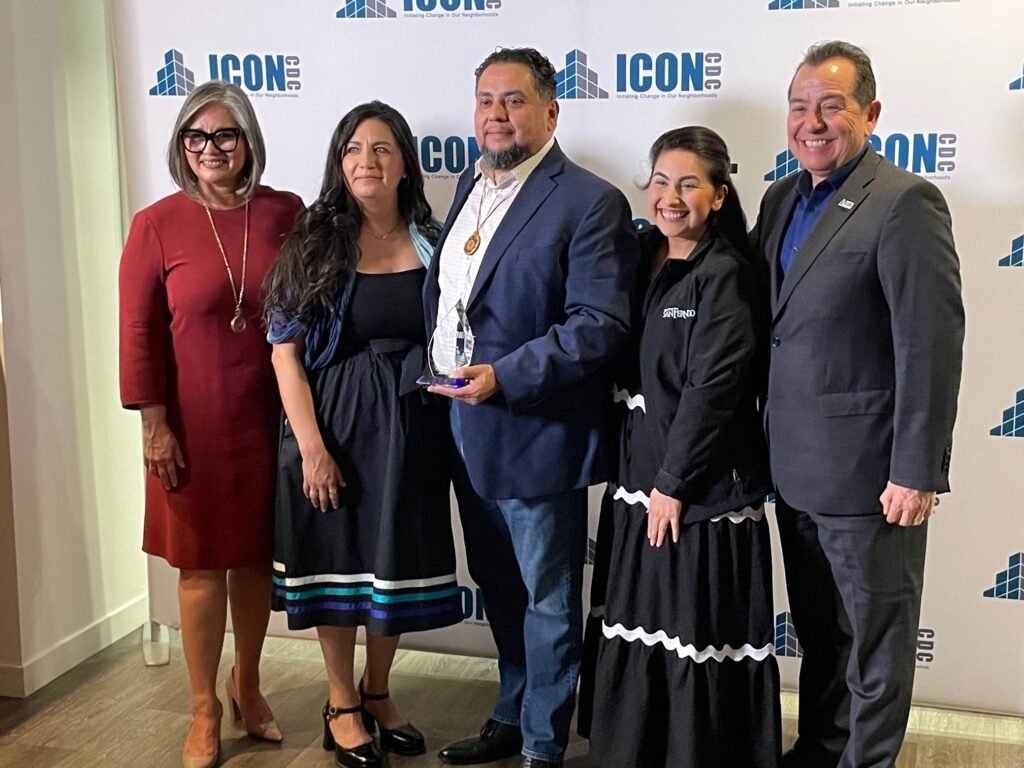
Rudy Ortega Jr., the newly appointed member of the Los Angeles Board of Water and Power (DWP) Commissioners, was feted yesterday evening at a reception hosted by ICON CDC in the City of San Fernando — a fitting venue, given that the land surrounding it once formed the ancestral territory of his tribe.
Ortega, who serves as Tribal President of the Fernandeño Tataviam Band of Mission Indians, was appointed to the DWP board by Los Angeles Mayor Karen Bass on Jan. 5, and confirmed by the Los Angeles City Council on Feb. 10. He becomes the first representative of a sovereign tribal nation to serve on the commission that oversees one of the nation’s largest municipal utilities, a body with jurisdiction stretching across three states.
The reception was organized by ICON CDC — Initiating Change in Our Neighborhoods Community Development Corporation — a San Fernando Valley-based nonprofit that has served the region’s small business and Latino communities for more than two decades. Roberto Barragán, ICON CDC’s executive director, emceed the event, drawing a crowd of elected officials, community leaders, and longtime allies of Ortega.
For Ortega, the appointment carries deep personal and historical weight. In his remarks, he described how the DWP, along with the Metropolitan Water District and other regional agencies, shaped — and in his view, diminished — his tribe’s connection to its ancestral lands. He noted that roughly 14,000 acres stretching across the San Fernando Valley, including portions of the City of San Fernando, should have been set aside as reservation land for the Fernandeño Tataviam.
“Water and power were taken from my community,” Ortega told the gathering. “Now I can’t take it away from other communities, but I can bring the power to our communities, to better serve them — to bring rates down, to really look at how we can bring the justice of equality.”
Ortega said he initially hesitated when approached about the appointment, fielding inquiries from tribal allies, former DWP commissioners, and contacts within Bass’s office. “If you’re not going to do it, who do you think could?” he recalled being asked. He ultimately accepted, he said, because of the opportunity to address longstanding inequities in how the utility serves working-class and low-income Angelenos.
Ortega’s appointment restores a Native American voice to the DWP board. In 2023, Bass removed former Commissioner Cynthia Ruiz, the first Native American ever to serve on the panel, after just one year — a decision that drew criticism from Indigenous advocacy groups.

LA City Councilmember Monica Rodriguez, whose district includes the City of San Fernando and the northeastern San Fernando Valley, attended the reception and spoke with LACP afterward. She said she was pleasantly surprised by Bass’s selection of Ortega, calling it a recognition of both the Valley and the indigenous community.
“It’s not just representation from the Valley, it’s representation from the indigenous community and the original stewards of this land,” said Rodriguez. “Water is a very powerful force that can make change in any community. And to have a representative who is not only local but someone who is going to be an excellent steward of resources — given the roots and the history — I think is incredibly important.”
Rodriguez also addressed the broader politics of water in the region, noting that Los Angeles is at its core a desert city whose growth has always depended on imported water. “Water rights are a very hyper-political issue,” she said. “Water is our California gold.” She expressed hope that water could emerge as a rare bipartisan issue, arguing that its stewardship transcends partisan lines.
Ortega brings an extensive governance résumé to the role. As Tribal President of the Fernandeño Tataviam Band of Mission Indians — a sovereign tribal nation of northern Los Angeles County — he oversees the tribe’s governmental affairs and has worked to preserve its rights, culture, and heritage.
His late father, Rudy Ortega Sr., led the tribe for more than 50 years and was elected to the LA City/County Native American Indian Commission in 1977. The family’s advocacy stretches back further still: his great-grandfather, Antonio Maria Ortega, fought in Los Angeles Superior Court in the 19th century to protect Native land from encroaching settlers.
Prior to his appointment, Ortega served as executive director of Pukúu Cultural Community Services, the tribe’s nonprofit arm, from 2004 to 2019. He has also helped establish the Tataviam Land Conservancy, co-managed Rudy Ortega Sr. Park with the City of San Fernando, and served on the LA River Master Plan Steering Committee, the Santa Monica Mountains Conservancy, and the LA County Blue Ribbon Commission on Climate Action and Fire-Safe Recovery.
At the reception, Ortega noted that since his nomination, he had been inundated with partnership inquiries. He encouraged constituents to visit either the commission’s downtown Los Angeles office or his tribe’s office in San Fernando.
His term runs through June 30, 2031.