


Three Theories That Can Transform How Local Government Is Covered

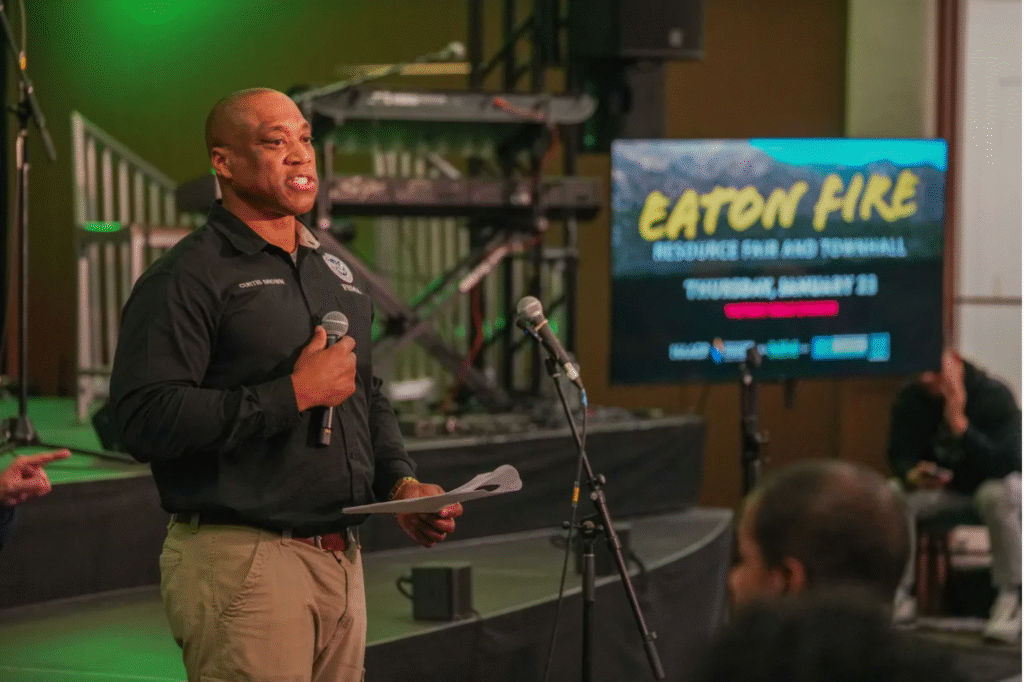
A FEMA official addresses Eaton Fire survivors at a resource fair and townhall hosted by the NAACP at Pasadena Victory Bible Church, Jan. 23, 2025. The recovery has involved federal, state, county and city agencies — with little public clarity about who is ultimately in charge. (FEMA Photo by Kevin Nha/Released)

An introduction to the analytical frameworks that define LACP’s approach to governance journalism

By Stephen Witt | Los Angeles County Politics | © 2026 Los Angeles County Politics. All rights reserved.


Local political journalism has a problem. For decades, coverage of government has defaulted to what reporters call “horse-race” journalism — who’s winning, who’s losing, who’s fighting whom. Its coverage is built around conflict and personality, not around the structural forces that actually shape how power works.

At Los Angeles County Politics (LACP), we think that’s not enough. LA County is home to 10 million people governed by 88 cities, a county government, dozens of special districts, and overlapping state and federal jurisdictions. The forces shaping this landscape are complex, often invisible, and rarely explained. Explaining them is our job.

To do that, we’ve developed three original analytical frameworks — theoretical lenses that help us, and our readers, understand not just what is happening in local government, but why. These aren’t borrowed from political science textbooks. They emerged from more than 30 years of covering local politics, refined through the specific challenges of reporting on one of the most complicated governing jurisdictions in the United States.

We’re introducing them formally here because we believe journalism that doesn’t explain its methodology isn’t fully honest with its readers. These are the tools we use. You should know what they are.


Framework One: Nested Legitimacy Crisis Theory

Core proposition: Contemporary governance faces simultaneous legitimacy challenges at multiple scales — local, regional, state, federal — that create cascading destabilization, because solutions at one level often undermine legitimacy at another.

The traditional assumption of political journalism is that institutional failures are discrete events. A city council acts corruptly. An agency mismanages funds. A department fails its constituents. The journalist covers the failure, accountability follows (or doesn’t), and the system moves on.

What Nested Legitimacy Crisis Theory recognizes is that this picture is almost never accurate anymore. Failures don’t stay contained. They cascade.

The theory draws on political scientist David Easton’s systems theory — which modeled government as an input/output legitimacy machine — and philosopher Jürgen Habermas’s work on legitimation crisis. But it extends both by focusing on what happens when those crises occur simultaneously across multiple layers of a complex governing system.

In LA County, this dynamic is everywhere. When residents lose trust in a city’s building department, they don’t just stop trusting that department — they lose trust in the city, which bleeds into distrust of the county, which compounds existing distrust of state and federal agencies. Legitimacy drains through the nested layers like water through cracked pipes.

The theory also explains a phenomenon we call “legitimacy arbitrage” — the political strategy of shifting blame between levels of government when accountability is demanded. When the city blames the county, the county blames the state, and the state blames Washington, no one is actually held responsible. This isn’t incompetence. It’s a structural feature of multi-jurisdictional governance, and it requires a multi-jurisdictional analytical lens to expose.

LA County residents don’t need to look far for a living example. The recovery from the 2025 wildfires has produced a textbook Nested Legitimacy Crisis in real time. At the federal level, the Trump administration has conditioned disaster relief in ways that undermine FEMA’s legitimacy as a neutral recovery mechanism. At the state level, Governor Newsom demands federal money be released while remaining unable to guarantee how it will be spent or who will oversee it. At the county level, the Board of Supervisors asserts relevance in a recovery it doesn’t fully control. At the city level, Mayor Bass is caught between federal pressure, state politics, and constituent fury over the pace of rebuilding. And beneath all of it, fire survivors are left trying to figure out who to call, who is responsible, and who actually has the authority to help them.

Notice what is almost entirely absent from this picture: any serious public discussion of oversight, accountability structures, or who is ultimately in charge of the recovery. That silence is not an accident. It is the predictable result of legitimacy arbitrage — every level of government claiming credit for wanting to help, and no level claiming responsibility for the outcome. Nested Legitimacy Crisis Theory doesn’t just describe this dynamic. It predicts it.

The practical journalism application: When we cover any local governance failure, we don’t just ask what went wrong here. We ask which institutional layer the failure originated in, how it cascaded to other layers, and who benefited from the resulting confusion over accountability.


Framework Two: Temporal Polarization Theory

Core proposition: Political divisions increasingly organize around competing temporal orientations — not just left/right ideology, but fundamentally different relationships to past, present, and future that create incompatible political epistemologies.

Political journalists are trained to explain conflict through the lens of ideology. Democrats want this; Republicans want that. Progressives argue X; conservatives argue Y. But in local government — where ideological labels often matter less than in national politics — this framing breaks down constantly. Why do two people with similar values, similar demographics, and similar neighborhoods end up in bitter conflict over a proposed development project, a policing policy, or a school curriculum?

Temporal Polarization Theory offers an answer: they may not disagree on what they want. They disagree on when — and that temporal gap is just as unbridgeable as ideological disagreement.

The theory extends sociologist Karl Mannheim’s generational theory beyond birth cohorts to what we call “temporal consciousness” — a person’s or group’s fundamental relationship to time in politics. It also integrates behavioral economics research on temporal discounting (how differently people value present versus future outcomes) with historian Reinhart Koselleck’s work on how societies experience historical temporality.

In practice, Temporal Polarization Theory reveals three dominant temporal orientations in local politics:

Preservationist temporality — oriented toward protecting what exists, viewing rapid change as inherently destabilizing, and drawing legitimacy from established community identity.

Developmentalist temporality — oriented toward future transformation, willing to accept present disruption for long-term gain, and drawing legitimacy from projected outcomes.

Crisis temporality — operating in compressed time frames, treating present conditions as emergency, and resistant to long-horizon arguments because the present feels catastrophically urgent.

The insight is that these orientations operate on different evidence standards. Someone in crisis temporality is largely unreachable by long-term cost-benefit arguments — not because they’re irrational, but because their temporal frame makes those arguments feel irrelevant to the actual problem. When a community meeting devolves into apparent chaos over a housing project, what’s often happening is a collision between these temporal orientations, not a genuine disagreement about facts or values.

The practical journalism application: We don’t just cover “community opposition.” We examine what temporal orientation is driving it — and we ask whether the conflict is actually about the project, or about a deeper collision between incompatible relationships to time.


Framework Three: Algorithmic Mediation Theory

Core proposition: Political power increasingly derives not from traditional institutional control or electoral mandates, but from the capacity to shape algorithmic information architectures that mediate between citizens and political reality.

This is the most contemporary of the three frameworks, and in some ways the most uncomfortable — because it implicates journalism itself as part of the problem it describes.

Algorithmic Mediation Theory synthesizes several intellectual traditions: Antonio Gramsci’s concept of cultural hegemony (the idea that power operates through control of meaning-making institutions, not just through force), Michel Foucault’s analysis of dispersed mechanisms of control, and Walter Lippmann’s early 20th century insight about the “manufacture of consent” — updated for the age of platform capitalism and engagement optimization.

The core insight is that the algorithms governing what information reaches which citizens are not neutral distribution mechanisms. They are power structures. Whoever shapes those algorithms — or whoever best understands how to work within them — holds a form of political influence that traditional political science frameworks were not designed to analyze.

For local government journalism, this creates a specific challenge: local political information almost never “performs” well algorithmically. It lacks the emotional intensity of national political combat. It requires context to understand. It involves names and jurisdictions that most people don’t follow. As a result, it gets systematically de-prioritized by the platforms that now mediate most people’s relationship to news.

The theory also explains what we call the “viral accountability paradox” — the phenomenon in which a local governance failure achieves accountability only when it goes viral, even though the conditions for viral reach (dramatic imagery, simple moral framing, emotional intensity) often distort the underlying story. The ICE detention videos that forced national policy conversations, the police body camera footage that drove reform legislation — these achieved accountability not through journalistic investigation but through algorithmic amplification. The journalism caught up to the algorithm, rather than the other way around.

The practical journalism application: We ask not just “what happened?” but “what is the information environment in which this happened?” Who controlled the narrative? Which institutional actors understood algorithmic dynamics and used them strategically? What stories never became visible because they lacked algorithmic properties, regardless of their civic importance?


Why This Matters for Local Journalism

These three frameworks share a recognition that classical political journalism was built on assumptions that no longer hold. It assumed stable information environments where journalists mediated between institutions and citizens. It assumed clear institutional boundaries where accountability could be assigned. It assumed a shared sense of political time in which democratic deliberation could occur.

None of those assumptions describes LA County today — or most of American local government.

LACP is not the only outlet covering LA County politics. But we believe we’re one of the only outlets attempting to develop a systematic analytical architecture for understanding it. These frameworks are not academic exercises. They are working tools — applied when the story warrants it, set aside when it doesn’t.

Not every story requires a theoretical lens. Election results, council votes, budget approvals, and breaking news should be reported cleanly and factually. Horse-race coverage of campaigns serves a legitimate purpose — voters need to know who’s ahead, where the money is, and what the endorsements mean. We cover all of it.

But when a story involves cascading institutional failure, entrenched community conflict, or the invisible forces shaping what gets covered and what disappears — that’s when these frameworks earn their place. We’ll apply them to our analytical and accountability coverage, name them when they’re relevant, and be transparent when a story reveals the limits of any framework.

That’s what analytical nonpartisanship actually means: not the false objectivity of pretending to have no perspective, and not the affectation of applying theory where plain reporting serves better — but the honest acknowledgment of the tools you’re using, and the intellectual commitment to test them against what you find.


Stephen Witt is the founder, publisher, and editor-in-chief of Los Angeles County Politics, which he launched in April 2025. He has more than 30 years of journalism experience, including extensive work for The New York Post/News Corp and as founder of KingsCountyPolitics.com in Brooklyn, which he sold to Schneps Media — a New York-based chain of more than 70 print and digital publications — subsequently serving as their Political Editor-in-Chief before relocating to Los Angeles to build LACP. He brings a tabloid-trained instinct for news judgment and a governance-focused analytical approach to one of America’s most complex political landscapes. Journalists he has mentored have gone on to hold positions at major outlets, including the Washington Post and CNN.

© 2026 Los Angeles County Politics. Nested Legitimacy Crisis Theory, Temporal Polarization Theory, and Algorithmic Mediation Theory are analytical frameworks developed by Stephen Witt and Los Angeles County Politics. All rights reserved.


Leave a Reply

Your email address will not be published. Required fields are marked *

An introduction to the analytical frameworks that define LACP’s approach to governance journalism

By Stephen Witt | Los Angeles County Politics | © 2026 Los Angeles County Politics. All rights reserved.


Local political journalism has a problem. For decades, coverage of government has defaulted to what reporters call “horse-race” journalism — who’s winning, who’s losing, who’s fighting whom. Its coverage is built around conflict and personality, not around the structural forces that actually shape how power works.

At Los Angeles County Politics (LACP), we think that’s not enough. LA County is home to 10 million people governed by 88 cities, a county government, dozens of special districts, and overlapping state and federal jurisdictions. The forces shaping this landscape are complex, often invisible, and rarely explained. Explaining them is our job.

To do that, we’ve developed three original analytical frameworks — theoretical lenses that help us, and our readers, understand not just what is happening in local government, but why. These aren’t borrowed from political science textbooks. They emerged from more than 30 years of covering local politics, refined through the specific challenges of reporting on one of the most complicated governing jurisdictions in the United States.

We’re introducing them formally here because we believe journalism that doesn’t explain its methodology isn’t fully honest with its readers. These are the tools we use. You should know what they are.


Framework One: Nested Legitimacy Crisis Theory

Core proposition: Contemporary governance faces simultaneous legitimacy challenges at multiple scales — local, regional, state, federal — that create cascading destabilization, because solutions at one level often undermine legitimacy at another.

The traditional assumption of political journalism is that institutional failures are discrete events. A city council acts corruptly. An agency mismanages funds. A department fails its constituents. The journalist covers the failure, accountability follows (or doesn’t), and the system moves on.

What Nested Legitimacy Crisis Theory recognizes is that this picture is almost never accurate anymore. Failures don’t stay contained. They cascade.

The theory draws on political scientist David Easton’s systems theory — which modeled government as an input/output legitimacy machine — and philosopher Jürgen Habermas’s work on legitimation crisis. But it extends both by focusing on what happens when those crises occur simultaneously across multiple layers of a complex governing system.

In LA County, this dynamic is everywhere. When residents lose trust in a city’s building department, they don’t just stop trusting that department — they lose trust in the city, which bleeds into distrust of the county, which compounds existing distrust of state and federal agencies. Legitimacy drains through the nested layers like water through cracked pipes.

The theory also explains a phenomenon we call “legitimacy arbitrage” — the political strategy of shifting blame between levels of government when accountability is demanded. When the city blames the county, the county blames the state, and the state blames Washington, no one is actually held responsible. This isn’t incompetence. It’s a structural feature of multi-jurisdictional governance, and it requires a multi-jurisdictional analytical lens to expose.

LA County residents don’t need to look far for a living example. The recovery from the 2025 wildfires has produced a textbook Nested Legitimacy Crisis in real time. At the federal level, the Trump administration has conditioned disaster relief in ways that undermine FEMA’s legitimacy as a neutral recovery mechanism. At the state level, Governor Newsom demands federal money be released while remaining unable to guarantee how it will be spent or who will oversee it. At the county level, the Board of Supervisors asserts relevance in a recovery it doesn’t fully control. At the city level, Mayor Bass is caught between federal pressure, state politics, and constituent fury over the pace of rebuilding. And beneath all of it, fire survivors are left trying to figure out who to call, who is responsible, and who actually has the authority to help them.

Notice what is almost entirely absent from this picture: any serious public discussion of oversight, accountability structures, or who is ultimately in charge of the recovery. That silence is not an accident. It is the predictable result of legitimacy arbitrage — every level of government claiming credit for wanting to help, and no level claiming responsibility for the outcome. Nested Legitimacy Crisis Theory doesn’t just describe this dynamic. It predicts it.

The practical journalism application: When we cover any local governance failure, we don’t just ask what went wrong here. We ask which institutional layer the failure originated in, how it cascaded to other layers, and who benefited from the resulting confusion over accountability.


Framework Two: Temporal Polarization Theory

Core proposition: Political divisions increasingly organize around competing temporal orientations — not just left/right ideology, but fundamentally different relationships to past, present, and future that create incompatible political epistemologies.

Political journalists are trained to explain conflict through the lens of ideology. Democrats want this; Republicans want that. Progressives argue X; conservatives argue Y. But in local government — where ideological labels often matter less than in national politics — this framing breaks down constantly. Why do two people with similar values, similar demographics, and similar neighborhoods end up in bitter conflict over a proposed development project, a policing policy, or a school curriculum?

Temporal Polarization Theory offers an answer: they may not disagree on what they want. They disagree on when — and that temporal gap is just as unbridgeable as ideological disagreement.

The theory extends sociologist Karl Mannheim’s generational theory beyond birth cohorts to what we call “temporal consciousness” — a person’s or group’s fundamental relationship to time in politics. It also integrates behavioral economics research on temporal discounting (how differently people value present versus future outcomes) with historian Reinhart Koselleck’s work on how societies experience historical temporality.

In practice, Temporal Polarization Theory reveals three dominant temporal orientations in local politics:

Preservationist temporality — oriented toward protecting what exists, viewing rapid change as inherently destabilizing, and drawing legitimacy from established community identity.

Developmentalist temporality — oriented toward future transformation, willing to accept present disruption for long-term gain, and drawing legitimacy from projected outcomes.

Crisis temporality — operating in compressed time frames, treating present conditions as emergency, and resistant to long-horizon arguments because the present feels catastrophically urgent.

The insight is that these orientations operate on different evidence standards. Someone in crisis temporality is largely unreachable by long-term cost-benefit arguments — not because they’re irrational, but because their temporal frame makes those arguments feel irrelevant to the actual problem. When a community meeting devolves into apparent chaos over a housing project, what’s often happening is a collision between these temporal orientations, not a genuine disagreement about facts or values.

The practical journalism application: We don’t just cover “community opposition.” We examine what temporal orientation is driving it — and we ask whether the conflict is actually about the project, or about a deeper collision between incompatible relationships to time.


Framework Three: Algorithmic Mediation Theory

Core proposition: Political power increasingly derives not from traditional institutional control or electoral mandates, but from the capacity to shape algorithmic information architectures that mediate between citizens and political reality.

This is the most contemporary of the three frameworks, and in some ways the most uncomfortable — because it implicates journalism itself as part of the problem it describes.

Algorithmic Mediation Theory synthesizes several intellectual traditions: Antonio Gramsci’s concept of cultural hegemony (the idea that power operates through control of meaning-making institutions, not just through force), Michel Foucault’s analysis of dispersed mechanisms of control, and Walter Lippmann’s early 20th century insight about the “manufacture of consent” — updated for the age of platform capitalism and engagement optimization.

The core insight is that the algorithms governing what information reaches which citizens are not neutral distribution mechanisms. They are power structures. Whoever shapes those algorithms — or whoever best understands how to work within them — holds a form of political influence that traditional political science frameworks were not designed to analyze.

For local government journalism, this creates a specific challenge: local political information almost never “performs” well algorithmically. It lacks the emotional intensity of national political combat. It requires context to understand. It involves names and jurisdictions that most people don’t follow. As a result, it gets systematically de-prioritized by the platforms that now mediate most people’s relationship to news.

The theory also explains what we call the “viral accountability paradox” — the phenomenon in which a local governance failure achieves accountability only when it goes viral, even though the conditions for viral reach (dramatic imagery, simple moral framing, emotional intensity) often distort the underlying story. The ICE detention videos that forced national policy conversations, the police body camera footage that drove reform legislation — these achieved accountability not through journalistic investigation but through algorithmic amplification. The journalism caught up to the algorithm, rather than the other way around.

The practical journalism application: We ask not just “what happened?” but “what is the information environment in which this happened?” Who controlled the narrative? Which institutional actors understood algorithmic dynamics and used them strategically? What stories never became visible because they lacked algorithmic properties, regardless of their civic importance?


Why This Matters for Local Journalism

These three frameworks share a recognition that classical political journalism was built on assumptions that no longer hold. It assumed stable information environments where journalists mediated between institutions and citizens. It assumed clear institutional boundaries where accountability could be assigned. It assumed a shared sense of political time in which democratic deliberation could occur.

None of those assumptions describes LA County today — or most of American local government.

LACP is not the only outlet covering LA County politics. But we believe we’re one of the only outlets attempting to develop a systematic analytical architecture for understanding it. These frameworks are not academic exercises. They are working tools — applied when the story warrants it, set aside when it doesn’t.

Not every story requires a theoretical lens. Election results, council votes, budget approvals, and breaking news should be reported cleanly and factually. Horse-race coverage of campaigns serves a legitimate purpose — voters need to know who’s ahead, where the money is, and what the endorsements mean. We cover all of it.

But when a story involves cascading institutional failure, entrenched community conflict, or the invisible forces shaping what gets covered and what disappears — that’s when these frameworks earn their place. We’ll apply them to our analytical and accountability coverage, name them when they’re relevant, and be transparent when a story reveals the limits of any framework.

That’s what analytical nonpartisanship actually means: not the false objectivity of pretending to have no perspective, and not the affectation of applying theory where plain reporting serves better — but the honest acknowledgment of the tools you’re using, and the intellectual commitment to test them against what you find.


Stephen Witt is the founder, publisher, and editor-in-chief of Los Angeles County Politics, which he launched in April 2025. He has more than 30 years of journalism experience, including extensive work for The New York Post/News Corp and as founder of KingsCountyPolitics.com in Brooklyn, which he sold to Schneps Media — a New York-based chain of more than 70 print and digital publications — subsequently serving as their Political Editor-in-Chief before relocating to Los Angeles to build LACP. He brings a tabloid-trained instinct for news judgment and a governance-focused analytical approach to one of America’s most complex political landscapes. Journalists he has mentored have gone on to hold positions at major outlets, including the Washington Post and CNN.

© 2026 Los Angeles County Politics. Nested Legitimacy Crisis Theory, Temporal Polarization Theory, and Algorithmic Mediation Theory are analytical frameworks developed by Stephen Witt and Los Angeles County Politics. All rights reserved.