


Friedman Bill to Fund Police Drones for Car Chases Leaves Facial Recognition Restrictions to Local Departments

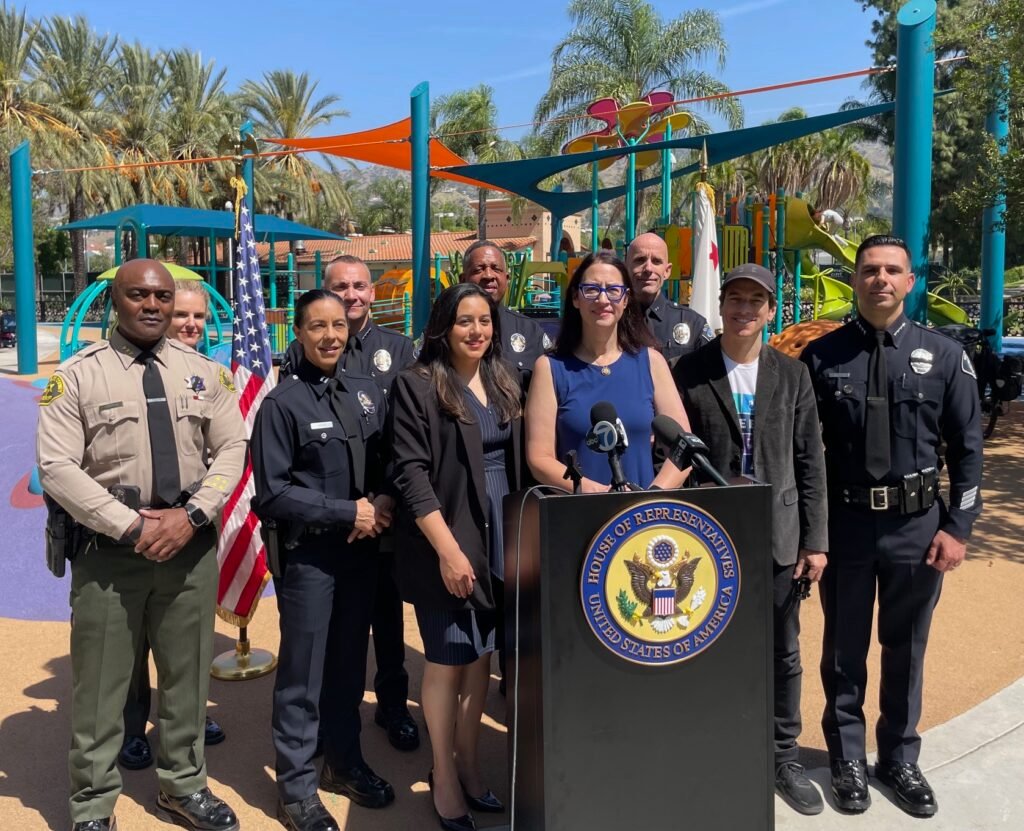
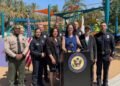
U.S. Rep. Laura Friedman (center, blue) is joined at a Burbank press conference Wednesday by Burbank Councilmember and former Mayor Nikki Perez, Michael Schneider of Streets for All, LA County Assistant Sheriff Myron Johnson, LAPD Captain Yvonne Ortiz, Burbank Police Chief Rafael Quintero, Burbank Deputy Police Chief Adam Cornell, and Glendale Interim Police Chief Robert Williams for the launch of the Next Gen Road Safety Act. Photo: Stephen Witt / Los Angeles County Politics

By Stephen Witt

A proposed federal bill that would fund police drones to curb the dangers of high-speed car chases would leave restrictions on facial recognition and other controversial surveillance uses entirely to individual police departments — raising civil liberties questions that the legislation itself does not answer.
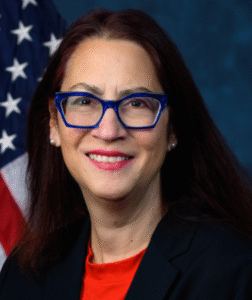
U.S. Rep. Laura Friedman

The disclosure came in response to a question from LACP at a Wednesday press conference in Burbank, where U.S. Rep. Laura Friedman (D-Burbank/Glendale/Pasadena) launched the Next Gen Road Safety Act alongside law enforcement officials and community safety advocates.

Friedman acknowledged that the bill functions as grant funding directed to individual departments, which would operate under existing state law governing data collection, sharing and deletion — but said no federal restrictions on drone use are written into the legislation itself.

“It’s really funding that goes to the departments,” Friedman said. “So it’s up to the departments to decide how they’re going to restrict within the context of existing state law.”

The nonpartisan bill, introduced alongside U.S. Rep. Laurel Lee (R-FL), would expand the Community Oriented Policing Services grant program to, for the first time, allow agencies to purchase vehicle disabling systems, GPS-enabled dart technology, drone tracking systems, and police bumper systems designed to stop fleeing vehicles without triggering dangerous chases.

Friedman said the legislation would unlock tens of millions of federal dollars for law enforcement agencies that want the technology but cannot afford it.

The numbers driving the bill are stark. In California alone, there were nearly 12,000 police pursuits in 2022, leaving 34 people dead and more than 400 innocent bystanders injured in that single year. Nationally, between 2017 and 2022, at least 3,000 people were killed in police vehicle pursuits — roughly two per day. The U.S. Department of Justice has called vehicle pursuits the most dangerous of all ordinary police activities.

In Los Angeles County, the problem is acute. The Los Angeles Sheriff’s Department recorded 936 vehicle pursuits in 2023 and 893 in 2024, with the LAPD logging just over 1,000 pursuits each year in both 2024 and 2025. In the City of Los Angeles alone, 114 innocent bystanders were injured or killed in pursuit-related crashes in 2024 — a year that saw a 56% increase in city pursuits from the prior year.

LA County Assistant Sheriff Myron Johnson, attending on behalf of Sheriff Robert Luna, called the legislation a meaningful step forward.

“This is about giving our personnel the ability to use better tools to make better decisions in real time,” Johnson said. “It’s about reducing risk, saving lives and ensuring that public safety doesn’t come at the cost of another tragedy.”

Burbank Police Chief Rafael Quintero and Glendale Interim Police Chief Robert Williams both expressed support, noting that most departments want the technology but cannot afford it. More than 94% of police pursuits currently end without any technological intervention. Drones were repeatedly cited as a priority — described as a more nimble, affordable alternative to police helicopters for departments without air assets.

Michael Schneider, founder and CEO of Streets for All, offered the community safety perspective.

“As a society, should we pursue people who may have committed a crime so they don’t get away with it? Of course,” Schneider said. “But we don’t need to have these long, dangerous and unpredictable chases when we have the technology to make them much shorter.”

LACP also asked whether cross-jurisdictional coordination during pursuits across LA County’s multiple law enforcement agencies creates additional safety risks. Johnson said dispatch systems can connect across agencies and that sheriff’s helicopters carry frequencies for all county jurisdictions, though he acknowledged he lacked data on whether multiple jurisdictions increase or decrease pursuit safety outcomes overall.

The bill has not yet been assigned a committee hearing date. Friedman said she will continue pushing for its passage.

Leave a Reply

Your email address will not be published. Required fields are marked *

This site uses Akismet to reduce spam. Learn how your comment data is processed.

  • Latest
  • Comments
  • Trending

By Stephen Witt

A proposed federal bill that would fund police drones to curb the dangers of high-speed car chases would leave restrictions on facial recognition and other controversial surveillance uses entirely to individual police departments — raising civil liberties questions that the legislation itself does not answer.

U.S. Rep. Laura Friedman

The disclosure came in response to a question from LACP at a Wednesday press conference in Burbank, where U.S. Rep. Laura Friedman (D-Burbank/Glendale/Pasadena) launched the Next Gen Road Safety Act alongside law enforcement officials and community safety advocates.

Friedman acknowledged that the bill functions as grant funding directed to individual departments, which would operate under existing state law governing data collection, sharing and deletion — but said no federal restrictions on drone use are written into the legislation itself.

“It’s really funding that goes to the departments,” Friedman said. “So it’s up to the departments to decide how they’re going to restrict within the context of existing state law.”

The nonpartisan bill, introduced alongside U.S. Rep. Laurel Lee (R-FL), would expand the Community Oriented Policing Services grant program to, for the first time, allow agencies to purchase vehicle disabling systems, GPS-enabled dart technology, drone tracking systems, and police bumper systems designed to stop fleeing vehicles without triggering dangerous chases.

Friedman said the legislation would unlock tens of millions of federal dollars for law enforcement agencies that want the technology but cannot afford it.

The numbers driving the bill are stark. In California alone, there were nearly 12,000 police pursuits in 2022, leaving 34 people dead and more than 400 innocent bystanders injured in that single year. Nationally, between 2017 and 2022, at least 3,000 people were killed in police vehicle pursuits — roughly two per day. The U.S. Department of Justice has called vehicle pursuits the most dangerous of all ordinary police activities.

In Los Angeles County, the problem is acute. The Los Angeles Sheriff’s Department recorded 936 vehicle pursuits in 2023 and 893 in 2024, with the LAPD logging just over 1,000 pursuits each year in both 2024 and 2025. In the City of Los Angeles alone, 114 innocent bystanders were injured or killed in pursuit-related crashes in 2024 — a year that saw a 56% increase in city pursuits from the prior year.

LA County Assistant Sheriff Myron Johnson, attending on behalf of Sheriff Robert Luna, called the legislation a meaningful step forward.

“This is about giving our personnel the ability to use better tools to make better decisions in real time,” Johnson said. “It’s about reducing risk, saving lives and ensuring that public safety doesn’t come at the cost of another tragedy.”

Burbank Police Chief Rafael Quintero and Glendale Interim Police Chief Robert Williams both expressed support, noting that most departments want the technology but cannot afford it. More than 94% of police pursuits currently end without any technological intervention. Drones were repeatedly cited as a priority — described as a more nimble, affordable alternative to police helicopters for departments without air assets.

Michael Schneider, founder and CEO of Streets for All, offered the community safety perspective.

“As a society, should we pursue people who may have committed a crime so they don’t get away with it? Of course,” Schneider said. “But we don’t need to have these long, dangerous and unpredictable chases when we have the technology to make them much shorter.”

LACP also asked whether cross-jurisdictional coordination during pursuits across LA County’s multiple law enforcement agencies creates additional safety risks. Johnson said dispatch systems can connect across agencies and that sheriff’s helicopters carry frequencies for all county jurisdictions, though he acknowledged he lacked data on whether multiple jurisdictions increase or decrease pursuit safety outcomes overall.

The bill has not yet been assigned a committee hearing date. Friedman said she will continue pushing for its passage.