



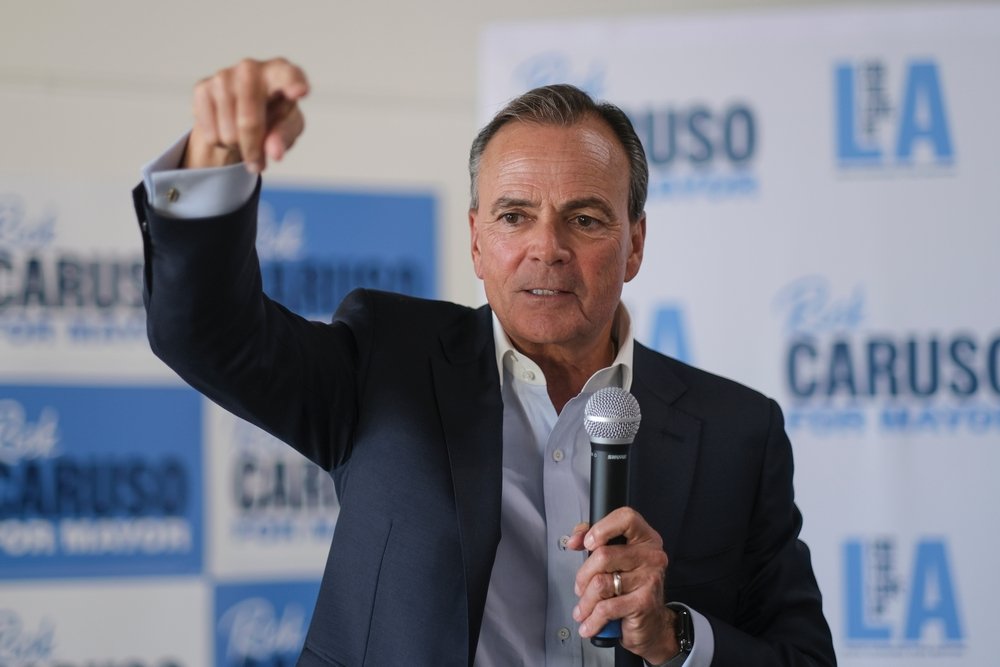

Rick Caruso has finally found his political calling. It just doesn’t involve running for anything.
The real estate mogul’s debut column in the newly launched California Post—the News Corp.-owned sister publication of the New York Post, where I worked from 2006 to 2009—confirms what became clear to me after nine months covering LA politics: Caruso is built for commentary, not campaigns.
I hope he’s thicker-skinned as a columnist than he proved to be as a perennial political candidate, because the California Post is entering a blood sport of a media market. And Caruso, for all his business acumen and policy insights, has consistently shown he lacks the stomach for the arena itself.
The telltale sign emerged early after I launched Los Angeles County Politics (LACP) in April 2025: Caruso maintained unusual distance from local political media. This works fine in the business world, where you control access and message. In politics, it’s disqualifying.
I’m not talking policy disagreements. I’m talking about the fundamental inability to take a punch and punch back—the essential skill of anyone seeking executive office in a major American city or state.
Compare Caruso to LA Mayor Karen Bass. Her Honor served in the State Assembly and Congress before running for mayor. She can take a political hit and return it with sharp elbows. Same with Governor Gavin Newsom—politics is in his blood. He thrives in confrontation.
Even Donald Trump, whom I’m no fan of, understands this instinctively. When he first ran in this cycle, one of his early interviews was with the National Association of Black Journalists. They carved him up. He punched back. That’s the game.
Caruso never showed that appetite. He wants influence without the combat. Commentary gives him that—a platform without opponents, analysis without accountability, punditry without the possibility of losing.
Make no mistake: the California Post is functioning as a Trump Administration mouthpiece on the West Coast. The evidence is in their coverage. Their launch stories have featured exclusive comments from Trump himself—indicating direct access during their rollout. Their framing of LA’s wildfire recovery, complete with quotes attacking California’s “red tape,” reads as if it were dictated from Mar-a-Lago.
But here’s the thing: even Trump-friendly tabloids can do real journalism. The California Post has already broken legitimate stories. They exposed an LA city official who gave herself a $150,000 raise in a secret backroom deal. They covered left-wing activists disrupting an LAPD community meeting—a story that cuts against the “LAPD as villain” narrative many LA outlets prefer.
That’s valuable work, even if their wildfire coverage doubles as Trump talking points about California governance failures.
Los Angeles has talented reporters and writers. What it lacks is tabloid-style accountability journalism that treats local officials like the powerful figures they are, rather than celebrities to be profiled.
LA’s political media culture is, frankly, a bit Mickey Mouse—which makes sense in the entertainment capital of the world, where access matters more than adversarial questioning. Too many local elected officials skate by with see-no-evil, hear-no-evil coverage. A tabloid willing to call them out, even from a partisan perspective, serves as a useful disinfectant.
LACP takes a different approach—analytical rather than tabloid, focused on governance structures rather than personality conflicts—but there’s room for both models in LA’s media ecosystem.
This is especially important in a functionally one-party city and county, where Democratic officials face minimal opposition at the ballot box. If the California Post holds Bass accountable for governance failures, or catches county supervisors in backroom deals, that’s a net positive—even if their editorial line tilts right.
Stephen Witt is the founder and editor-in-chief of Los Angeles County Politics. He previously worked as a staff reporter and/or editor for more than 30 years in New York City and the metropolitan area, where he was awarded the New York Press Association News Story of the year, among other awards and recognitions.