

Koreatown to Cambodia Town: Pacific Rim Communities Mobilize for the June Primary

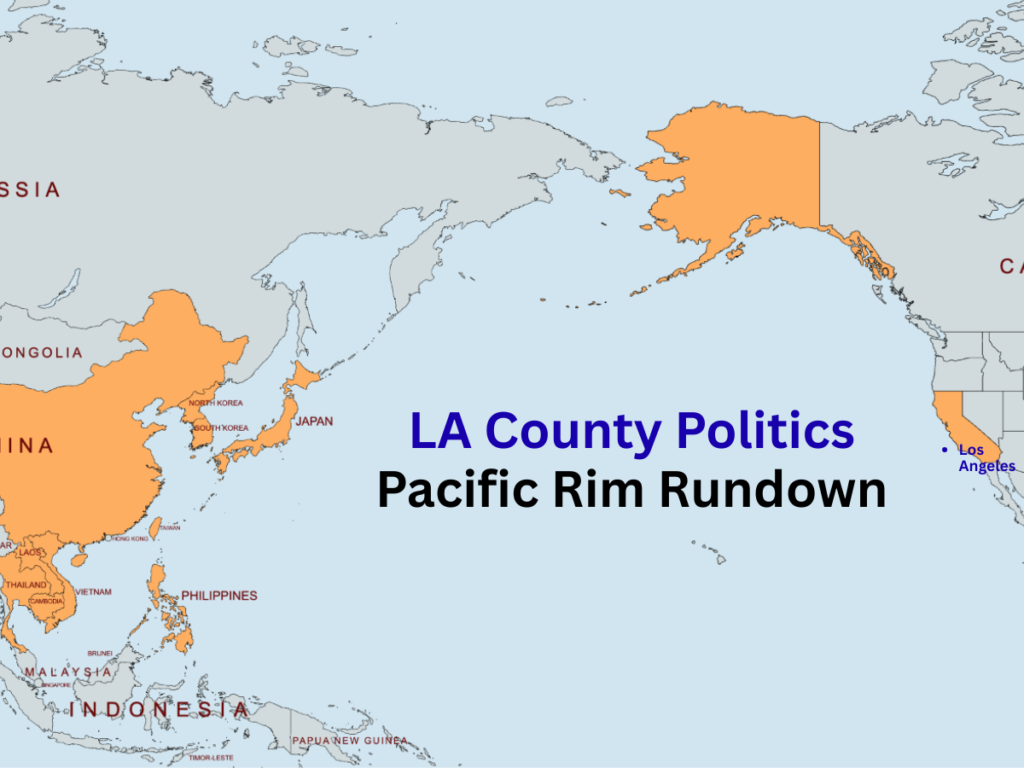
About this column: LA County is home to more Chinese, Filipino, Korean, Cambodian, Thai, and Vietnamese Americans than any other county in the United States — a Pacific Rim diaspora that makes up nearly 16% of the county’s 9.7 million residents and holds majority status in 14 of its 88 cities. LA County Politics periodically surveys the political landscape of these communities — their civic organizations, elected officials, and neighborhood institutions — across all 88 cities. This is the Pacific Rim Rundown.

By Los Angeles County Politics (LACP)

The June 2 California primary is three weeks out, and across Los Angeles County’s Pacific Rim communities — from Little Tokyo to Historic Filipinotown to the Anaheim Street corridor in Long Beach — the civic machinery is running at a pitch not seen since 2020.

County elections officials began mailing ballots to every registered voter on May 4 — meaning ballots are sitting in households across Koreatown, the San Gabriel Valley, and Cambodia Town right now, waiting to be filled out and returned. The question every Pacific Rim civic organization is racing to answer: will their communities pick them up?

Over 7.3 million Asian Americans, Native Hawaiians, and Pacific Islanders reside in California, representing more than 15% of the state’s population and one of its fastest-growing communities over the past decade, comprising nearly 20% of California’s electorate. In LA County, that is not an abstraction. It is a governing reality — and the organizations that have spent decades building civic infrastructure in these communities are betting this cycle will prove it.

A note on political balance: the mobilization covered in this edition is largely driven by Democratic-aligned organizations, which have the most developed civic infrastructure in Pacific Rim LA County at this moment. That does not reflect the full political spectrum of these communities. Vietnamese Americans and Filipino Americans in particular contain significant Republican constituencies — a dimension of Pacific Rim politics this column will cover in future editions.

KOREAN AMERICAN — Flexing at the Governor’s Race

The Korean American Democratic Committee (KADC) demonstrated its organizational muscle on April 18, co-hosting a California gubernatorial forum at World Mission University alongside the Center for Asian Americans United for Self-Empowerment. Five Democratic candidates — Xavier Becerra, Tom Steyer, Antonio Villaraigosa, Tony Thurmond, and Betty Yee — faced questions developed by 40 civic groups, with strictly timed 90-second responses. Notably absent were fellow Democrats Katie Porter and Matt Mahan.

The format was deliberate and pointed — structured to extract policy specifics rather than campaign rhetoric. The KADC has been a chartered club under the Los Angeles County Democratic Party since 1992. The Korean American Federation of Los Angeles (KAFLA), founded in 1962, is coordinating parallel voter registration and community outreach efforts for the primary.

CHINESE AMERICAN — A Pioneer’s Passing, a Community’s Resolve

LA County’s largest Chinese coalition lost its founder last month. Sue Zhang passed away April 20 at 91, and on April 28, LA County Supervisors Kathryn Barger and Hilda L. Solis adjourned the Board of Supervisors meeting in her memory. Zhang had devoted more than four decades to the Chinese-American community and built the Roundtable of Southern California Chinese-American Organizations into the county’s most expansive Chinese civic network.

Her death focuses attention on who carries the work forward into an election cycle defined by immigration fear and tariff uncertainty, hitting San Gabriel Valley businesses hard. The Chinese American Citizens Alliance LA Lodge, founded in 1914, and the Chinatown Service Center remain the primary institutional anchors for civic engagement in the Chinese-American community. Also influential is the Wong Benevolent Association of Los Angeles.

FILIPINO AMERICAN — Organizing Where It Counts

Pilipino American Los Angeles Democrats, the Filipino political club chartered under the LA County Democratic Party, is driving voter contact for the primary in Historic Filipinotown and communities across the county. Organizers note that Filipino voters — a significant bloc in Carson, Cerritos, and parts of the San Fernando Valley — have historically been undercounted and under-contacted by both parties.

Pilipino Workers Center (pwcsc.org) and SIPA (sipausa.org) are both running voter engagement programs through the primary, with PWC’s voice carrying particular weight after its director questioned gubernatorial candidates directly at the April 18 forum.

CAMBODIAN AMERICAN — Long Beach, Eyes on the Ballot

Cambodia Town’s civic organizations are steering residents toward the June ballot with particular attention to local races in Long Beach, where the Cambodian-American community has secured elected representation in recent cycles. The United Cambodian Community of Long Beach, with over 40 years of presence at 2201 E. Anaheim St., and the Cambodian Association of America, the oldest Cambodian organization in the country, are both conducting voter education programming ahead of the primary.

JAPANESE AMERICAN — Invoking History

The Japanese American Citizens League Pacific Southwest District has been among the most vocal regional voices connecting the current federal immigration climate to its own community’s history of government-sanctioned removal, drawing a direct line between the Alien Enemies Act invoked by the Trump administration and its use during World War II to detain Japanese Americans without due process.

For the primary, JACL’s Greater Los Angeles chapter and the Little Tokyo Service Center are emphasizing down-ballot judicial and county races where community organizing can have an outsize impact.

COUNTY-WIDE — Your Ballot Is Already in the Mail

One thread running beneath all the community-specific mobilization: the ballot is already there. It arrived the week of May 4. Filling it out and returning it — by mail, drop box, or in person by June 2 — requires no registration line, no polling place, no language barrier beyond what LA County’s multilingual ballot materials are designed to address.

LA County is required to provide election assistance in Chinese, Cambodian/Khmer, Farsi, Korean, Spanish, Tagalog/Filipino, Vietnamese, Hindi, Japanese, Thai, Bengali, Burmese, Gujarati, Indonesian, Mongolian, and Telugu. AAPI Equity Alliance and Asian Americans Advancing Justice — Southern California, which operates voter rights helplines in eight languages, are both pushing language access as a voting rights issue in the final stretch before June 2.

The ballot is in your hand. The primary is three weeks away.
Leave a Reply

Your email address will not be published. Required fields are marked *

This site uses Akismet to reduce spam. Learn how your comment data is processed.

About this column: LA County is home to more Chinese, Filipino, Korean, Cambodian, Thai, and Vietnamese Americans than any other county in the United States — a Pacific Rim diaspora that makes up nearly 16% of the county’s 9.7 million residents and holds majority status in 14 of its 88 cities. LA County Politics periodically surveys the political landscape of these communities — their civic organizations, elected officials, and neighborhood institutions — across all 88 cities. This is the Pacific Rim Rundown.

By Los Angeles County Politics (LACP)

The June 2 California primary is three weeks out, and across Los Angeles County’s Pacific Rim communities — from Little Tokyo to Historic Filipinotown to the Anaheim Street corridor in Long Beach — the civic machinery is running at a pitch not seen since 2020.

County elections officials began mailing ballots to every registered voter on May 4 — meaning ballots are sitting in households across Koreatown, the San Gabriel Valley, and Cambodia Town right now, waiting to be filled out and returned. The question every Pacific Rim civic organization is racing to answer: will their communities pick them up?

Over 7.3 million Asian Americans, Native Hawaiians, and Pacific Islanders reside in California, representing more than 15% of the state’s population and one of its fastest-growing communities over the past decade, comprising nearly 20% of California’s electorate. In LA County, that is not an abstraction. It is a governing reality — and the organizations that have spent decades building civic infrastructure in these communities are betting this cycle will prove it.

A note on political balance: the mobilization covered in this edition is largely driven by Democratic-aligned organizations, which have the most developed civic infrastructure in Pacific Rim LA County at this moment. That does not reflect the full political spectrum of these communities. Vietnamese Americans and Filipino Americans in particular contain significant Republican constituencies — a dimension of Pacific Rim politics this column will cover in future editions.

KOREAN AMERICAN — Flexing at the Governor’s Race

The Korean American Democratic Committee (KADC) demonstrated its organizational muscle on April 18, co-hosting a California gubernatorial forum at World Mission University alongside the Center for Asian Americans United for Self-Empowerment. Five Democratic candidates — Xavier Becerra, Tom Steyer, Antonio Villaraigosa, Tony Thurmond, and Betty Yee — faced questions developed by 40 civic groups, with strictly timed 90-second responses. Notably absent were fellow Democrats Katie Porter and Matt Mahan.

The format was deliberate and pointed — structured to extract policy specifics rather than campaign rhetoric. The KADC has been a chartered club under the Los Angeles County Democratic Party since 1992. The Korean American Federation of Los Angeles (KAFLA), founded in 1962, is coordinating parallel voter registration and community outreach efforts for the primary.

CHINESE AMERICAN — A Pioneer’s Passing, a Community’s Resolve

LA County’s largest Chinese coalition lost its founder last month. Sue Zhang passed away April 20 at 91, and on April 28, LA County Supervisors Kathryn Barger and Hilda L. Solis adjourned the Board of Supervisors meeting in her memory. Zhang had devoted more than four decades to the Chinese-American community and built the Roundtable of Southern California Chinese-American Organizations into the county’s most expansive Chinese civic network.

Her death focuses attention on who carries the work forward into an election cycle defined by immigration fear and tariff uncertainty, hitting San Gabriel Valley businesses hard. The Chinese American Citizens Alliance LA Lodge, founded in 1914, and the Chinatown Service Center remain the primary institutional anchors for civic engagement in the Chinese-American community. Also influential is the Wong Benevolent Association of Los Angeles.

FILIPINO AMERICAN — Organizing Where It Counts

Pilipino American Los Angeles Democrats, the Filipino political club chartered under the LA County Democratic Party, is driving voter contact for the primary in Historic Filipinotown and communities across the county. Organizers note that Filipino voters — a significant bloc in Carson, Cerritos, and parts of the San Fernando Valley — have historically been undercounted and under-contacted by both parties.

Pilipino Workers Center (pwcsc.org) and SIPA (sipausa.org) are both running voter engagement programs through the primary, with PWC’s voice carrying particular weight after its director questioned gubernatorial candidates directly at the April 18 forum.

CAMBODIAN AMERICAN — Long Beach, Eyes on the Ballot

Cambodia Town’s civic organizations are steering residents toward the June ballot with particular attention to local races in Long Beach, where the Cambodian-American community has secured elected representation in recent cycles. The United Cambodian Community of Long Beach, with over 40 years of presence at 2201 E. Anaheim St., and the Cambodian Association of America, the oldest Cambodian organization in the country, are both conducting voter education programming ahead of the primary.

JAPANESE AMERICAN — Invoking History

The Japanese American Citizens League Pacific Southwest District has been among the most vocal regional voices connecting the current federal immigration climate to its own community’s history of government-sanctioned removal, drawing a direct line between the Alien Enemies Act invoked by the Trump administration and its use during World War II to detain Japanese Americans without due process.

For the primary, JACL’s Greater Los Angeles chapter and the Little Tokyo Service Center are emphasizing down-ballot judicial and county races where community organizing can have an outsize impact.

COUNTY-WIDE — Your Ballot Is Already in the Mail

One thread running beneath all the community-specific mobilization: the ballot is already there. It arrived the week of May 4. Filling it out and returning it — by mail, drop box, or in person by June 2 — requires no registration line, no polling place, no language barrier beyond what LA County’s multilingual ballot materials are designed to address.

LA County is required to provide election assistance in Chinese, Cambodian/Khmer, Farsi, Korean, Spanish, Tagalog/Filipino, Vietnamese, Hindi, Japanese, Thai, Bengali, Burmese, Gujarati, Indonesian, Mongolian, and Telugu. AAPI Equity Alliance and Asian Americans Advancing Justice — Southern California, which operates voter rights helplines in eight languages, are both pushing language access as a voting rights issue in the final stretch before June 2.

The ballot is in your hand. The primary is three weeks away.