

By Stephen Witt, Los Angeles County Politics
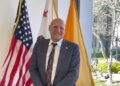
The Village Bakery and Cafe sits on Los Feliz Boulevard in Atwater Village, the kind of sunny, tree-lined neighborhood spot where the clientele leans creative class, and the politics lean reliably left. It was an unlikely setting for a candid conversation about the future of the Republican Party in Los Angeles County — but Roxanne Hoge, Chairman of the LA County GOP, seemed perfectly at ease.
At an outdoor table last week, with neighboring diners close enough to overhear, Hoge spoke freely and with animated conviction about the 2026 governor’s race, the LA mayoral race, and why she believes this could be the most consequential election cycle for LA County Republicans in a generation.
The Arithmetic and Winning the Governorship
Hoge noted that while LA County is overwhelmingly Democratic, there are still approximately 1.1 million registered Republicans — a number larger than the entire Republican Party of 40 states.
Republicans hold only a handful of elected offices with meaningful representation in LA County. Kathryn Barger, whose supervisorial district covers Palmdale, Lancaster, Santa Clarita, San Marino, Pasadena, La Cañada-Flintridge, and portions of the San Gabriel Valley, is the lone Republican on the Board of Supervisors. State Sen. Suzette Valladares represents Santa Clarita, Palmdale, and Lancaster but her district extends beyond LA County lines.
The other Republicans who represent portions of LA County, along with neighboring counties, are Assemblyman Tom Lackey, Sen. Tony Strickland — who represents mostly Orange County but touches the southeastern edge of LA — and U.S. Rep. Jay Obernolte, whose district Hoge describes as having only LA County’s “left ankle.”
This said, Hoge likes the math going into the June 2 governor’s primary, which sends the top two vote-getters — regardless of party — to the November general election, meaning if two Republicans finish first and second on June 2, no Democrat will appear on the fall ballot.
Going into the final month of the primary, eight candidates are registering in polling out of 61 on the ballot. Republicans include Trump-backed commentator Steve Hilton and Riverside County Sheriff Chad Bianco. On the Democratic side are billionaire investor Tom Steyer, former Orange County Congresswoman Katie Porter, former HHS Secretary Xavier Becerra, former LA Mayor Antonio Villaraigosa, San Jose Mayor Matt Mahan, and state schools superintendent Tony Thurmond.
Hoge sees an opening in those numbers, noting Republicans typically capture about 40% of the California statewide vote while Democrats capture about 60%. With only two Republicans splitting that 40% against six Democrats dividing 60%, she argues the math could break in a way that lands two Republicans in the top two for the November general election.
“I still see the Democrats absolutely in panic and fractured. The fact is that they don’t like their own candidates. If they had liked one of their own candidates, they would have elevated that person. The person they elevated [Eric Swalwell] was, at the least, a lecherous alcoholic — but at the worst, an actual active, predatory sexual assailant,” Hoge said.
The Mayoral Race
In the LA mayoral race, Hoge is notably enthusiastic about Spencer Pratt, the reality television personality who launched his mayoral bid in January after losing his Palisades home in the 2025 wildfire, describing him as someone with an unusually clear diagnosis of the city’s problems and a concrete plan to address them.
“I have not seen a candidate in recent history, especially locally, be so good at diagnosing the problem and proposing solutions,” she said, noting his commercials and social media clips are gaining a lot of attention.
Hoge acknowledged that Mayor Karen Bass remains formidable and is very good at the retail politics of connecting to constituents, but that with several candidates splitting the vote, there is a likelihood Bass won’t get the 50 percent threshold, and Pratt could well come in second, creating an insider-outsider showdown in the November general election.
“LA hasn’t been well run since the 90s… It would be such a gift to all of us to have a mayor who doesn’t want us to get mugged. Like at the end of the day, everyone pitching equality or equity — they’re looking for equality of misery for the rest of us and for a few to do very well,” said Hoge.
Measure G and the Horvath Question
On Measure G — the landmark governance reform that passed in November 2024 and will create an elected County CEO and expand the Board of Supervisors from five to nine members — Hoge said LA County Supervisor Lindsey Horvath championed the measure and is widely expected to seek the new elected CEO position when it comes online in 2028.
“Lindsey Horvath is very wily,” she said, “and she created a future job for herself with almost no accountability.”
On the GOP side, Hoge reserved her warmest words about county governance for Barger, who she described as a singular and isolated figure in LA County’s overwhelmingly Democratic political landscape. The elected County CEO position, which Hoge noted will become one of the most powerful elected positions in county government, is one she sees Barger as uniquely suited to speak to.
“She [Barger] described it once as being on an island,” Hoge said. “It’s very hard. If you quietly support her, drop her a note. Let her know.”
The Long Way to the GOP
Hoge, a Jamaican-American naturalized citizen whose family immigrated to Miami, came to Los Angeles after winning a nationwide screen test while at Davidson College, where she had planned to become a psychologist before the entertainment industry intervened. She then became a successful sitcom actress, most notably appearing regularly on A Different World, a Cosby Show spinoff about life at a fictional Historically Black College and University (HBCU).
Always politically active, she volunteered for the Bill Clinton, Dianne Feinstein, and Barbara Boxer campaigns after moving to Los Angeles, but by her own description, was swimming in the water without knowing what the temperature was.
Three moments changed that.
The first was September 11, 2001. Hoge and her husband — who comes from a prominent journalism and political family — watched the attacks together. “We looked at each other and said, thank God Bush is president on this day.”
The second was sending her child to a Los Angeles public school. Hoge grew up in Jamaica, attending a school with a rigorous British-style curriculum — standing when the teacher entered the room, learning phonics, and reading by age three. What she found in the LA public school system was something else entirely.
“That was the biggest radicalizer ever,” she said. “They’re not set up for excellence.”
The third was Barack Obama. Hoge’s Jamaican family recognized something in Obama’s soaring rhetoric that many Americans without Caribbean political experience did not — the echo of Michael Manley, Jamaica’s silver-tongued prime minister, whose class warfare politics led to societal breakdown and violence.
“We know how that ends,” she said flatly. “It ends with mobs coming to your house and taking your stuff.”