



By Stephen Witt, Los Angeles County Politics
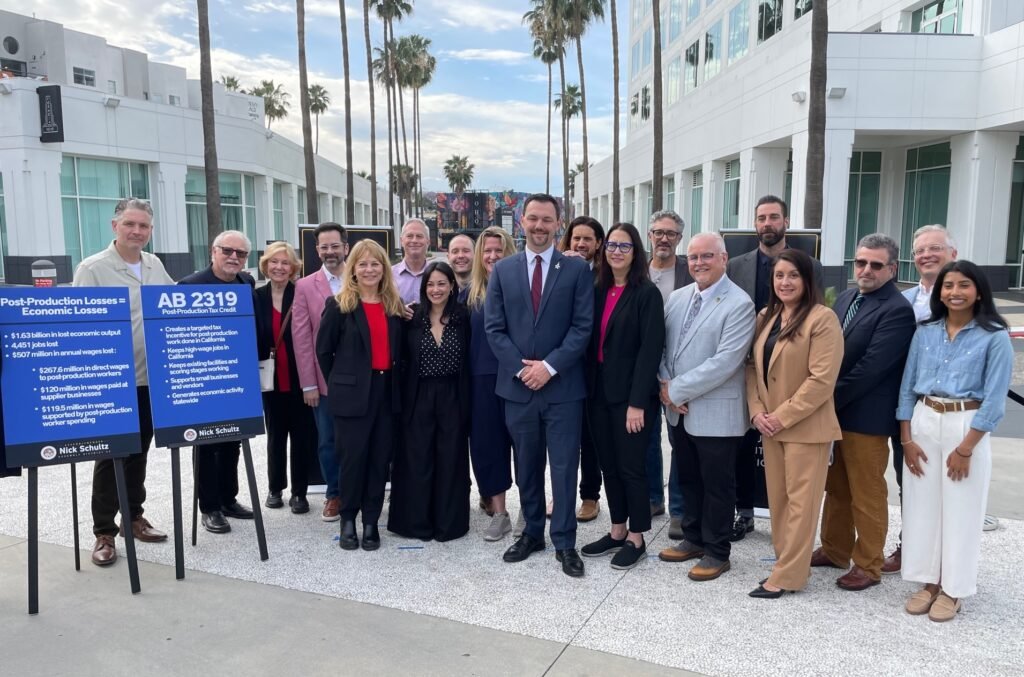
A bipartisan coalition of state and federal lawmakers, industry executives, and union leaders gathered Monday morning at the Formosa Group’s North Hollywood facility to launch Assembly Bill 2319, legislation that would create a standalone post-production tax credit for work performed in California — regardless of where principal photography takes place.
Assemblymember Nick Schultz (D-Burbank, Glendale, North Hollywood) authored the bill and convened the rally, joined by Assemblymember Tom Lackey (R-Palmdale, Lancaster, Acton), Congresswoman Laura Friedman (D-Burbank, Glendale, West Hollywood) and Congresswoman Luz Rivas (D-North Hollywood, Toluca Lake, Valley Village) — a rare show of bipartisan, cross-governmental alignment spanning Sacramento and Washington.
“At a time when people are hurting across California, I can think of no better bipartisan approach to keep jobs here,” Schultz said. “This is proof that Democrats and Republicans can come together, identify problems and solutions that work, and get good things done for Angelenos and Californians.”
The stakes are concrete. California’s share of the national post-production workload has declined from roughly 53 percent to 42 percent over the past decade, according to Schultz. Since 2022, total employment in the state’s entertainment industry has dropped nearly 30 percent, Rivas said. Economist Adam Fowler, founding partner of CVL Economics, put a sharper point on one figure: 1,800 jobs lost — a 13 percent decline since 2012 — at a time when streaming was exploding and production globally was growing.
“This is not an industry in decline,” Fowler said. “This is a decline that is taking place in California while the industry is growing everywhere else.”
The culprit, speakers agreed, is the competitive disadvantage California has created for itself by omitting standalone post-production incentives from its existing film tax credit program. New York has offered a dedicated post-production tax credit for 16 years. British Columbia has aggressively targeted the sector for decades. AB 2319 would close that gap by making qualified California post-production expenditures eligible for a tax credit even when a project’s principal photography occurred out of state.
Marielle Abaunza, president of the California Post Alliance and executive vice president of Signature Post, helped found the advocacy organization specifically to address the problem. “Post production is one of the longest parts of this entire process,” she said. “Films are made in script, production, and post — and we need to go back to being the global gold standard.”
Lackey, whose district covers parts of Lancaster, Palmdale, and Acton in the northern reaches of Los Angeles County, said post-production workers came to his Sacramento office to tell him their unemployment benefits were nearly exhausted.
“These are people that are meaningful parts of our community,” he said. “They don’t want to move out of California, but the economics are driving them that way.”
The bill also carries a federal dimension. Friedman told the crowd she is working on bicameral legislation for a national film tax credit to stem the broader flight of productions to Canada and Europe, and said the Trump administration has signaled openness to the idea. “Donald Trump sees the value of Hollywood, and that’s a huge boost to us,” she said.
One unresolved tension emerged. F. Hudson Miller, president of the Motion Picture Editors Guild, IATSE Local 700, representing nearly 8,000 union members, offered strong support for the bill while calling for amendments to include explicit labor standards — ensuring tax credits go to employers who provide fair wages, health care, and retirement benefits, and not to those who undercut union shops.
“Not all jobs are equal,” Miller said. “We believe this bill needs to be amended. It needs clear, strong labor standards.”
Schultz acknowledged there is existing language on the union question and said conversations are ongoing. Lackey declined to take a hard position but questioned what a union-only carve-out would mean for the broader economic case.
Dennis Dreith, a film composer, CAPA co-founder, and past president of the Recording Musicians Association, offered a pragmatic middle ground: the bill should create jobs and let the unions do their own organizing.
“Legislators have to do their job,” Dreith said. “They shouldn’t have to do the job of the union — and the union should do the job of the union.”
AB 2319 was scheduled to be heard on Tuesday morning, April 7, in the Assembly Arts, Entertainment and Culture Committee in Sacramento — the first legislative hurdle for the bill.