


By Los Angeles County Politics (LACP)
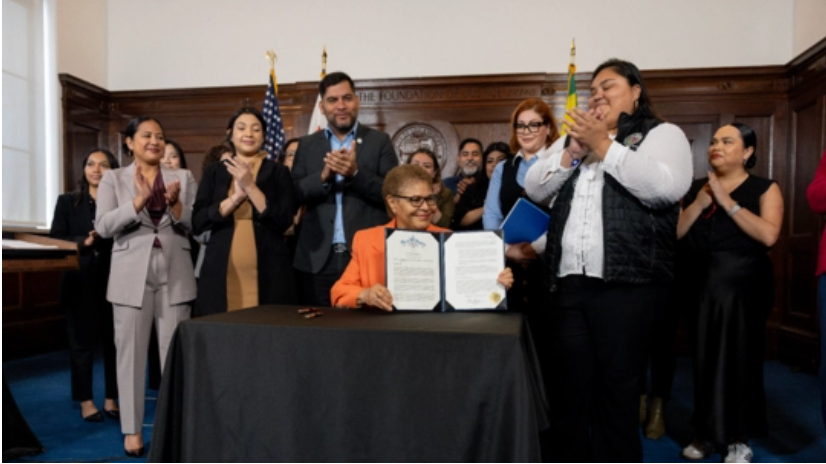
Los Angeles Mayor Karen Bass surrounded herself with progressive City Council allies yesterday as she signed an executive order escalating Los Angeles’ confrontation with federal immigration enforcement—a show of unity as Councilwoman Nithya Raman challenges her re-election.
Executive Directive 17 prohibits federal agents from using city property as staging areas for immigration raids, requires body-worn cameras during any interaction with federal immigration enforcement, and mandates disclosure of contracts between city vendors and the Department of Homeland Security. The directive also calls on the Police Commission to enforce state laws barring masked federal agents from operating in Los Angeles.
“Immigration raids across L.A. have not stopped, and neither has our resolve to protect Angelenos from ICE’s campaign of terror,” said Bass, flanked by council members Eunisses Hernandez, Hugo Soto-Martinez, and Ysabel Jurado. “It’s outrageous that federal agents hide behind masks while racially profiling hardworking Angelenos.”
The three council members represent the progressive wing that could prove crucial in a Bass-Raman matchup. Their public support gives Bass cover on her left flank as Raman, who has built her council career on progressive policy positions, now runs against the incumbent she once endorsed.
“At a moment when fear and cruelty are being used as political tools, this directive makes it clear that our city will not weaponize our departments against our own neighbors,” Hernandez said. “Our immigrant families are the economic and cultural engine of this city.”
Soto-Martinez praised Bass for “strengthen[ing] protections for immigrant families and send[ing] a strong message that Los Angeles will not cooperate with fear-based federal attacks on our neighborhoods.”
Jurado said the directive represents “meaningful action to reclaim our shared spaces and hold law enforcement accountable for safeguarding Angelenos from the unconstitutional actions of masked agents.”
The directive also stakes out territory on Bass’s left at a moment when Raman appears to be positioning herself as a business-friendly moderate. In January, Raman met with the Valley Economic Alliance to discuss strengthening small businesses—a signal she may challenge Bass from the center rather than compete for the progressive base Bass secured Tuesday.
The directive builds on Executive Directive 12, which Bass issued in June when Los Angeles became a test case for the Trump administration’s immigration enforcement raids. That earlier order raised $1.7 million in immediate relief for affected families and served as a model for Portland, Minneapolis, and Chicago as they faced similar federal actions.
ED17 goes further by mandating that city property cannot be used by federal immigration agents for staging areas or processing locations, directing the Police Commission to update LAPD protocols related to federal immigration actions, and initiating a process to ensure city contractors disclose agreements with the Department of Homeland Security.
The emphasis on transparency and accountability—particularly the body-camera requirement and the ban on masked agents—represents a significant escalation in the city’s posture toward federal immigration enforcement.
By staking out aggressive progressive territory on immigration enforcement while Raman courts Valley business interests, Bass is executing a classic incumbent strategy: consolidate the base before your challenger can build a counter-coalition.
Whether that approach can withstand a moderate challenge in a city frustrated by homelessness and rising costs remains the central question of the 2026 mayoral race.