



LA Charter Commission on the road in Echo Park

Los Angeles City Charter Commission Executive Director Justin Ramirez in sunglasses and Pasadena City Councilmember Rick Cole discuss the Charter Commission with local Echo Park residents. Photo credit: LACP

By Los Angeles County Politics (LACP)

Los Angeles City Charter Commission Executive Director Justin Ramirez stood in Echo Park Saturday afternoon, seeking community input and explaining to residents how the commission, charged with rewriting the city’s governing document, is racing toward an April deadline with sweeping changes on the table.

Ramiriz, who Mayor Karen Bass appointed to the position, and the commission, which launched in May and began full operations in June, must submit its recommendations to the City Council by the first week of April. The council will then decide which proposals to place on the November 2026 ballot, marking the first major charter reform effort since 1999.

“Everything’s on the table,” Ramirez said during the community outreach event, noting that the commission has been conducting study sessions, listening sessions, and presentations from experts across the country.

Among the most significant proposals under consideration is expanding the 15-member City Council, which has remained at that size for a century. Each current council member represents approximately 265,000 residents, far more than any other council member in America.

“There is no council member that comes close to representing” that many people, said Ramirez. The commission’s government structure committee has already signaled strong interest in expansion, voting to explore options for 21, 25, or 31 council members.

The commission is also examining the distribution of power among citywide elected officials, including whether to split the City Attorney’s office into separate functions, how to structure the relationship between the mayor and City Council, and whether to establish regular intervals for future charter reviews.

Drawing Lessons from County Reform

While the commission operates independently from Los Angeles County’s recent governance overhaul under Measure G, Ramirez said the city effort doesn’t “happen in a vacuum.”

The commission has received presentations from officials involved in implementing the county’s expansion from five to nine supervisors and the creation of an elected chief executive officer. Most importantly, the commission is studying Measure G’s mistakes to avoid similar pitfalls.

“We saw, you know, there was a mistake on Measure G, Measure J,” Ramirez said, referring to apparent language errors in the two county ballot measures, which could force a revote. “So we are making sure that we don’t accidentally do the same thing.”

To prevent such problems, the commission is pursuing what Ramirez called an “all of the above” approach, combining extensive public outreach with careful internal review. “We’re making sure that we’re talking to everyone within city hall, making sure everyone’s seen final language that will go through the charter from departments to the city attorneys, council members, making sure everyone has eyes on it.”
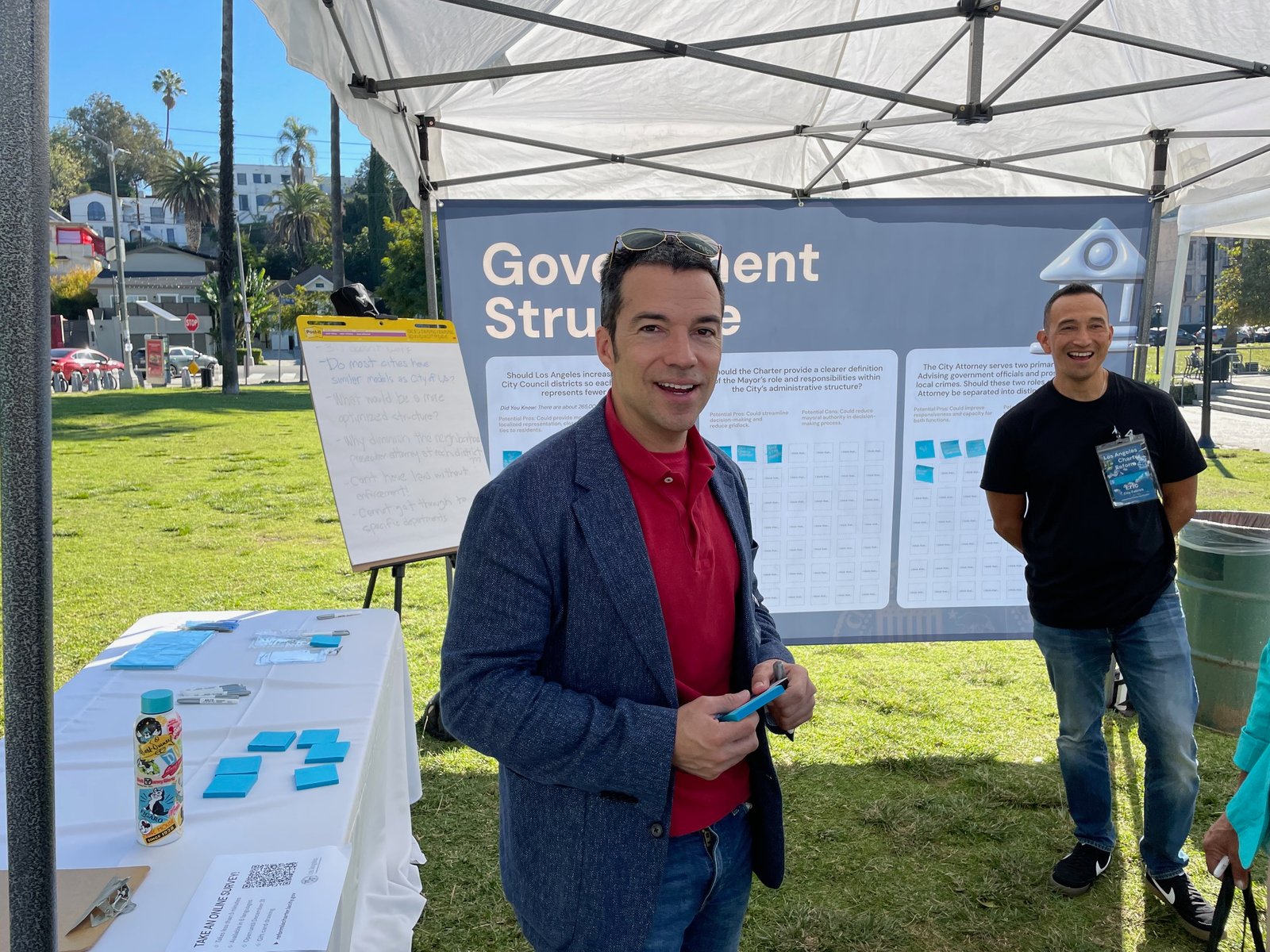
Los Angeles City Charter Commission Executive Director Justin Ramirez brought Charter Commission workers for an outreach session in Echo Park on Saturday. Photo Credit: LACP

The commission is also discussing election reforms, including controversial ranked choice voting (RCV), which New York and other cities have adopted. However, unlike New York and many cities that have instituted RCV, California law already requires open primaries for city elections.

Veteran Observer Calls for Structural Reform

Among those attending Saturday’s outreach event was Pasadena City Councilmember Rick Cole, who has worked for Los Angeles three times over several decades and testified before the charter commission early in its process.

Cole, who served as Deputy Mayor for Budget under former Mayor Eric Garcetti and most recently as Chief Deputy Controller under Kenneth Mejia, brought a critical perspective shaped by years of navigating the city’s fragmented power structure.

“LA wasn’t designed to work, and that’s not a criticism. That’s a historic fact,” Cole said. “100 years ago, in order to avoid the perception of corrupt cities in Chicago and New York, the reformers here wrote a charter that decentralized authority.”

The result, he argued, is a dysfunctional structure in which 15 council members essentially serve as mayors of their own districts, with no one effectively coordinating 40-plus departments and a budget exceeding $25 billion, including utilities, the airport, and the port.

Cole has recommended three key reforms: creating a Chief Operating Officer under the mayor to oversee day-to-day operations, establishing a Chief Financial Officer to consolidate budget functions currently scattered across multiple offices and officials, and implementing a two-year budget cycle with a five-year capital plan.

On the question of whether such positions should be elected or appointed, Cole took a clear stance against the county’s decision to create an elected CEO through Measure G.

“An election with 10 million people who don’t pay very close attention to counties means that the unions will decide who is the chief elected officer in LA County,” Cole said, adding that in a low-information electorate, “they’ll put up the most money” and “elect a politician to run the county.”

For the city, Cole argued that a CEO or Chief Operating Officer should be appointed by the mayor but require City Council approval, with protections against arbitrary dismissal similar to those for department heads.

Path Forward

As the commission enters the critical months leading up to its April deadline, Ramirez emphasized the importance of transparency and public engagement. The commission has been holding events throughout the city and maintaining an extensive presentation schedule to ensure community input shapes the final recommendations.

Whether examining the possibility of 25 council members or fundamentally restructuring executive authority, the commission’s work represents the most comprehensive review of Los Angeles city government in a generation.

The proposals that ultimately reach the November 2026 ballot could reshape how the nation’s second-largest city governs itself for decades to come.


Leave a Reply

Your email address will not be published. Required fields are marked *

By Los Angeles County Politics (LACP)

Los Angeles City Charter Commission Executive Director Justin Ramirez stood in Echo Park Saturday afternoon, seeking community input and explaining to residents how the commission, charged with rewriting the city’s governing document, is racing toward an April deadline with sweeping changes on the table.

Ramiriz, who Mayor Karen Bass appointed to the position, and the commission, which launched in May and began full operations in June, must submit its recommendations to the City Council by the first week of April. The council will then decide which proposals to place on the November 2026 ballot, marking the first major charter reform effort since 1999.

“Everything’s on the table,” Ramirez said during the community outreach event, noting that the commission has been conducting study sessions, listening sessions, and presentations from experts across the country.

Among the most significant proposals under consideration is expanding the 15-member City Council, which has remained at that size for a century. Each current council member represents approximately 265,000 residents, far more than any other council member in America.

“There is no council member that comes close to representing” that many people, said Ramirez. The commission’s government structure committee has already signaled strong interest in expansion, voting to explore options for 21, 25, or 31 council members.

The commission is also examining the distribution of power among citywide elected officials, including whether to split the City Attorney’s office into separate functions, how to structure the relationship between the mayor and City Council, and whether to establish regular intervals for future charter reviews.

Drawing Lessons from County Reform

While the commission operates independently from Los Angeles County’s recent governance overhaul under Measure G, Ramirez said the city effort doesn’t “happen in a vacuum.”

The commission has received presentations from officials involved in implementing the county’s expansion from five to nine supervisors and the creation of an elected chief executive officer. Most importantly, the commission is studying Measure G’s mistakes to avoid similar pitfalls.

“We saw, you know, there was a mistake on Measure G, Measure J,” Ramirez said, referring to apparent language errors in the two county ballot measures, which could force a revote. “So we are making sure that we don’t accidentally do the same thing.”

To prevent such problems, the commission is pursuing what Ramirez called an “all of the above” approach, combining extensive public outreach with careful internal review. “We’re making sure that we’re talking to everyone within city hall, making sure everyone’s seen final language that will go through the charter from departments to the city attorneys, council members, making sure everyone has eyes on it.”

Los Angeles City Charter Commission Executive Director Justin Ramirez brought Charter Commission workers for an outreach session in Echo Park on Saturday. Photo Credit: LACP

The commission is also discussing election reforms, including controversial ranked choice voting (RCV), which New York and other cities have adopted. However, unlike New York and many cities that have instituted RCV, California law already requires open primaries for city elections.

Veteran Observer Calls for Structural Reform

Among those attending Saturday’s outreach event was Pasadena City Councilmember Rick Cole, who has worked for Los Angeles three times over several decades and testified before the charter commission early in its process.

Cole, who served as Deputy Mayor for Budget under former Mayor Eric Garcetti and most recently as Chief Deputy Controller under Kenneth Mejia, brought a critical perspective shaped by years of navigating the city’s fragmented power structure.

“LA wasn’t designed to work, and that’s not a criticism. That’s a historic fact,” Cole said. “100 years ago, in order to avoid the perception of corrupt cities in Chicago and New York, the reformers here wrote a charter that decentralized authority.”

The result, he argued, is a dysfunctional structure in which 15 council members essentially serve as mayors of their own districts, with no one effectively coordinating 40-plus departments and a budget exceeding $25 billion, including utilities, the airport, and the port.

Cole has recommended three key reforms: creating a Chief Operating Officer under the mayor to oversee day-to-day operations, establishing a Chief Financial Officer to consolidate budget functions currently scattered across multiple offices and officials, and implementing a two-year budget cycle with a five-year capital plan.

On the question of whether such positions should be elected or appointed, Cole took a clear stance against the county’s decision to create an elected CEO through Measure G.

“An election with 10 million people who don’t pay very close attention to counties means that the unions will decide who is the chief elected officer in LA County,” Cole said, adding that in a low-information electorate, “they’ll put up the most money” and “elect a politician to run the county.”

For the city, Cole argued that a CEO or Chief Operating Officer should be appointed by the mayor but require City Council approval, with protections against arbitrary dismissal similar to those for department heads.

Path Forward

As the commission enters the critical months leading up to its April deadline, Ramirez emphasized the importance of transparency and public engagement. The commission has been holding events throughout the city and maintaining an extensive presentation schedule to ensure community input shapes the final recommendations.

Whether examining the possibility of 25 council members or fundamentally restructuring executive authority, the commission’s work represents the most comprehensive review of Los Angeles city government in a generation.

The proposals that ultimately reach the November 2026 ballot could reshape how the nation’s second-largest city governs itself for decades to come.